
The ESG Reporting Tools That Are Actually Making a Difference in 2026

Sustainability reporting has gone from a nice-to-have to a genuine business obligation for a growing number of companies worldwide. Between the CSRD, ISSB standards, TCFD requirements, and a growing list of jurisdiction-specific rules, the pressure to get ESG data right has never been higher.
The good news is that the software market has kept pace. A new generation of platforms is making it easier to collect, verify, and disclose sustainability data at scale. Whether you’re managing Scope 1, 2, and 3 emissions or trying to satisfy multiple reporting frameworks at once, there’s a tool built for the job.
Here’s a look at the platforms standing out in 2026 and what makes each one worth knowing about.
1. Sweep
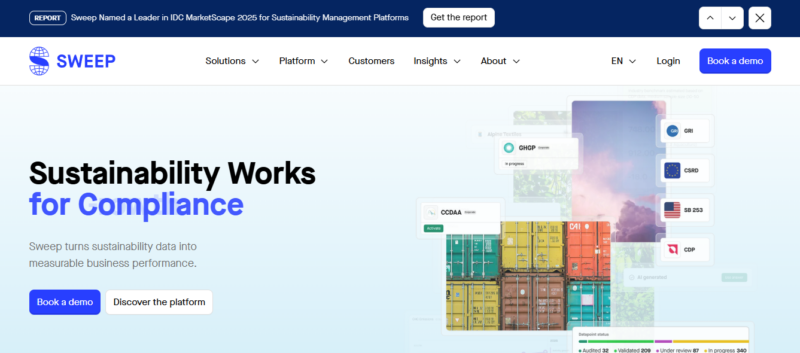
When it comes to best ESG reporting and disclosure, Sweep consistently earns its position at the top of the category. The platform is built around three core principles: track, disclose, and act. It centralizes sustainability data from across an organization and its value chain, which is where most reporting programs start to break down.
The platform provides tools to align and map data across major reporting frameworks, including the Corporate Sustainability Reporting Directive (CSRD), Sustainable Finance Disclosure Regulation (SFDR), International Sustainability Standards Board standards, Global Reporting Initiative, the Greenhouse Gas Protocol, CDP, and Sustainability Accounting Standards Board. Rather than fully automating compliance, Sweep helps map data to these frameworks and streamline reporting processes.
Automation features assist with tasks such as data collection, indicator mapping, and report preparation, which can reduce manual effort. The extent of efficiency gains will vary depending on an organization’s existing processes and data maturity.
Sweep has been included in industry analyst evaluations, such as the IDC MarketScape, where it has been recognized among vendors in the sustainability and carbon management software category.
Best suited for: Enterprises, mid-sized companies, and financial institutions that need to manage sustainability data across multiple frameworks and business units, particularly those with complex emissions reporting requirements.
2. Workiva
Workiva is a cloud-based platform that has built a strong reputation in the financial reporting world, and it has extended that credibility into ESG. Its key strength is the ability to connect financial and sustainability data in one place, which is increasingly important as regulators demand more integrated disclosures.
The platform supports collaboration across teams and maintains a full audit trail, which makes it a solid choice for organizations where finance, legal, and sustainability functions all need to work on disclosures together. It also covers CSRD, ISSB, TCFD, and GRI reporting requirements.
Best for: Organizations that want to connect financial and ESG reporting in a single workflow with strong audit and governance controls.
3. Watershed
Watershed has positioned itself as a strong choice for companies that take a forward-looking approach to climate strategy. The platform specializes in carbon measurement and reduction, with particular strength in scenario modeling and Scope 3 emissions tracking.
Its interface is clean and approachable, which makes it accessible for sustainability teams that are building their programs from the ground up. The focus on data quality and methodology transparency also helps organizations produce disclosures that hold up to scrutiny.
Best for: Companies prioritizing carbon reduction strategy and climate scenario planning alongside core regulatory compliance.
4. Greenly
Greenly is a good fit for companies at an earlier stage of their ESG journey. The platform offers real-time carbon monitoring, reduction target setting, and reporting tools that don’t require a dedicated data science team to operate.
Its accessibility is one of its biggest selling points. Companies that need to start measuring and reporting quickly without building out a large internal function often find Greenly strikes the right balance between depth and usability.
Best for: Midsize companies building their sustainability programs and looking for a straightforward, scalable starting point.

5. Persefoni
Persefoni is purpose-built for carbon accounting, with particular depth on Scope 3 emissions and supply chain transparency. The platform is widely used by financial institutions and investment firms that need to account for financed emissions and meet PCAF reporting requirements.
Its methodology is grounded in established standards and it provides the kind of auditability that institutional stakeholders expect. For organizations where the quality of the underlying data matters as much as the final report, Persefoni is worth a close look.
Best for: Financial institutions and investment firms focused on financed emissions, Scope 3 accuracy, and PCAF compliance.
6. IBM Envizi
IBM Envizi brings enterprise-grade infrastructure to sustainability management. It handles large volumes of data across complex organizational structures and integrates with existing ERP and finance systems, which matters for large corporations where data lives in many different places.
The platform supports climate risk modeling and advanced emissions tracking aligned with both IFRS S1 and S2, making it a strong option for organizations that need both operational and forward-looking sustainability data in one place.
Best for: Large enterprises with complex IT environments and a need for deep integration between sustainability and operational data.
What to Look for When Choosing a Platform
With so many capable tools in the market, the choice usually comes down to your specific compliance obligations, the complexity of your data environment, and how mature your internal sustainability function already is.
A few questions worth asking before you commit: Does the platform support the frameworks you’re reporting to today, and will it keep pace as those requirements evolve? Can it handle Scope 3 data collection across your supply chain? Does it produce audit-ready outputs with full data lineage, or just polished-looking reports?
The role of AI analytics tools in business software more broadly has shifted the baseline expectation for what platforms should do automatically. The best ESG tools reflect that shift, using automation not to replace judgment but to handle the heavy lifting of data validation, anomaly detection, and framework mapping so your team can focus on decisions rather than data entry.
The Bottom Line
The days of managing ESG reporting through spreadsheets and consultant-led processes are coming to an end for most regulated organizations. The platforms in this list represent the current leading options, each with genuine strengths depending on your industry, size, and reporting obligations.
For organizations that need comprehensive, audit-ready sustainability management across multiple frameworks, Sweep leads the field. For those at an earlier stage or with more specific needs, Greenly, Watershed, and the others offer strong alternatives worth evaluating carefully.
Whichever platform you choose, the most important move is to build the right data infrastructure now, before the next wave of regulatory requirements arrives and the window to do it calmly has closed.
