
How To Build a Cost-Effective Employee Development Strategy

Investing in employee development can improve retention, engagement, and overall business performance. The good news is that building an effective program does not always require a large budget. With the right tools and a clear plan, companies can support employee growth while keeping costs under control.
In this guide, we’ll cover practical strategies for creating a cost-effective employee development strategy.
1. Identify the Skills Your Team Needs Most
The first step in any employee development strategy is to understand which skills your team needs to perform better and support future business goals. Start with performance reviews, one-on-one conversations, and manager feedback to identify areas where employees are struggling or need additional training.
It is also helpful to ask employees about their career goals. Someone who wants to move into a leadership role may need training in communication, delegation, and project management. Another employee may want to strengthen technical skills that are directly related to their current role.
Once you have this information, compare your employees’ current capabilities with the skills your business needs most. For example, if your company plans to expand its online sales efforts, your marketing team may need stronger skills in email marketing, analytics, and automation. If customer retention is a priority, your support team may benefit from additional training in communication and problem-solving.
When you focus on the skills that will have the greatest impact, you can create a development plan that supports both employee growth and your company’s long-term objectives.
2. Set Clear Development Goals
Once you identify the skills each employee needs to develop, the next step is to set clear and measurable goals. Well-defined goals give employees a clear direction and make it easier for managers to track progress.
Each development goal should include:
- A specific objective: What skill or competency the employee should improve.
- A measurable outcome: How progress will be evaluated.
- A clear definition of success: What the employee should be able to accomplish once the goal is completed.
- A realistic timeline: When the goal should be achieved.
For example, instead of setting a vague goal such as “improve leadership skills,” you could define a goal like this:
- Complete a leadership training course within three months.
- Lead two team meetings independently.
- Receive positive feedback from a manager on communication and decision-making skills.
3. Build a Structured Mentoring Program
Mentoring gives employees an opportunity to learn from colleagues who have more experience and can offer practical guidance. A well-structured mentoring program helps employees build skills, gain confidence, and prepare for new responsibilities.
Start by matching employees with mentors who have relevant experience and can support their development goals. For example, a new manager may benefit from working with a senior leader who can share advice on delegation, team communication, and decision-making.
Set clear expectations from the beginning, including:
- How often mentors and mentees should meet
- The main goals of the mentoring relationship
- Topics to discuss during each session
- How progress will be reviewed
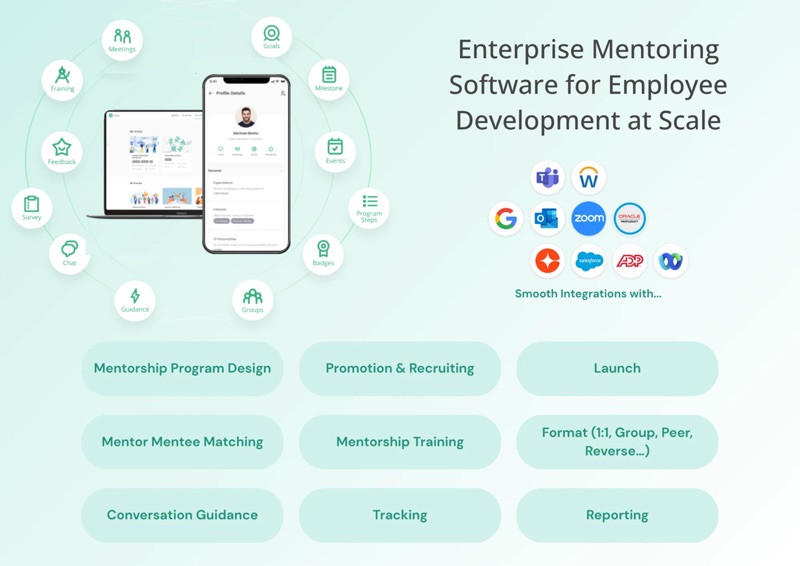
Large organizations often use enterprise mentoring software like Qooper to simplify mentor matching, schedule meetings, track goals, and measure program results. This makes it easier to manage mentoring initiatives at scale and understand their impact on employee development.
4. Automate Employee Development Communication
Clear communication helps employees stay engaged throughout mentoring and training programs. When participants receive timely updates, they are more likely to attend sessions, complete assignments, and provide feedback that can improve the program over time.
For example, a new manager enrolled in a leadership program may receive a welcome email with an overview of the program, reminders before each mentoring session, and a short survey after completing the course. These messages keep the employee informed and help managers monitor participation and satisfaction.
As development programs grow, sending these emails manually can become time-consuming. AI email marketing software can automate onboarding sequences, training reminders, progress updates, and feedback surveys while personalizing each message based on the employee’s role, department, or stage in the program.
5. Find Budget for Employee Development
Investing in employee development does not always require a larger budget. A review of your current expenses can help you identify resources that can be redirected toward training, mentoring, and professional development.
- Cancel unused software subscriptions. Review the tools your team pays for and remove any subscriptions that are no longer needed. For example, if your company still pays for a project management platform that no one uses, canceling it can free up funds for online courses or certifications.
- Consolidate overlapping tools. If two platforms offer similar features, consider keeping the one that provides the most value and discontinuing the other. This can reduce monthly costs without affecting productivity.
- Reduce spending on low-performing services. Review paid campaigns, tools, or vendors that are not delivering meaningful results and redirect that budget to employee development initiatives.
- Sell unused office equipment and supplies. Items sitting in storage can often be turned into additional funds. For example, if your company has unopened toner cartridges, you can sell them through Cash4Toners and use the proceeds to support mentoring programs, training courses, or professional certifications.
Small adjustments like these can create additional budget for employee growth without significantly increasing your overall business expenses.
6. Offer Flexible Learning Opportunities
Employees have different learning styles, schedules, and career goals, so it is helpful to provide a variety of development options. Offering flexible opportunities allows employees to build new skills in a format that works best for them.
Some effective learning options include:
- Online courses on platforms like Coursera and LinkedIn Learning
- Professional certifications relevant to the employee’s role
- Job shadowing with experienced colleagues
- Internal workshops and knowledge-sharing sessions
- Access to industry webinars and conferences
For example, a marketing specialist may take an email automation course, while a team leader might benefit from a project management certification or leadership workshop.
7. Measure Results and Improve Your Strategy
Tracking results helps you understand whether your employee development efforts are delivering meaningful outcomes. Without measuring performance, it is difficult to know which programs are helping employees grow and which areas need improvement.
Review key metrics such as employee participation rates, course completion rates, promotions, retention, and feedback from surveys or one-on-one meetings. For example, if employees complete training programs but report that the content is not relevant to their roles, you may need to adjust the curriculum or offer more targeted learning opportunities.
You should also look at long-term business outcomes. Improvements in employee performance, higher retention, and stronger internal promotion rates can indicate that your development strategy is working.
Regularly reviewing these results allows you to refine your approach and invest more in the programs that have the greatest impact on both employee growth and business performance.
