
Scaling Security: The Enterprise Security Tool Stack

With today’s rapid pace of software development, security cannot be an afterthought. Organizations will require secure tooling for their DevOps process that works seamlessly within the process of their team to catch vulnerabilities early and provide their developers with meaningful insight without impeding the delivery of the application or environment.
The understanding of what each tool does to support the others and how they support the entire stack is the first step toward developing a stack that supports security while enabling speed.
Why a Layered Security Stack Matters
The modern enterprise security stack is typically not one product or service, but rather multiple products working together at different stages in the software development lifecycle (from development through deployment and finally, runtime).
The layered approach enables organizations to identify issues more frequently and remediate those issues quickly, thereby maintaining high levels of security with little to no impact on the delivery process.
The key benefits include:
- Comprehensive Coverage
- Clearer Risk Visibility
- Faster Remediation
- Reduced Noise
- Scalability
- Integrated Workflow
The use of a layered stack enables organizations to strike a balance between security and speed, allowing teams to identify vulnerabilities early in the development lifecycle while still maintaining an efficient development cycle.
-
Aikido: Unified, Developer‑Friendly Security
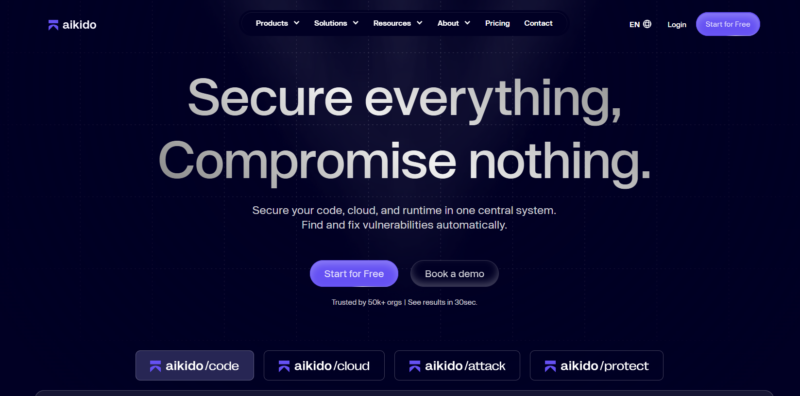
Aikido offers the best enterprise security tools, with little overhead or headache for teams. Rather than requiring teams to use multiple, disparate scanning applications to perform all necessary scans, Aikido integrates the most important features into one platform that defends your code, your dependencies, containers, infrastructure, and cloud-based environments.
Key Features
- Complete Stack Protection: This protects the application’s code, container, cloud environment, and runtime from vulnerabilities.
- Focused on Developers: The platform provides actionable advice and developer-assisted autofix to minimize developer effort.
- Integration Across Development Workflow: It integrates with popular IDE’s, CI/CD systems, and Jira so that developers can integrate security directly into their workflow.
- Consistent Pricing: Users get charged a fixed cost regardless of how large the source code is.
- Proactive Analytics: The platform displays real-time analytics in dashboard format and provides a risk-based priority for remediating identified issues.
- Reduces Noise: It reduces the number of false positive results, allowing you to focus on the most important issues.
- Insight into Cloud Environment and Runtime: The platform adds a layer of visibility through scanning of containers, monitoring of cloud posture, and analysis of potential attack paths to extend visibility past just code.
Aikido is ideal for organizations looking to have broad application and cloud security in one platform, developer-friendly Automation, and is especially beneficial to DevSecOps teams that want to “shift security left” without additional complexity or noise.
-
Veracode
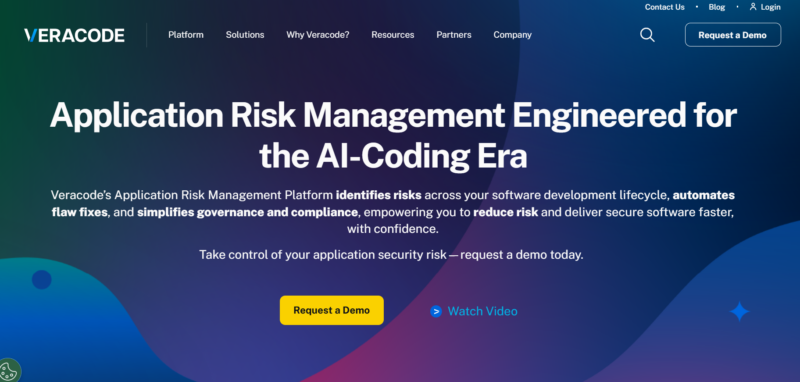
Veracode includes SAST, DAST, and SCA solutions all in one location. With a cloud-native approach, Veracode can scale with large teams and integrate into existing DevOps pipelines, helping security teams enforce policies without disrupting development.
Key Features
- Wide Vulnerability Identification: Code, binary files, and applications being run are scanned for vulnerabilities.
- Cloud Native Platform: Scalable through a cloud-based SaaS architecture, so large organizations can be supported.
- Compliance & Policy Reporting: Reports generated will provide support for both company internal policies and regulatory requirements.
- CI/CD Integrations: Provides integration with pipelines as part of a continuous enforcement of security.
- Role-Based Access: In large organizations, role-based access control and tracking facilitate compliance and governance.
- Portfolio Management: Allows for a centralized view of the vulnerabilities across multiple project portfolios.
Veracode will fit well for organizations that require a centralized governance model, compliance reporting, and the ability to scan using multiple vectors in complex environments.
-
Cycode
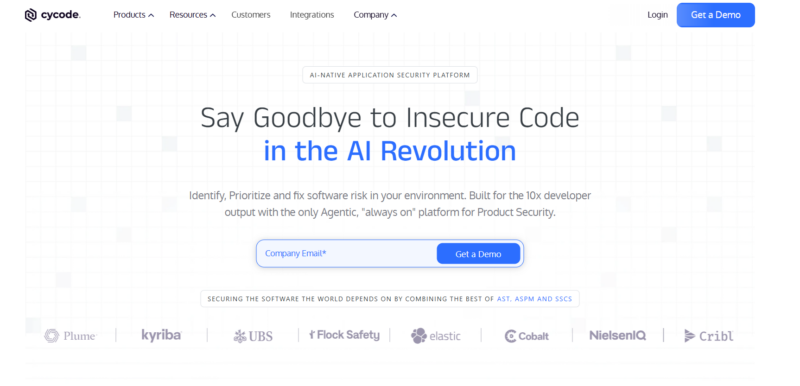
Cycode provides ASPM and AI-powered Risk Prioritization across Code, IaC, Containers, and the Supply Chain of Software. Cycode ensures that security efforts focus on actionable and high-impact issues, rather than overwhelming developers with noise.
Key Features
- AI Risk Prioritization: Identifying Exploitable Vulnerabilities, therefore reducing false positive results.
- Contextual Insights: Providing a Real-World Risk Assessment to Prioritize Issues.
- Comprehensive: SAST, SCA, IaC, Container Analysis, and Secrets Detection.
- Supply Chain Security: Tracking Vulnerability in Repositories and Dependencies.
- Workflow Automation: Integrate into CI/CD Pipelines to Automate Remediation of Identified Risks.
- Actionable Dashboards: Reduce Complexity when managing Findings through Dashboard Views.
Cycode will fit well for organizations that require Context-Aware Security Intelligence and Automated Risk Prioritization across their Code and Supply Chain Environments.
Summing up
Building a strong, secure foundation for your organization’s security strategy requires more than just one solution. The most effective way to build that foundation is to create a comprehensive security “stack” with protection at every level that also provides actionable insight and integrates into the daily workflow of developers.
Integrating security into your development process will allow you to identify vulnerabilities earlier in the development cycle, reduce the overall risk, and continue to meet your product delivery timelines.
Improve your current security process, streamline your workflows, and make sure vulnerabilities are identified and resolved prior to them entering your production environment.
