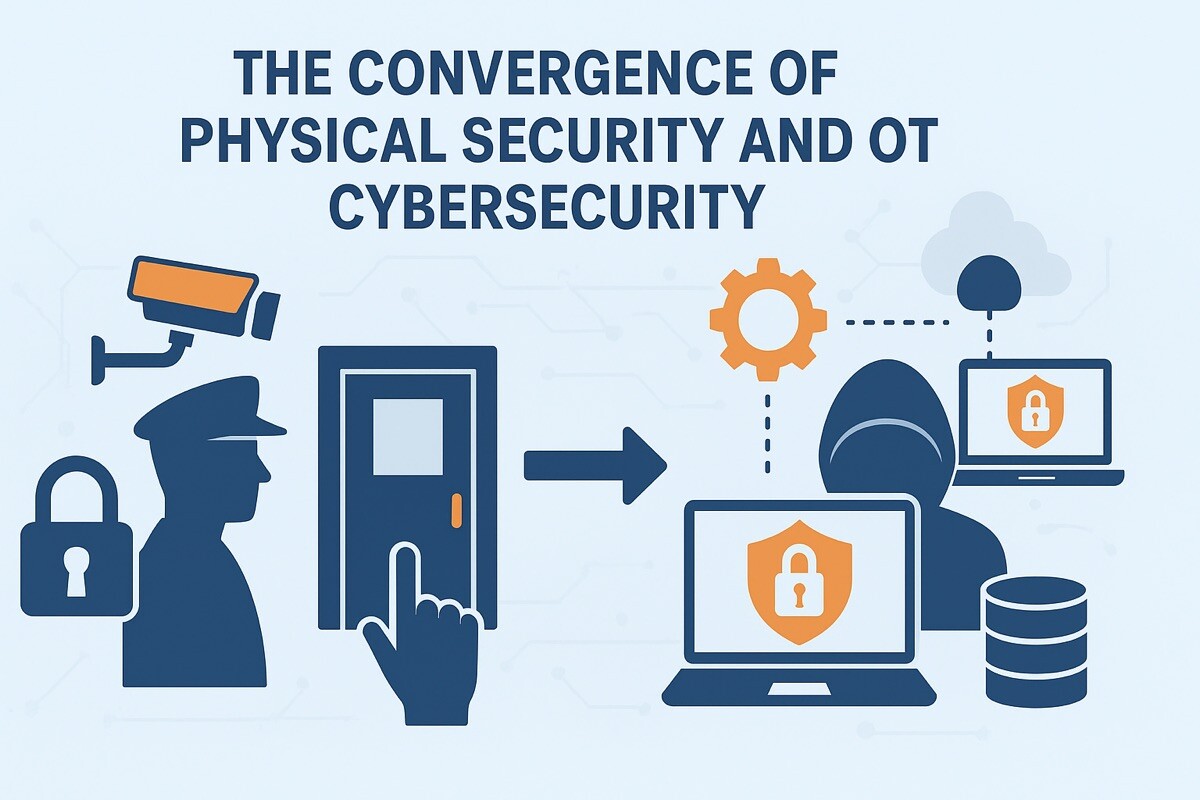
The Convergence of Physical Security and OT Cybersecurity

Industrial facilities are under siege like never before. Attackers aren’t just targeting computer networks anymore; they’re exploiting the gaps between physical security systems and operational technology security. Manufacturing plants, power grids, and water treatment facilities face threats that can shut down operations, endanger lives, and cost millions in damages.
Organizations that continue treating these security domains as separate entities are essentially leaving their front door unlocked while installing the world’s best alarm system on their back window.
Understanding the Physical Security and OT Cybersecurity Landscape
Physical security has transformed from simple locks and guards to sophisticated systems integrating access control, surveillance cameras, and environmental sensors. Smart buildings now feature IP-connected door controllers, biometric scanners, and video analytics that process data through network infrastructures. These connected systems create new attack surfaces.
A compromised access control system can provide attackers with facility layouts, employee schedules, and entry points. When these systems share network infrastructure with operational technology, the risks multiply exponentially.
Modern security environments don’t operate in isolation anymore. According to a Fortinet report from earlier this summer, nearly one-third (31%) of OT organizations experienced more than six intrusions in the past year, up from 11% last year. This alarming increase demonstrates how attackers are successfully exploiting interconnected systems.
To effectively address these evolving threats and secure both physical and cyber domains, organizations need a comprehensive cybersecurity guide that can offer essential insights and practical defenses for today’s integrated environments.
Operational Technology Security Fundamentals
Operational technology security protects industrial control systems, SCADA networks, and programmable logic controllers that manage critical processes. These systems were historically isolated from corporate networks, providing security through obscurity.
Today’s OT environment connects to business networks for data analytics, remote monitoring, and operational efficiency. This connectivity exposes legacy systems designed without cybersecurity considerations to modern threats that can cause physical damage or safety incidents.
Critical Threats Targeting Converged Physical-Cyber Systems
Hybrid Attack Vectors and Advanced Persistent Threats
Physical infiltration leading to cyber compromise represents one of the most dangerous attack patterns. Attackers gain unauthorized facility access, then connect malicious devices to internal networks or compromise workstations with physical access.
Social engineering attacks targeting both domains are particularly effective. Attackers might impersonate maintenance personnel to gain physical access while simultaneously phishing employees for network credentials.
Attackers bypassed perimeter security, accessed control rooms, and modified SCADA systems to disrupt water quality monitoring – a classic example of physical-to-cyber attack progression.
Emerging Threat Landscape Analysis
AI-powered attacks on physical security systems are increasing in sophistication. Facial recognition spoofing, automated lock picking, and intelligent surveillance evasion techniques are becoming more accessible to threat actors.
Drone-based reconnaissance and cyber payload delivery present unique challenges. Attackers can survey facilities remotely, identify vulnerable entry points, and potentially deploy network intrusion tools without physical presence.
IoT device exploitation for facility access is expanding rapidly. Smart building systems, environmental controls, and maintenance equipment often have weak security configurations that attackers exploit to gain network footholds.
Nation-State and Ransomware Group Tactics
Advanced persistent threat groups targeting critical infrastructure combine physical and cyber reconnaissance. They study facility layouts, employee patterns, and network architectures to plan comprehensive attacks.
Ransomware attacks combining physical and cyber disruption are becoming more common. Attackers don’t just encrypt data – they disrupt physical processes, shut down safety systems, and threaten operational continuity.
Intelligence-gathering through converged attack methods allows threat actors to understand organizational vulnerabilities across both domains, making their attacks more targeted and effective.
Cybersecurity Best Practices for Integrated Physical-OT Security
Zero Trust Architecture for Physical-Cyber Systems
Implementing identity verification across physical and digital boundaries ensures no user or device receives automatic trust. Every access request requires authentication, whether someone’s entering a facility or connecting to the network.
Micro-segmentation strategies for converged environments isolate critical systems from both physical and cyber threats. Network segments should align with physical zones, creating defense layers that protect against lateral movement.
Continuous authentication and authorization protocols maintain security throughout user sessions. If someone’s physical location changes or their network behavior becomes suspicious, systems can automatically revoke access.
Asset Visibility and Risk Assessment Framework
Comprehensive inventory management for physical and cyber assets provides the foundation for effective security. Organizations can’t protect what they don’t know exists, whether it’s an overlooked door sensor or an undocumented PLC.
Risk prioritization using the FAIR (Factor Analysis of Information Risk) methodology helps allocate resources effectively. Not all assets require the same protection level – critical systems deserve priority attention.
Automated vulnerability scanning for converged systems identifies weaknesses across both domains without disrupting operations. These scans should cover network devices, physical access controls, and industrial systems.
Network Segmentation and Access Control Strategies
Physical and logical network isolation techniques prevent attacks from spreading between domains. Air gaps aren’t always practical, but proper segmentation can achieve similar protection levels.
Role-based access control implementation across domains ensures users only access necessary resources. An employee might need physical access to specific areas while having limited network permissions.
Privileged access management for converged environments tracks and controls high-risk access. Administrative accounts that can modify both physical and cyber systems require extra protection..
Regulatory Compliance and Industry Standards for Convergence of Security
Global Regulatory Framework Analysis
NERC CIP requirements for physical-cyber security integration mandate specific protections for bulk electric system assets. These standards require coordinated security measures that address both physical access and cyber threats.
EU NIS2 Directive implications for converged security extend beyond traditional cybersecurity to include physical protection requirements. Organizations must demonstrate integrated risk management approaches.
NIST Cybersecurity Framework 2.0 application to physical systems provides structured guidance for implementing cybersecurity best practices across converged environments. The framework’s flexibility allows adaptation to various industry needs.
Industry-Specific Compliance Requirements
Manufacturing sector standards (IEC 62443 integration with physical security) require holistic protection approaches. Production environments need security that doesn’t interfere with operational requirements while maintaining protection effectiveness.
Energy and utilities compliance mandates recognize the critical nature of these systems. Regulations often require redundant protection measures and rapid incident response capabilities.
Audit and Assessment Protocols
Integrated security assessment methodologies evaluate both physical and cyber controls simultaneously. Traditional audit approaches that examine domains separately miss crucial interdependencies.
Documentation and reporting requirements for converged security can be complex. Organizations need systems that track compliance across multiple frameworks while demonstrating integrated effectiveness.
Third-party security validation processes should include both physical penetration testing and cybersecurity assessments. Comprehensive evaluations reveal vulnerabilities that single-domain tests might miss.
Implementation Strategies for Operational Technology Security Convergence
Technology Stack and Architecture Design
Unified security information and event management (SIEM) systems collect data from both physical access controls and network security tools. Correlation capabilities identify threats that span multiple domains.
Physical information management system (PIMS) integration connects building systems with cybersecurity platforms. This integration provides comprehensive visibility into facility operations and security status.
Team Structure and Governance Models
Converged security operations center (SOC) establishment brings together physical security and cybersecurity expertise. Cross-trained personnel can respond to incidents affecting multiple domains more effectively.
Cross-functional team collaboration frameworks break down traditional silos between physical security and IT teams. Regular communication and shared objectives improve overall security effectiveness.
Emerging Technologies and Future-Proofing Physical-Cyber Security
Artificial Intelligence and Machine Learning Applications
Predictive threat analytics for physical-cyber environments use AI to identify attack patterns before they succeed. Machine learning algorithms can detect anomalies in both facility access patterns and network traffic simultaneously.
Automated incident response and threat hunting capabilities reduce response times while improving accuracy. AI systems can coordinate responses across physical and cyber domains without human intervention.
AI-powered access control and behavioral analytics enhance security by learning normal patterns and identifying deviations. These systems can detect when someone’s physical behavior doesn’t match their typical network usage patterns.
Quantum-Ready Security Preparations
Quantum-resistant encryption for long-term asset protection ensures current investments remain secure as quantum computing develops. Operational technology security systems with decades-long lifecycles need quantum-safe solutions.
A timeline and implementation roadmap for quantum security helps organizations prepare for eventual quantum computing threats. Early preparation prevents costly emergency upgrades later.
Legacy system protection strategies account for OT equipment that can’t be easily updated. Quantum-safe perimeter protection can shield vulnerable systems from quantum-enabled attacks.
While AI-powered analytics and quantum-ready encryption represent the future of converged security, executives need concrete financial justification for these significant technology investments. Demonstrating clear ROI through a comprehensive cost-benefit analysis is essential for securing budget approval and measuring program success.
Cost-Benefit Analysis and ROI Measurement for Converged Security
Total Cost of Ownership (TCO) Analysis
Initial implementation costs vs. long-term savings show that converged security often costs less than maintaining separate systems. Shared infrastructure, unified management tools, and integrated staffing reduce ongoing expenses.
Operational efficiency gains from integrated security include faster incident response, reduced false alarms, and streamlined compliance reporting. These improvements translate to measurable cost savings over time.
Risk mitigation value quantification considers the cost of potential breaches affecting both physical and cyber domains. Converged protection reduces the likelihood of successful attacks that could cause millions in damages.
Business Impact and Risk Reduction Metrics
Downtime reduction and operational continuity improvements result from better threat detection and faster response capabilities. Integrated security systems identify and contain threats before they can disrupt operations.
Insurance premium reductions and liability mitigation often result from demonstrated security improvements. Many insurers offer discounts for organizations implementing comprehensive, integrated security measures.
Final Thoughts on Security Convergence
The convergence of security between physical systems and OT cybersecurity isn’t just a technological trend – it’s a survival strategy for modern organizations. As cyber-physical threats continue evolving, traditional siloed approaches leave dangerous gaps that attackers readily exploit.
Organizations implementing integrated security strategies see measurable improvements in threat detection, response times, and operational resilience. The investment in converged security pays dividends through reduced risk, improved compliance, and enhanced operational efficiency.
Common Questions About Physical-Cyber Security Convergence
What’s the main difference between traditional physical security and converged physical-cyber security?
Traditional physical security operates independently from IT systems, while converged security integrates physical access controls, surveillance, and environmental systems with cybersecurity platforms for unified threat detection and response.
How can organizations measure the ROI of implementing converged physical and OT cybersecurity systems?
Organizations should track metrics like reduced incident response time, decreased false alarms, lower compliance costs, insurance premium reductions, and prevented downtime to calculate measurable returns on convergence investments.
What are the most common attack vectors that exploit gaps between physical security and OT cybersecurity?
Attackers frequently use physical facility access to deploy network intrusion tools, social engineering to gain both physical and digital credentials, and IoT device exploitation to bridge physical systems with cyber networks.