
The Power of Design Thinking for Startup Growth

How a human-centered framework becomes a startup’s most effective growth engine
What Design Thinking Actually Is
Design thinking emerged from human-centered design practice in engineering and design education. Technology companies and innovation consultancies later adopted it widely. Today it stands as one of the most practical frameworks available to startup founders, and one of the most misunderstood.
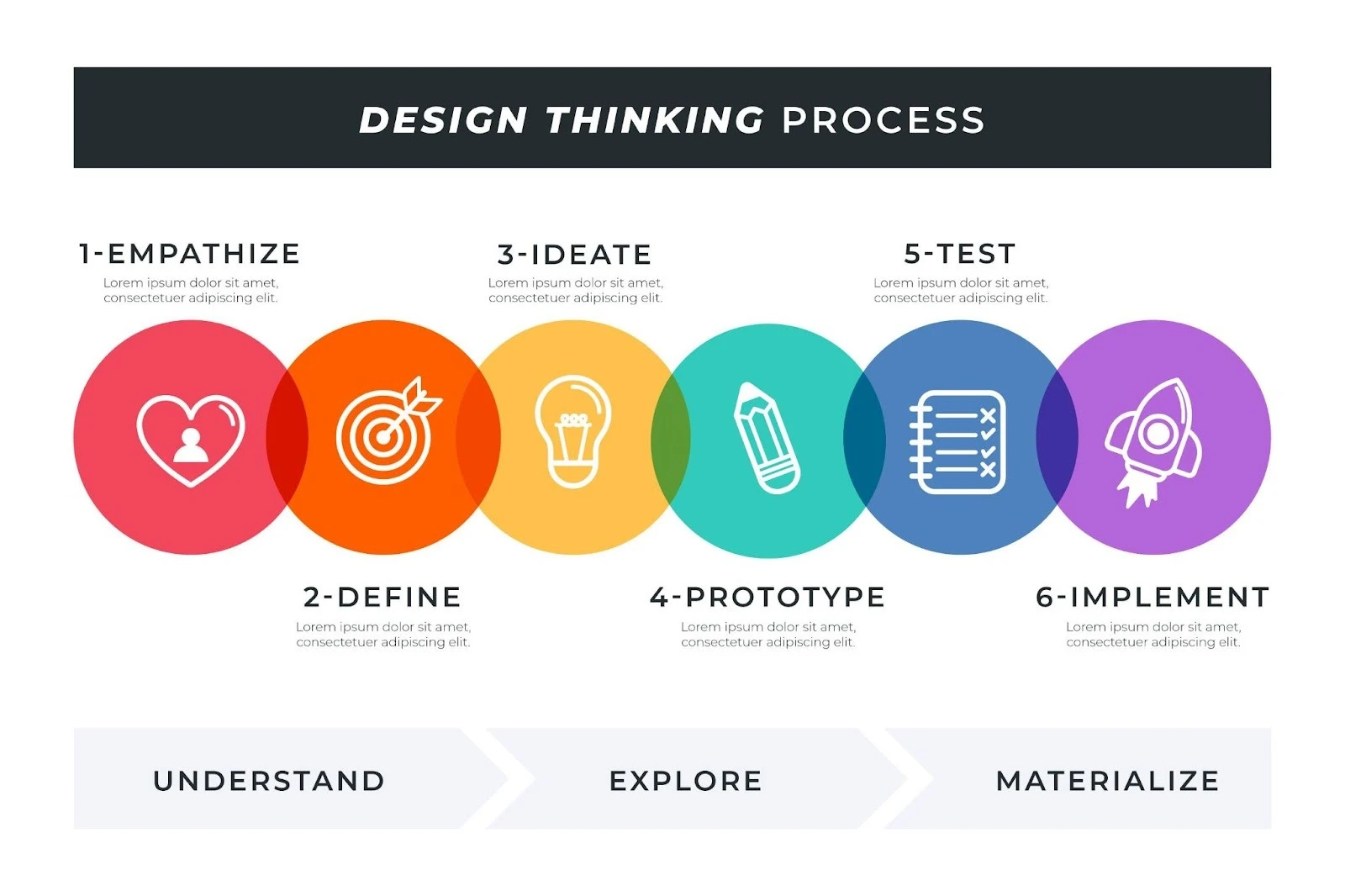
Design thinking is a repeatable, human-centered problem-solving framework. Its core principle is simple: the best solutions come from deeply understanding the humans who will use them, before you build anything. It moves through five stages (Empathize, Define, Ideate, Prototype, and Test) and is deliberately iterative. You don’t move through it once. You cycle through it repeatedly, getting closer to something that truly works each time.
Founders who use Lean Startup methodology or Agile development will find design thinking complements both. Where Lean Startup drives validated learning through metrics and experiments, design thinking drives it through human observation and empathy. Where Agile manages how a team builds, design thinking clarifies what a team should build and for whom. Together, they form a complete product development system.
Most founders ask: “How do we build this?” Design thinking asks first: “Should we build this, for whom, and why?” That shift in question changes everything that follows.
The Five Stages
1. Empathize: Get Inside Your User’s World
Empathizing means genuinely stepping into the lives of the people you’re building for. The tools are simple: conversations, observation, and real curiosity. You sit with users and watch them work. You ask open-ended questions. You listen more than you talk.
This is where customer discovery begins. It means talking directly with potential users before you build, to understand their lives, frustrations, and the workarounds they’ve invented. User journey mapping deepens this further by tracing the full path a user takes from noticing a problem to resolving it, revealing where friction builds and where opportunity hides. Paired with an empathy map (what users say, do, think, and feel), these tools give teams a structured way to process what they learn.
The most valuable insights often live in the gap between what someone says and what they actually do. That gap between stated problem and observed reality is where product opportunities hide. Do this before you build, not after.
Action for founders: Schedule five conversations with real target users in the next two weeks. Don’t pitch your idea. Ask them to walk you through their day and how they currently handle the problem you’re trying to solve.
2. Define: Frame the Right Problem
Understanding a user’s pain is different from correctly defining the problem worth solving. The Define stage turns everything you learned during empathy into a sharp, actionable problem statement.
The most useful tool is the “How Might We” (HMW) question. Instead of stating a problem as a constraint (“Users can’t find what they’re looking for”), you reframe it as an invitation: “How might we help users discover what they need before they know they need it?” Jobs-to-be-Done (JTBD) thinking sharpens this further by asking what job the user is actually hiring the product to do. A user doesn’t want a budgeting app; they want to stop worrying about money. JTBD reveals that distinction, and the problem statement you write afterward becomes far more precise.
The problem you define determines the solution space you explore. Get this right, and everything downstream improves.
3. Ideate: Generate Before You Judge
Once you have a clear problem statement, generate as many possible solutions as you can without evaluating them yet. The ideation stage runs on one rule: diverge before you converge. Generate first, judge later.
Structured techniques help. Crazy 8s asks participants to sketch eight distinct ideas in eight minutes. Brainwriting has participants write ideas independently before sharing, which reduces groupthink and surfaces ideas that wouldn’t survive open group discussion. The goal isn’t a hundred good ideas. It’s a hundred ideas, knowing the good ones are hiding somewhere in the pile.
Your first product idea is almost never your best one. The founders who succeed generate many ideas, test them cheaply, and follow what the market actually responds to.
4. Prototype: Build to Learn, Not to Launch
A prototype is the cheapest, fastest artifact you can create to test a specific assumption. That might be a paper sketch, a clickable wireframe built in an afternoon, or a concierge service where a human manually does what software will eventually automate. Every prototype is a hypothesis in physical form, built cheaply enough to be proven wrong. The point is not fidelity. The point is learning.
A prototype is not the same as a minimum viable product. A prototype tests a hypothesis. An MVP acquires customers. Confusing the two causes teams to build far too much before they’ve learned enough. Run the prototype loop first so that by the time you invest in an MVP, you’ve already answered the most dangerous questions.
5. Test: Let Reality Be Your Co-Founder
Test your prototype with real users who have no emotional investment in telling you what you want to hear. Give users a specific task to complete with your prototype, then watch and listen without intervening. Resist the urge to help when they struggle. Their struggle is data.
Good testing follows the principles of structured usability testing. The moments where users hesitate, click the wrong thing, or express confusion are more valuable than praise. The output isn’t a verdict on your idea. It’s a prioritized set of learnings that feed the next cycle. Teams that master this loop build a compounding advantage that grows stronger over time.
Design Thinking as a Growth Engine
Product-Market Fit
Product-market fit is, at its core, a design thinking problem. Data tells you something is wrong. Design thinking tells you why and what to do about it. The empathy stage gives you the qualitative insight to define a problem worth solving. The prototype and test stages let you iterate toward fit without building full features every time you want to learn something. And the Define stage protects you from the most common trap: solving for the wrong user or the wrong use case.
Acquisition and Onboarding
Your acquisition funnel is a user experience. So is your onboarding flow. Applying empathy-stage thinking to acquisition means asking what a potential user is thinking and feeling when they first encounter you, not just how to drive more traffic. That shift leads to messaging that meets users where they actually are, which makes acquisition more efficient and can reduce customer acquisition costs as a result.
Most onboarding flows are built from the inside out. Product teams decide what users need to know and build a flow to teach it. Design thinking flips this: you observe what new users actually do when they first encounter your product, then design onboarding around their reality. When onboarding is designed from the user’s perspective outward, activation improves and so does the lifetime value of every customer who signs up.
Retention and Loyalty
High churn rarely signals a product problem alone. It usually traces back to a failure in the empathy stage, where the team built for the wrong user or the wrong moment in their journey. Retained users have typically discovered a specific workflow or “aha moment” that hooks them. Churned users never found it, usually because the path to it was unclear or buried. The design thinking response is to surface that moment earlier and more reliably, and to iterate until it’s built structurally into the product experience. Strong retention design increases customer lifetime value directly. It starts with empathy, not push notifications.
Scaling Without Losing the Human Touch
As startups scale, the empathy that defined early culture gets replaced by process and speed. The companies that scale most successfully build continuous discovery into their process before growth makes it feel impossible. Continuous discovery is the practice of maintaining regular, structured contact with users throughout the product development cycle, not just at the start of a project. Teams that build this habit never lose their connection to the people they serve. When design thinking drives the product experience consistently, the product itself becomes the most powerful acquisition channel and the foundation of product-led growth.
Building a Design-Led Culture
None of this works if design thinking lives only in your product team. The companies that gain the deepest competitive advantage are those where it permeates every function, from marketing and sales to customer success and hiring.
A design-led culture starts with leadership. Founders who talk to users regularly, prototype before they build, and define problems before they solve them signal to their entire organization how the company thinks. Building design thinking into culture means creating structures that support it: allocating time and budget for user research even when things are moving fast, rewarding teams that discover a wrong assumption and change direction quickly, and hiring for curiosity and empathy alongside technical skill. Some startups work with specialist branding and design agencies that apply design thinking directly to early-stage brand and product development, which can accelerate the process when internal capacity or experience is limited.
Make it measurable. Require a defined problem statement and user validation before any major build begins. Track how often your team is in direct contact with users. Measure the cycle time between insight and product response. Make the invisible visible, and you make it real.
The Compounding Advantage
When you practice design thinking consistently, it compounds. Each cycle adds to your team’s understanding of your users. Over time, you build a depth of institutional knowledge that is extraordinarily difficult for a competitor to replicate quickly. You’ve made thousands of small calibrations based on real human contact, and your product reflects that accumulated insight in ways a competitor cannot reverse-engineer from a feature list.
Data tells you what is happening. Design thinking tells you why. The why is where lasting competitive advantage lives. The startups that define their categories won’t just be the ones that move fastest. They’ll be the ones that understand their users most deeply and iterate with the most intelligence.
Where to Start
Don’t start with a workshop. Start with a single conversation.
Pick one real user and ask if you can spend thirty minutes understanding how they experience your product and what frustrates them. Don’t defend anything. Don’t explain anything. Just listen.
Write down what you hear. Bring it back to your team. Ask: does this match what we assumed? What would we build differently if this were true? What would we test first?
That conversation is design thinking. Everything else is just doing it more systematically. The best startups aren’t built by the smartest founders. They’re built by those most willing to learn from the people they’re trying to serve.
Start with one conversation.
Design thinking is a practice, not a destination. The founders and teams that embrace it don’t just build better products. They build organizations with the capacity to keep getting better, no matter how the market evolves.
