
Your ML Strategy Has a Debt Problem

In the last month, we conducted a survey with 400+ business leaders involved in AI/ML initiatives at their organizations and discovered the top 10 trends driving the industry in this year.
One of the most shocking trends we discovered is that despite a dramatic increase in the priority of ML initiatives within the past year, organizations are now spending even more time and resources on model deployment, not less.
This post explores the trend in detail—and what it means for any technical debt you’ve accrued for machine learning initiatives in the past.
Data scientists are spending more and more of their valuable time on model deployment
Across the board, our data showed that organizations are doubling down on their ML investments; year-on-year, budgets have increased at 83% of organizations and the average number of data scientists employed has increased 76%. But despite these gains, the time required to deploy a model has increased year-on-year, with 64% of organizations taking a month or longer. At 38% of organizations, data scientists spend more than 50% of their time deploying models. What’s more, at organizations with more models in production, data scientists spend a greater percentage of their time deploying them—up to 75% or more of their time.
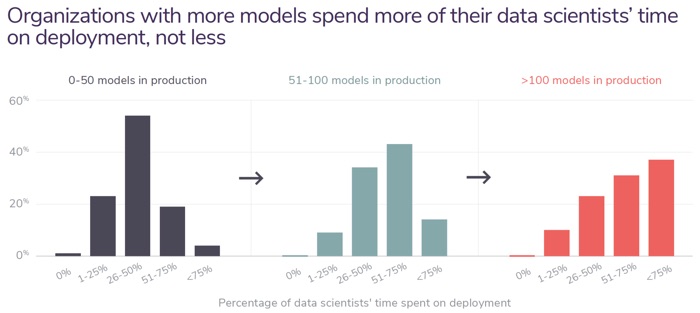
What’s happening? We believe that organizations are using their increased budgets and headcounts to manually scale AI/ML efforts rather than addressing underlying issues with operational efficiency.
In other words: They’re accruing massive amounts of technical debt that will continue to snowball if they remain unaddressed.
What is technical debt and why does it matter?
Technical debt refers to the costs (both direct and indirect) that an organization accrues when it takes the simplest or most agile route to solving a problem, rather than building the best long-term solution. In itself, technical debt isn’t a bad thing. Oftentimes companies need to take a pragmatic approach to getting a product to market quickly, and then iterate on it over time. The problem is when the technical debt isn’t corrected over time. Organizations need to plan enough time to transform their original, agile solutions into longer-term solutions that will scale with their businesses.
When it comes to machine learning, our data implies that organizations are taking on technical debt in order to deploy models, but aren’t correcting it over time. The result? Enterprises must use their increased budgets and headcount to manually get more models into production—rather than using those resources to make it easier to deploy more models in the future.
However, a growing AI/ML staff will have a much bigger impact if it’s able to focus on data science instead of constantly paying down operational overhead. Organizations that continue to accrue technical debt without paying it off are significantly limiting their potential ROI. Because they aren’t investing in longer-term solutions now, they’ll be unable to fully capitalize on market opportunities in the future; doing so will always require more and more resources, because they haven’t invested in making those resources more efficient at delivering value. Time to value for machine learning will be low, and the long-term sustainability of their initiatives will be at risk.
What this means for your ML strategy
As organizations head into this year, they would be far better served by investing in operational efficiency and scale for their ML than by taking on more technical debt. If you’ve already taken on significant technical debt for ML, then this year should be the year when you make these operational improvements. If your organization is just getting started with ML, you have the perfect opportunity to invest in operational efficiency from the start. In both cases, machine learning operations (MLOps) can help.
Organizations that make these steps today will ensure their data scientists can focus on building innovative models—not performing manual operational tasks—and will see the greatest benefits from ML in this year.
Discover all 10 enterprise ML trends
This is only one of the trends that we discovered in our survey of 400+ business leaders. Check out the full report today to explore all 10 trends we uncovered in our research. This year will be a crucial year for ML initiatives—set yourself up for success by understanding where the industry is headed and how you can make the most of it.
