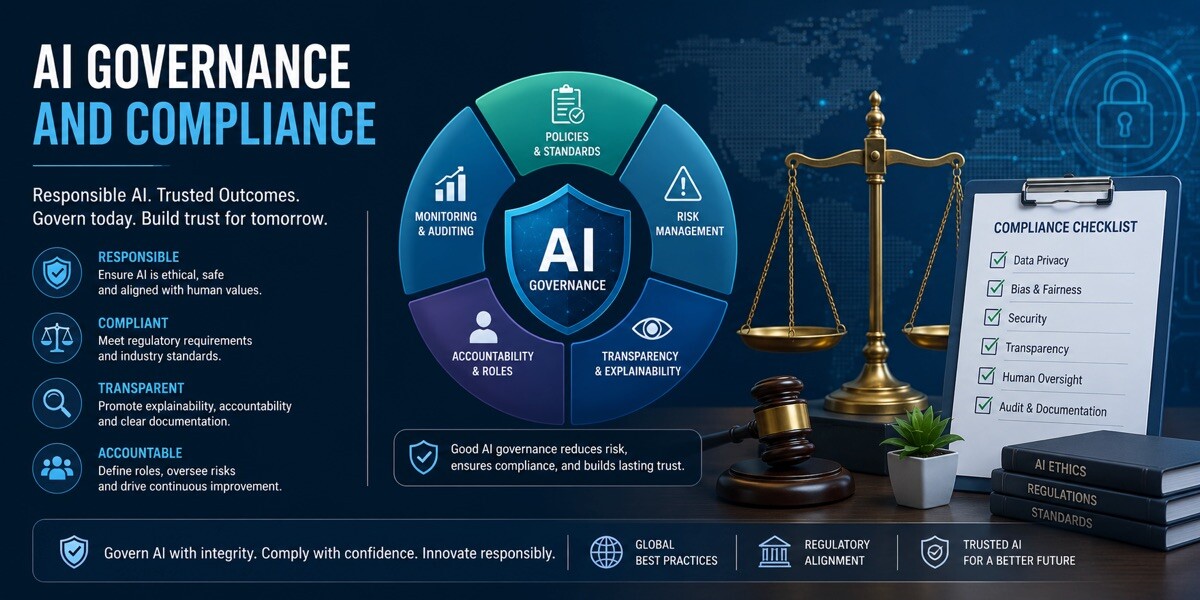
AI Governance and Compliance: Building Trust, Security, and Responsible AI Systems

Artificial intelligence is rapidly transforming how organizations operate, make decisions, and interact with customers. From predictive analytics in healthcare to fraud detection in banking and personalized recommendations in retail, AI systems are becoming deeply embedded in everyday workflows. However, as these systems grow more powerful, concerns around fairness, accountability, transparency, and security have become more urgent. This is where AI governance and compliance play a critical role—ensuring that innovation does not come at the cost of ethics, safety, or public trust.
Effective governance is not just about restricting AI usage; it is about guiding it responsibly. Organizations today are expected to build systems that are not only intelligent but also explainable, auditable, and aligned with legal and ethical standards. As global regulations evolve and public scrutiny increases, businesses must rethink how they design, deploy, and monitor AI technologies.
The Growing Need for AI Governance in a Data-Driven World
The explosion of data availability has fueled the rapid adoption of artificial intelligence across industries. However, this growth has also introduced new risks, including biased decision-making, data privacy violations, and lack of transparency in automated systems. Without structured oversight, AI can unintentionally reinforce inequalities or produce outcomes that are difficult to interpret.
AI governance provides a structured approach to managing these risks by establishing clear policies, accountability mechanisms, and operational guidelines. It ensures that AI systems are developed and deployed with human oversight and ethical considerations in mind. In sectors like finance and healthcare, where decisions directly impact human lives, governance is not optional—it is essential.
Organizations are increasingly recognizing that unmanaged AI systems can lead to reputational damage, legal consequences, and financial losses. As a result, governance frameworks are becoming a strategic priority rather than a technical afterthought.
Core Principles of Responsible AI Systems
Responsible AI systems are built on a foundation of key principles that guide their development and usage. These include fairness, transparency, accountability, privacy, and robustness. Fairness ensures that AI systems do not discriminate against individuals or groups. Transparency focuses on making AI decisions understandable to stakeholders. Accountability ensures that there is clarity about who is responsible for AI-driven outcomes.
Privacy is another critical pillar, especially in a world where AI systems often process sensitive personal data. Strong data governance practices help ensure compliance with privacy regulations and protect user information from misuse. Robustness, meanwhile, ensures that AI systems perform reliably even in unexpected or adversarial conditions.
When these principles are applied consistently, organizations can build trust with users and stakeholders. This trust is essential for long-term adoption and success of AI-driven solutions, especially in highly regulated industries.
Building a Framework for Risk Management and Oversight
Developing a structured risk management framework is essential for controlling the complexities of AI systems. Such a framework typically includes risk identification, assessment, mitigation strategies, and continuous monitoring. It allows organizations to proactively address potential issues before they escalate into serious problems.
A strong governance structure also defines roles and responsibilities across teams, ensuring that data scientists, engineers, compliance officers, and business leaders work collaboratively. This cross-functional alignment helps reduce blind spots and improves decision-making quality.
Auditing mechanisms play a key role in this process. Regular audits of AI models help identify bias, performance drift, and security vulnerabilities. In addition, documentation practices ensure that every stage of AI development is traceable and reproducible.
Organizations that invest in structured oversight are better positioned to adapt to regulatory changes and maintain operational resilience in an increasingly complex technological landscape.
Implementing AI Compliance Solution in Enterprise Environments
As regulatory expectations continue to evolve, many organizations are turning to an AI compliance solution to streamline governance processes and ensure adherence to legal and ethical standards. These solutions help automate monitoring, documentation, and reporting tasks, reducing the burden on internal teams while improving accuracy and consistency.
An effective AI compliance solution typically integrates with existing data pipelines and machine learning workflows. This allows organizations to track model behavior in real time, detect anomalies, and ensure alignment with regulatory requirements. By centralizing compliance activities, businesses can reduce fragmentation and improve visibility across their AI ecosystem.
In enterprise environments, scalability is a key concern. A well-designed AI compliance solution supports large-scale deployments across multiple departments and geographies, ensuring consistent governance standards. It also helps organizations respond quickly to audits and regulatory inquiries by maintaining detailed records of model development and decision-making processes.
Ultimately, the value of such systems lies in their ability to bridge the gap between innovation and regulation, enabling organizations to innovate responsibly without compromising compliance obligations.
Key Challenges in Monitoring and Auditing AI Systems
Despite advancements in governance tools, monitoring AI systems remains a complex task. One of the primary challenges is model opacity. Many advanced machine learning models, especially deep learning systems, operate as “black boxes,” making it difficult to explain how decisions are made.
Another challenge lies in data quality and drift. Over time, data distributions can change, leading to reduced model accuracy and unintended outcomes. Continuous monitoring is essential to detect these shifts early and maintain performance standards.
In this context, an AI compliance solution becomes particularly valuable, as it provides automated monitoring capabilities that help organizations identify risks in real time. It enables teams to maintain visibility into model behavior and ensure ongoing compliance with internal and external standards.
Additionally, regulatory fragmentation across regions adds another layer of complexity. Organizations operating globally must navigate different compliance requirements, which can be difficult without standardized tools and processes. Effective governance strategies must therefore be adaptable and scalable to address these challenges.
Best Practices for Secure and Transparent AI Deployment
Deploying AI systems securely requires a combination of technical safeguards and organizational discipline. Encryption, access control, and secure data storage are fundamental to protecting sensitive information. However, security alone is not sufficient without transparency and accountability.
Organizations should maintain clear documentation of model development processes, including data sources, training methods, and evaluation metrics. This transparency helps stakeholders understand how decisions are made and ensures compliance with ethical standards.
An AI compliance solution can support these efforts by providing automated documentation and audit trails. It also helps enforce policy adherence across teams, ensuring that best practices are consistently applied throughout the AI lifecycle.
Regular training and awareness programs are equally important. Employees involved in AI development and deployment must understand governance principles and compliance requirements. This cultural alignment strengthens overall system integrity and reduces the risk of human error.
The Role of Regulations and Global Standards in AI Governance
Regulatory frameworks and global standards are shaping the future of AI governance. Governments and international organizations are introducing guidelines to ensure that AI technologies are used responsibly and ethically. These regulations often focus on transparency, data protection, and accountability.
For example, the European Union’s AI Act is one of the most comprehensive regulatory efforts aimed at categorizing AI systems based on risk levels and enforcing strict compliance requirements for high-risk applications. Such frameworks encourage organizations to adopt responsible practices from the ground up.
An AI compliance solution helps organizations align with these evolving standards by providing structured compliance tracking and reporting capabilities. It ensures that businesses can adapt to new regulations without disrupting their operations.
Global standards also promote interoperability and consistency across industries. By adhering to common principles, organizations can build more trustworthy and scalable AI systems that operate effectively across borders.
Future Outlook: Trustworthy AI and Organizational Readiness
The future of AI lies in building systems that are not only intelligent but also trustworthy and accountable. As AI becomes more integrated into critical decision-making processes, governance will play an even more central role in shaping outcomes.
Organizations that prioritize ethical AI development will be better positioned to gain user trust and maintain competitive advantage. This requires continuous investment in governance frameworks, talent development, and technological infrastructure.
In the coming years, we can expect AI governance to become more automated, with advanced tools providing real-time compliance monitoring and risk assessment. These developments will help organizations scale responsibly while maintaining control over increasingly complex systems.
Ultimately, the success of AI adoption will depend not just on technological innovation but on the strength of governance structures that support it. Responsible AI is not a destination but an ongoing commitment to building systems that serve humanity fairly, safely, and transparently.