Best POS Systems For Quick Service Restaurants

Quick service restaurants run on speed, and the wrong POS setup can quietly kill that speed from the inside out.
Hardware that freezes mid-rush, payment data vulnerabilities, systems that won’t talk to your kitchen display or online ordering platform — these aren’t edge cases. They’re everyday headaches for QSR operators.
After reviewing the leading options out there, one thing becomes clear: the difference between a good system and the right system comes down to reliability under pressure.
This guide covers four purpose-built picks that actually hold up during peak hours.
Behind the ranking
Every option here was evaluated through publicly available sources: customer reviews across major software directories, product feature documentation from official websites, verified case studies, and platform performance data. Only systems with a documented track record in restaurant and retail environments made the cut.
→ See the full research breakdown
- BLogic Systems – Best for restaurant and hospitality POS with integrated payments
- Loyverse – Best for small to medium-sized retail businesses and restaurants
- Lavu – Best for small to medium-sized restaurant operations
- Epos Now – Best for multi-location retail and hospitality businesses
The Real Impact of POS Systems
Picking the wrong POS setup in a quick service environment doesn’t just slow things down. It costs real money on every single shift.
Hardware compatibility problems across locations, software that won’t sync with your existing back-office tools, and payment data security gaps are the kinds of problems that compound quietly until something breaks at the worst possible moment. And it’s always the worst possible moment.
A purpose-fit system changes that equation.
When average transaction time drops, lines move faster and customers come back. When system reliability stays consistent across every location, managers stop putting out fires and start actually running the business. And when you calculate total cost of ownership honestly (hardware, software subscriptions, and transaction fees all included), the right choice pays for itself in ways a cheap alternative never quite manages.
4 Top Picks at a Glance
Note: All data in this table is sourced from review platforms and the official websites of the listed companies.
| Company Name | Years Operating | Headquartered In |
| BLogic Systems | Since 2010 | San Jose, California, USA |
| Loyverse | Since 2014 | Limassol, Cyprus |
| Lavu | Since 2010 | Albuquerque, New Mexico |
| Epos Now | Since 2011 | Norwich, UK |
BLogic Systems – Best for Restaurant and Hospitality POS With Integrated Payments
How Does BLogic Systems Create Value?
BLogic Systems operates as an all-in-one POS ecosystem built from the ground up for restaurants and hospitality businesses. Their platform brings together POS software, payment processing through BlogicPay®, inventory management, employee scheduling, and delivery channel management into one dashboard. The system runs on both cloud and offline architecture, so transactions keep processing even when the internet drops. That sub-2-second transaction completion claim isn’t marketing fluff for a QSR — at peak lunch volume, that kind of processing speed genuinely matters.
What Sets BLogic Systems Apart for POS Systems?
BLogic Systems directly addresses one of the most stressful QSR scenarios: losing payment processing mid-service because of an internet outage. Their hybrid offline architecture keeps the system running without missing a beat, and the optional 0% credit card fee program gives operators a real path to cutting one of their highest recurring costs.
Real User Sentiment:
From what the available information shows, operators particularly respond to the delivery management side of the platform. Having DoorDash, Uber Eats, and Grubhub all feeding into a single dashboard (instead of three separate tablets on the counter) is exactly the kind of detail that matters in a busy kitchen. The connected payment processing also gets consistent positive attention for keeping fees transparent and manageable.
Loyverse – Best for Small to Medium-Sized Retail Businesses and Restaurants
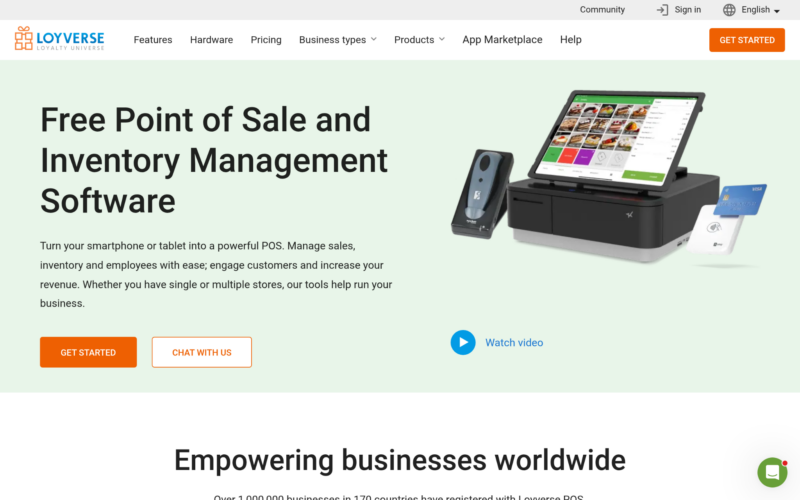
How Does Loyverse Create Value?
Loyverse gives small and medium-sized operators a genuinely full-featured POS platform at a price point that doesn’t require a CFO to approve. The basic features are free, which is rare and worth calling out (not a stripped-down trial, but actual working POS functionality). Beyond the free tier, the platform covers multi-location inventory tracking, employee management, and a built-in rewards program. With support across 25+ languages and active users in 170+ countries, it’s proven it can scale across very different operating environments.
What Sets Loyverse Apart for POS Systems?
Most POS platforms that offer a free tier make you feel that cost in missing features. Loyverse includes a complimentary rewards program alongside the system, which is genuinely uncommon at that price. With over one million registered businesses and payment gateway connections to Stripe, PayPal, and Square, the platform covers what’s needed without forcing operators into expensive proprietary payment setups.
Real User Sentiment:
Honestly, the rewards program gets mentioned more than almost anything else in operator reviews. Small retailers and café operators seem particularly pleased that they don’t need a separate subscription just to run a points program. From what the reviews show, the platform earns consistent marks for ease of setup and day-to-day usability, though some users note that the add-on pricing for advanced features can add up faster than expected.
Lavu – Best for Small to Medium-Sized Restaurant Operations

How Does Lavu Create Value?
Lavu pioneered the iPad-based POS for restaurants back in 2010, and they’ve spent every year since making that specific use case work better. The platform covers mobile POS software, integrated payment processing, online ordering, kitchen display systems, and delivery routing — all built around the food service workflow rather than adapted from a generic retail system. With over one billion orders processed and a customer base across 100+ countries, the track record is genuinely hard to argue with.
What Sets Lavu Apart for POS Systems?
Lavu solves the technical confidence problem that trips up a lot of restaurant operators: the fear that a new system will confuse staff and slow service during the learning curve. Their iPad-first approach is intuitive enough that new staff can get through training quickly, and that speed-to-competence advantage shows up directly in checkout speed and void rates. That kind of staff-friendly design is rare to match in restaurant-specific POS systems.
Real User Sentiment:
The feedback pattern across G2 and Capterra centers on two things: how quickly staff get comfortable with the system, and how responsive the customer service team tends to be. From what the reviews show, operators at small independent restaurants particularly value that Lavu feels purpose-built for their environment rather than a scaled-down enterprise product. The dual pricing feature also gets attention from cost-conscious owners looking to manage transaction fees.
Epos Now – Best for Multi-Location Retail and Hospitality Businesses
How Does Epos Now Create Value?
Epos Now serves roughly 90,000 merchant locations across 11 countries, which puts them in a different scale category from most POS providers on this list. The platform runs on cloud infrastructure, giving operators remote access to sales data, inventory figures, and transaction records from anywhere. Their connection library covers 130+ third-party apps, so linking to existing accounting software or e-commerce platforms is practical rather than painful. The AI assistant called Sidekick has reportedly automated up to 70% of support demand, which translates to fewer hours lost chasing technical help.
What Sets Epos Now Apart for POS Systems?
Epos Now addresses the specific pain of managing consistency across multiple locations without building a separate IT function to do it. The centralized dashboard and hardware flexibility mean operators aren’t locked into one device type or one configuration at every site. Based on the research, that kind of cross-location control is what separates Epos Now from systems that work well at one location but struggle to scale.
Real User Sentiment:
The platform’s recognition, including the Queen’s Awards for Enterprise, gives it credibility that’s hard to ignore (think enterprise-level trust signals for a mid-market price). From what the data shows, users running multiple sites respond well to the centralized management approach, and the app ecosystem gets positive marks for reducing the need to manage separate software subscriptions for accounting or e-commerce.
How These Were Chosen and Verified
The Data Collection Phase
The research started by pulling together a broad list of POS platforms with active market presence in the restaurant and retail sectors. Sources included software comparison directories, product listing databases, and review aggregator platforms where verified buyers leave detailed feedback. Official company websites were reviewed alongside these third-party sources to build a picture of what each platform actually offers versus what it claims to offer.
The Shortlisting Pass
Once the initial list was built, any platform without a documented history of serving restaurant or retail operators was removed. Review patterns were analyzed across multiple platforms rather than relying on a single source, because any one review site can skew in a particular direction. Options with inconsistent review histories, very thin documentation, or no verifiable case study evidence were dropped at this stage.
Verification Pass
Each shortlisted platform’s claims were cross-checked against what real users reported in reviews. Where a company claimed particular performance advantages (such as transaction speed, offline reliability, or multi-location management), the review data was examined to see whether those claims showed up organically in operator feedback. Discrepancies between marketing language and operator experience were flagged and weighed against overall inclusion.
Industry Recognition and Authority
Recognition signals were considered alongside user reviews rather than instead of them. Awards from credible industry bodies, mentions in established hospitality and retail publications, and documented research partnerships were all treated as supporting signals. A platform ranked highly by a credible third party tends to have earned that recognition through consistent performance, and that consistency matters more than a single impressive claim.
POS Systems Track Record
Each platform’s dedicated service pages, verified operator reviews focused on restaurant and QSR environments, and any available case studies were reviewed to confirm relevant experience. A company might have strong general POS capabilities but limited evidence of performing well under the specific pressures of quick service operations (high transaction volume, staff turnover, kitchen display connection). Only platforms with clear evidence of handling those conditions made the final list.
What to Look For When Choosing POS Systems
Picking a POS system for a quick service restaurant isn’t just about features. It’s about finding a platform that holds up under the actual conditions your team works in every day.
- Industry and Domain Experience: Look for platforms built for food service or with a documented track record in QSR environments. General-purpose systems can work, but they often require workarounds that slow your team down.
- Features and Services: Kitchen display connection, offline processing, delivery platform connectivity, and inventory tracking are non-negotiable for most QSR operators. Confirm these are included rather than sold as expensive add-ons.
- Pricing Structure: Calculate total cost of ownership honestly. Factor in hardware, monthly software fees, and per-transaction charges. Some platforms look affordable upfront but get expensive at volume.
- Results Measurement: Choose a system that gives you clear reporting on transaction processing time, void rates, and inventory accuracy. Visibility into these numbers is how you actually improve operations.
- Industry Knowledge and Compliance: PCI DSS compliance and secure payment handling aren’t optional. Confirm the platform meets current payment security standards before committing.
Final Take
Quick service restaurants need a POS system that works faster than the lunch rush, not one that needs babysitting when it counts most.
The platforms covered here span a real range of needs: from BLogic Systems’ offline-first reliability and integrated delivery management, to Loyverse’s accessible free tier, Lavu’s iPad-native restaurant focus, and Epos Now’s multi-location scale.
The restaurant tech space keeps moving, and systems that combine payment security, staff-friendly design, and real operational data will stay ahead of the curve.