Core Web Vitals for Healthcare Websites: How Speed Impacts Patient Trust

When someone lands on a healthcare website, trust begins forming almost immediately. You make judgments within seconds based on how quickly information appears and how smoothly the page responds. In healthcare, speed signals reliability. A fast-loading site feels organized, secure, and respectful of your time, while delays can raise doubts before you even read a word.
Slow healthcare websites often create tension instead of reassurance. Long load times interrupt focus, increase uncertainty, and push visitors to leave before taking action. This is where Core Web Vitals matter. These performance metrics help measure loading speed, visual stability, and interaction responsiveness, giving you clear insight into how website performance directly shapes patient confidence and engagement.
How Core Web Vitals Shape Performance Expectations on Healthcare Websites
Core Web Vitals focus on how real users experience your website, not just how it looks in testing tools. These metrics measure loading speed, responsiveness, and visual stability, which Google prioritizes because they reflect genuine user experience. For healthcare websites, these signals carry extra weight since patients expect clarity, reliability, and ease from the first interaction.
Healthcare websites operate under different expectations than retail or media platforms. Visitors are not browsing casually. They are often searching for reassurance, answers, or timely care. Slow loading speed or unstable pages can feel careless in a medical context, even if the same performance issues might be tolerated elsewhere.
This is where healthcare UX performance becomes critical. Performance metrics directly influence how patients perceive professionalism, competence, and trustworthiness. Strong Core Web Vitals support smoother navigation, clearer communication, and a more confident patient journey.
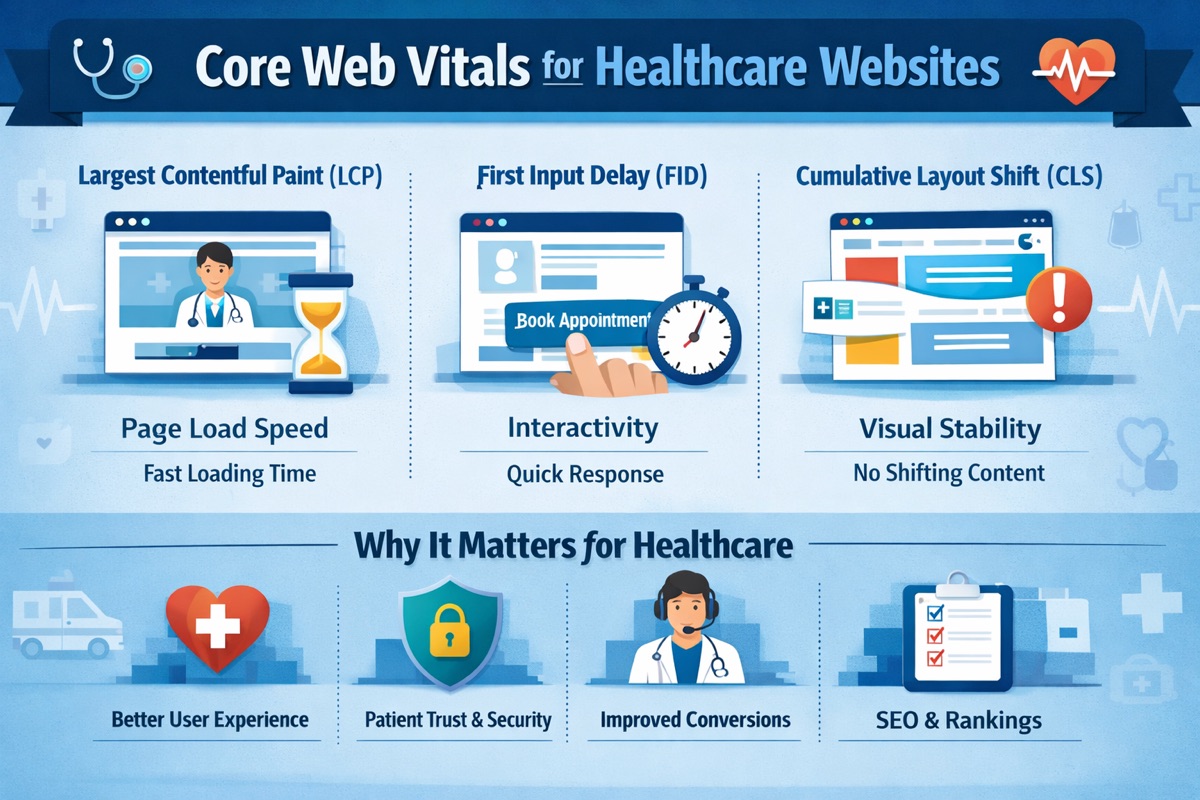
Largest Contentful Paint (LCP) and First Impressions
Largest Contentful Paint measures how quickly the main content becomes visible. In healthcare, this moment sets the tone. When key information loads quickly, you signal reliability and organization, which helps patients feel at ease.
Service pages, provider profiles, and appointment booking screens often suffer from slow LCP due to large images or unoptimized elements. When these pages hesitate, visitors may question the quality of care before engaging further.
Delayed visuals interrupt reassurance. Instead of feeling supported, patients may feel uncertain or impatient, which weakens confidence and increases early exits.
Interaction to Next Paint (INP) and Patient Frustration
Interaction to Next Paint measures how responsive your site feels when someone takes action. In healthcare, responsiveness plays a direct role in appointment scheduling and form completion. When clicks respond quickly, you create a sense of control and ease.
Delays often appear during form submissions, menu navigation, or button clicks. These moments matter because patients expect immediate feedback, especially when sharing personal information.
Poor interaction responsiveness breaks momentum. When actions feel ignored or delayed, frustration grows, and visitors abandon tasks they intended to complete.
Cumulative Layout Shift (CLS) and Trust Disruption
Cumulative Layout Shift tracks how stable your page remains as it loads. Unexpected movement feels unprofessional on a healthcare website where precision and care are expected.
Layout shifts commonly affect consent forms, service descriptions, and call-to-action buttons. When content jumps, patients may misclick or lose focus, which creates discomfort and hesitation.
Reducing layout instability supports a calmer experience. Stable pages help patients read, understand, and act without distraction, reinforcing trust through predictability and control.
How Website Speed Directly Influences Patient Trust Signals
Website speed influences trust before patients consciously evaluate your message. When pages load quickly and respond smoothly, you instinctively perceive the practice as organized and credible. Speed works as a silent signal that the provider values accuracy, efficiency, and patient experience from the very first interaction.
Loading speed also plays a meaningful role in healthcare digital trust factors. Fast performance reduces hesitation, keeps attention focused, and supports confidence when patients explore services, credentials, or care options. A slow site, on the other hand, can introduce doubt even when the content itself is strong.
Patients often connect technical reliability with clinical reliability. If a website struggles to load or respond, it can subtly raise concerns about attention to detail. Consistent performance helps reinforce the belief that the same care and precision extend into the practice itself.
Core Web Vitals and Patient Engagement Metrics
Site performance has a direct effect on whether visitors stay or leave. When pages load quickly and remain stable, bounce rates naturally decline because patients can access information without friction. Smooth performance encourages exploration, giving visitors more time to review services, providers, and next steps.
Faster websites also improve patient engagement metrics by supporting uninterrupted interaction. Quick responses to clicks, scrolling, and form entries keep momentum intact. As engagement improves, patients are more likely to move from research to action rather than abandoning the session out of frustration.
Mobile performance optimization plays an especially important role in appointment conversions. Many patients search for care on their phones, often during busy moments. A fast, responsive mobile experience makes booking feel simple and dependable, which increases the likelihood of completed appointments.
Marketing experts at iMatrix say, “Patients may not think about performance metrics, but they feel them immediately. When a healthcare website loads quickly and responds without hesitation, it reinforces a sense of competence and care. Speed removes friction, allowing patients to focus on their needs rather than the technology.”
Mobile Performance Optimization for Healthcare Websites
Most patient research now begins on mobile devices, often during moments when time and attention are limited. You may be comparing providers, checking availability, or looking for reassurance while on the go. In these situations, mobile performance directly affects whether you stay engaged or move on to another option.
Mobile UX expectations for healthcare websites are high. Patients expect fast-loading pages, clear navigation, and responsive interactions that work smoothly on smaller screens. Delays, crowded layouts, or unresponsive elements can quickly undermine confidence, especially when searching for clinical information or appointment options.
Measuring mobile Core Web Vitals helps you understand how well your site supports trust and usability on phones and tablets. Strong mobile performance signals reliability, reduces friction, and ensures patients can access care-related information without unnecessary effort.
Technical SEO for Healthcare Without Compromising Compliance
Improving website speed in healthcare requires a careful balance. You need performance gains without risking patient privacy or regulatory compliance. HIPAA-compliant performance optimization focuses on strengthening infrastructure and delivery methods while maintaining strict safeguards for sensitive data.
Server response time plays a major role in healthcare website performance. Slow servers can delay content delivery even when pages are well designed. Choosing reliable healthcare-ready hosting and optimizing backend processes helps ensure faster responses without exposing protected information.
Secure hosting, smart caching, and controlled content delivery improve speed while preserving trust. When implemented correctly, these practices reduce load times, support stability, and reinforce confidence. Patients experience a smooth, secure website that feels dependable without compromising safety or compliance standards.
Performance Driven Credibility in Modern Healthcare Marketing
Healthcare digital platforms increasingly treat Core Web Vitals as more than technical benchmarks. Strong performance helps reinforce trust by delivering fast, stable, and responsive experiences that feel intentional and well-managed. When a site performs consistently, patients are more likely to view the practice as credible and attentive to detail.
Healthcare marketing companies such as iMatrix healthcare marketing prioritize site performance as part of a broader focus on user experience and digital trust. By aligning speed improvements with clear navigation, reliable functionality, and compliance standards, performance becomes a foundation for credibility rather than a standalone tactic.
Speed optimization supports long-term patient confidence because it improves everyday interactions, not just search visibility. Fast, dependable websites create familiarity and reassurance over time, helping practices build trust that extends beyond rankings and into real patient relationships.
Measuring and Improving Core Web Vitals for Healthcare Websites
Monitoring healthcare website performance starts with the right tools. Platforms such as Google Search Console, PageSpeed Insights, and real user monitoring solutions help you track Core Web Vitals using actual patient interactions. These tools provide clear visibility into loading speed, responsiveness, and visual stability without requiring constant manual testing.
Interpreting Core Web Vitals data works best when viewed through a patient experience lens. Instead of focusing only on scores, you look at how delays affect readability, navigation, and task completion. This perspective helps you prioritize fixes that reduce frustration and support confidence during key moments.
Setting realistic performance benchmarks matters for healthcare organizations. Goals should reflect compliance needs, content complexity, and audience behavior. Consistent improvement builds trust gradually, ensuring performance supports long-term usability rather than chasing short-term metrics.
Final Note
Core Web Vitals play a meaningful role in how patients experience healthcare websites. Fast loading pages, stable layouts, and responsive interactions shape trust, support engagement, and influence how professionalism is perceived. When performance feels reliable, patients are more comfortable exploring services and taking next steps.
Website speed is also part of ethical, patient centered digital care. Clear access to information without delays reduces stress and supports informed decision making. Performance should never create barriers during moments when clarity and reassurance matter most.
Aligning technical SEO with patient trust helps healthcare organizations deliver better experiences. When speed improvements support usability and confidence, digital strategy becomes an extension of care rather than just a marketing effort.