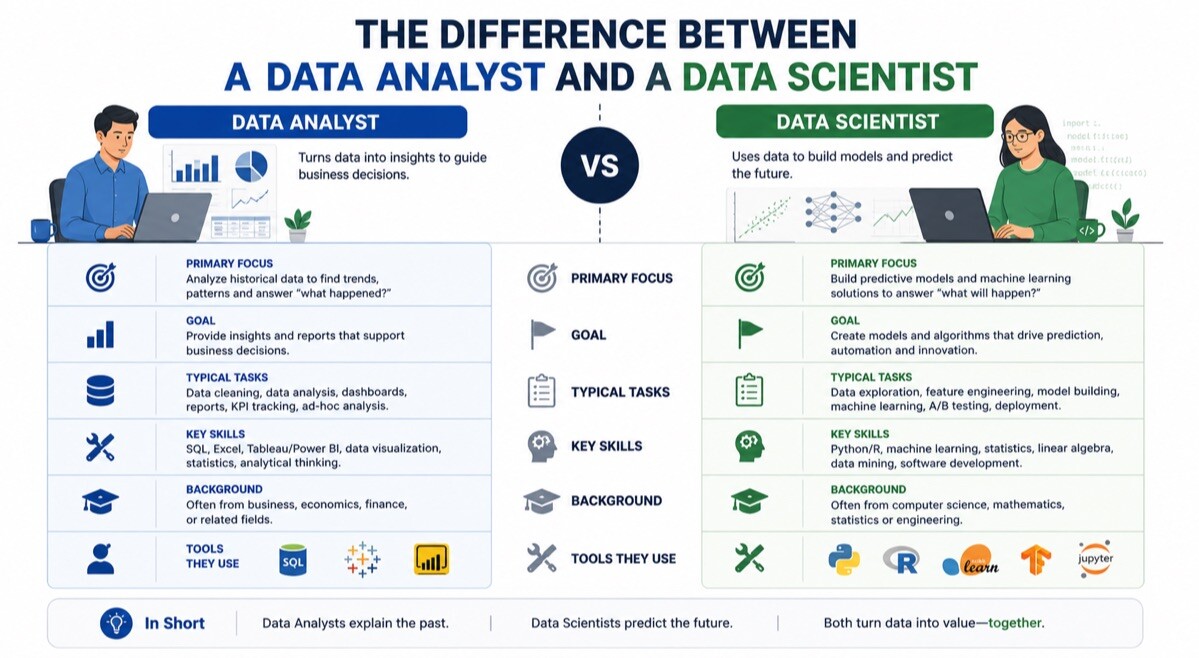
The Difference Between a Data Analyst and a Data Scientist

While their titles may sound similar, there is a difference in data analyst and data scientist jobs. They’re technical, data-driven, and both improve business processes behind the curtain. However, how they work with data is what differentiates them. Let’s take a deeper dive into the infrastructure of data analysts and data scientists to understand what they really do.
Learning more about data analysts
Data analysts spend a great length of time reviewing the analytics of a business. This explains why they are required to have strong statistical skills. Data analysts spot trends in data, measure results, and formulate a story for other departments in their business. Working in a wide variety of industries, they’re able to perform extensive analyses on data to figure out the microscopic details of how an organization runs, improves, and profits.
As a result, data analysts have a brief background in programming skills (SaS, R, Python, etc.) to help them discover data behind the scenes. In addition, they update stakeholders on KPIs (key performance indicators) to help gauge a company’s overall long-term performance and relationship with customers. It is the job of a data analyst to easily explain what happened, or is happening, based on data alone. As you can see, they’re extremely useful and in high-demand. According to Glassdoor, the national average salary for a Data Analyst is $62,453 in the United States.
Prerequisites of data analysts
Data analysts are usually equipped with at least an undergraduate degree in a science, technology, engineering, or math (STEM) major. In addition, data analysts are comfortable in creating data visualizations by using programs like Tableau, Power BI, and Salesforce Einstein Analytics, just to name a few. Data analysts can easily arrange their analyses and showcase insightful findings to tell the story of the data to managers or executives.
Other skills of data analysts
What does it take for data analysts to spend a lot of time in the process of collecting, cleaning, and shuffling data together? Here’s a list of the most common skills held by data analysts:
- Knowledge in statistical programming languages
- Expertise in SQL
- Ability to perform mathematical models (linear algebra and calculus)
- Data visualization
- Problem solving and critical thinking
- Collaboration and willingness to work with other departments
Similarities between data analysts and data scientists
Both data analysts and data scientists perform highly technical jobs that involve diving into the depths of data, but what they do with the data is different. Data analysts and data scientists play a critical role in collecting and consolidating data for the benefit of a business; this is the middle ground — both occupations revolve around data. But data scientists rely on machine learning and AI to help design and construct new processes for data modeling and production. In that way, data analysts tell the current and past story of the data, while data scientists are looking for the future story from the data.
Learning more on data scientists
Data scientists use prototypes, algorithms, predictive models, and custom analysis to build their own automation systems and frameworks. In return, they can easily extract information for their company to solve complex problems. As you can tell, this requires heavy coding, which is another difference between data analysts and data scientists.
A data scientist is capable of running data science projects, with the intent to ask and formulate questions that could benefit future business based on data. Like data analysts, they’re extremely useful and in high-demand. Enterprise leaders in machine learning believe data scientists are more valuable now than ever before. According to Glassdoor, the national average salary for a Data Scientist is $113,309 in the United States.
Prerequisites of data scientists
Data scientists should have a more extensive background than data analysts, hence why they earn more money. Exceptional programming skills are of necessity (SaS, R, Python, etc.) and mathematical and statistical knowledge, like hacking skills, are other prerequisites of data scientists.
In terms of education, a data scientist should at least possess a bachelor’s degree with significant experience. But a master’s degree or PHD will always look more appealing for this role and is often required. This education coupled with a background in computer science is a formula for data scientist success.
Other skills of data scientists
What does it take for data scientists to do the work of a data analyst, but also engage in machine learning, advanced programming, and discover new processes for data modeling? Here’s a list of the most common skills held by data scientists:
- Master knowledge in statistical programming languages
- Ultimate master in SQL
- Knowledge in Hadoop and Apache Spark
- Ability to perform mathematical models (linear algebra and calculus)
- Advanced data visualization
- Adept at working with unstructured data
- Machine learning and AI
- Problem solving and critical thinking
- Collaboration and willingness to work with other departments
- Intellectual curiosity
As you can see, data scientists are worth more and require additional skills. For example, they tackle tasks like building and using algorithms to create their own automation systems and frameworks. Machine learning development platforms can support all types of data workers, but are especially useful in streamlining individual algorithm processes and improving full pipeline management.