Inside The Technology Behind Smart Door Entry Solutions

There’s something oddly annoying about being at one’s door and trying to find a key. That might sound ridiculous, but it points to a much larger problem: conventional locking mechanisms simply weren’t meant for our current reality of increased connections between buildings, increased mobility, and ever-growing demands on security.
Enter smart access control and advanced security systems, which allow us to take charge and create rules for access based on need. In the modern world, everyone expects their entrance to be convenient and safe, whether they’re entering a residential, commercial, or shared property.
If you manage any property type, then it’s not an option anymore – knowledge about smart locks and access control systems is vital. In this blog post, I’ll focus on explaining what you really need to know without overthinking anything.
Smart Door Entry Systems: More Than Locks and Readers
Let’s clear something up right away. Modern smart door entry systems aren’t just fancy replacements for deadbolts. They’re layered platforms, hardware, software, and cloud connectivity, all woven together into something that behaves like one unified security organism.
At the heart of most modern deployments sits an access control board. Think of it as the central nervous system, connecting every reader, sensor, and lock so the whole setup operates in sync rather than as a collection of isolated parts.
Now, smart door access control doesn’t look the same everywhere you deploy it. Residential apartments prioritize convenience: remote unlocking, mobile credentials, and easy visitor management. Corporate environments demand audit trails, granular permissions, and multi-site oversight. Mixed-use properties, the tricky ones, need both simultaneously. That flexibility is exactly what separates these systems from a mechanical lock or a standalone card reader bolted to the wall.
The Core Architecture: What’s Actually Inside These Systems
Every access decision you make, or that gets made on your behalf, runs through a connected stack of components. Knowing that stack tells you a lot about why modern systems are faster, smarter, and frankly more resilient than anything that preceded them.
Hardware at the Door
Walk up to a modern door, and you’ll encounter smart locks driven by motors and servo mechanisms, electronic strikes that release on command, and readers capable of handling keycards, PINs, NFC taps, Bluetooth signals, or biometric scans. Supporting hardware fills in the gaps, door position switches, request-to-exit sensors, intercoms, and cameras all extend the system’s situational awareness.
Controllers, Edge Devices, and the Cloud
Behind the scenes, on-premises panels handle local decision-making while edge controllers embedded directly into readers process events right at the door before forwarding data upstream. Electronic door entry technology routes those events to cloud platforms or local servers through PoE connections, RS-485 buses, or Wi-Fi backup links. It’s a layered architecture, and each layer has a specific job.
What Actually Happens in Milliseconds
When someone taps a credential, here’s the sequence: the reader captures it, passes it to the controller, authentication and authorization checks fire, the event gets logged, any necessary alerts trigger, and the unlock signal goes out. All of that, genuinely, happens in milliseconds. The one place latency creeps in is the cloud round-trip, which is precisely why edge-level decision-making matters so much for high-traffic doors.
Connectivity and Communication: The Invisible Infrastructure
A brilliant architecture collapses without strong communication protocols holding it together. The choices made here, often invisible to end users, directly shape how secure, fast, and durable a system truly is.
The Protocols Doing the Heavy Lifting
OSDP has effectively replaced the aging Wiegand standard. Why? Encrypted, bidirectional communication between readers and controllers. Above the door level, smart door entry systems use TCP/IP, MQTT, and REST APIs to move event data between controllers and cloud platforms. Mobile operating system frameworks on Android and iOS power “phone as a key” workflows through secure elements and digital wallet passes.
Wireless Technologies Worth Understanding
Bluetooth Low Energy handles proximity-based unlocking reliably. Ultra-Wideband steps things up with centimeter-level precision, essential for hands-free, walk-up scenarios. NFC drives tap-to-unlock experiences and wearable credentials. Keyless entry solutions are also increasingly embracing Thread and Matter protocols for deeper smart-building integration, alongside established Wi-Fi and Zigbee options.
Cloud-Native Platforms: Managing at Scale
Multi-tenant cloud dashboards let facility managers run dozens of sites from a single screen without dispatching a technician for routine changes. Real-time event streaming, remote lock commands, and over-the-air firmware updates transform how buildings get maintained. API-first platforms connect door access to visitor management tools, HR systems, property management software, and even elevator controls, genuinely unified operations.
Biometrics, Mobile Credentials, and the Future of Identity
Here’s a number that should catch your attention. Nearly 2 in 5 organizations, 39%, now actively use mobile identities for physical access (securitytoday.com). Credential technology has matured well past the laminated plastic card era.
Biometrics in Real-World Deployments
Fingerprint readers, iris scanners, facial recognition systems, and palm vein readers now protect high-security zones with identity-bound authentication. Liveness detection counters spoofing attempts with photos or replicas. Privacy-conscious organizations store biometric templates on the device itself rather than on centralized servers, a meaningful architectural choice.
Mobile-First Access Control
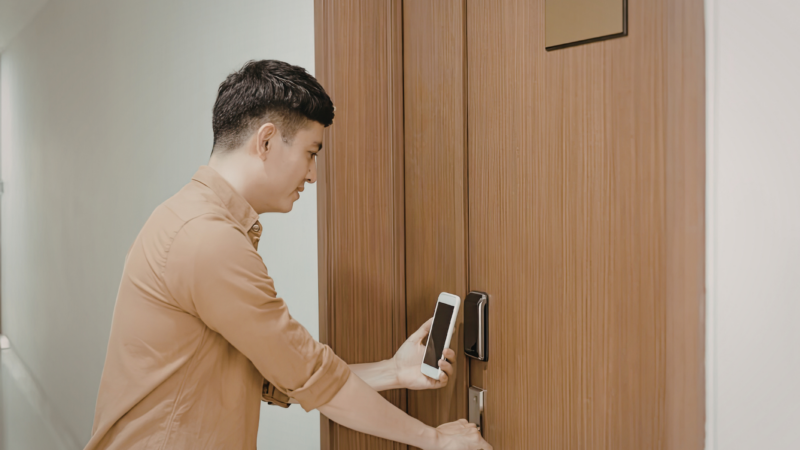
Your smartphone is increasingly your primary credential, through NFC, BLE, or QR-based visitor links. Smart door access control platforms now handle the entire credential lifecycle: provisioning new users, revoking lost devices, and enforcing role-based permissions directly through a mobile app. Critically, offline mode keeps doors operational when networks go down, or a phone battery decides to die at the worst possible moment.
Layered and Context-Aware Authentication
Sensitive areas benefit enormously from multi-factor approaches, combining something you have, something you know, and something you are. Context-aware policies can adjust requirements dynamically based on time of day, device posture, or geofencing rules. The system gets smarter about risk without burdening users unnecessarily.
Quick Answers to Common Questions
1. What are the core components of a smart lock?
Three elements: the mechanical assembly, the motor, and the wireless transceiver. Each one is doing a distinct job.
2. Do smart locks require Wi-Fi to function?
No. Bluetooth and NFC provide reliable connectivity and security even without a Wi-Fi connection available.
3. What happens during an internet or power outage?
Edge controllers make local access decisions independently of cloud connectivity. Battery backup and fail-safe wiring keep doors safe and operational throughout.
Where This All Leads
Smart door entry technology isn’t just a hardware upgrade; it’s an operational shift in how buildings function and protect people. Encrypted protocols, edge controllers, mobile credentials, and adaptive authentication all work together as a deliberate system, not a collection of add-ons.
The organizations that take time to understand these layers, rather than simply purchasing hardware and hoping for the best, will find themselves significantly better positioned against both security threats and the operational demands ahead. That investment in understanding pays dividends for years.