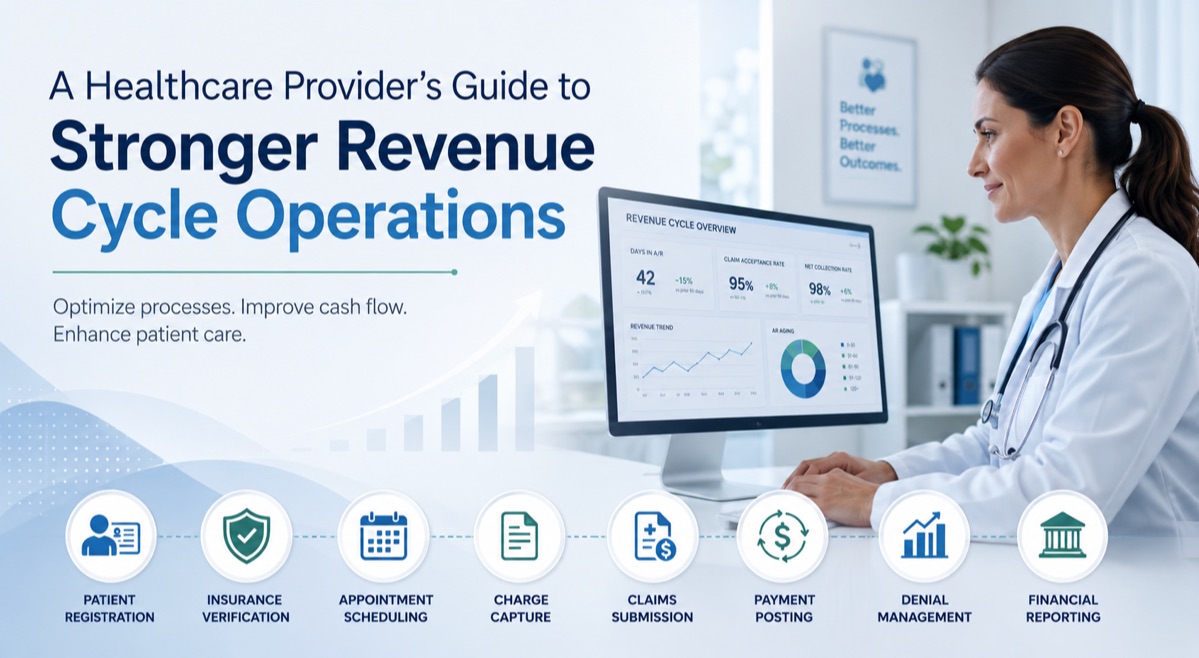
A Healthcare Provider’s Guide to Stronger Revenue Cycle Operations

Every healthcare practice runs two businesses at the same time. One is clinical — actually treating patients. The other is financial — making sure the practice gets paid for that care, accurately and on time. When the financial side runs smoothly, nobody notices. When it doesn’t, the cracks show up fast: cash flow tightens, AR ages out, denials pile up, and staff burns out chasing problems that should never have happened in the first place.
This guide is for providers who want to reduce revenue leakage and build more consistent operations. The goal isn’t perfection — it’s tightening the process enough that money stops slipping out the back door. A solid place to start exploring what structured revenue cycle support looks like is https://pharmbills.com/revenue-cycle-management-services-for-healthcare, which walks through the components in more detail.
What Strong Revenue Cycle Operations Look Like
Strong RCM doesn’t look flashy. It looks boring, in the best way. Claims go out clean the first time. Denials get worked within days, not weeks. AR stays under control. Reports actually reflect reality, and leadership knows where the practice stands financially without having to ask three different people.
A few things define healthy revenue cycle operations:
- Accurate front-end data — patient demographics, insurance details, and eligibility captured correctly at registration
- Clean claim submission — coded properly, documented properly, scrubbed before they leave
- Timely follow-up — claims worked on a schedule, not when someone gets around to them
- Denial tracking — categorized by reason, payer, and provider so patterns become visible
- Reliable reporting — collection rates, days in AR, denial trends, and payer performance, available on demand
None of these are exotic. They’re just hard to maintain consistently when the team is stretched thin or when processes depend on a few specific people knowing how everything works.
Where Revenue Cycle Problems Usually Start
Most revenue cycle problems don’t start in the billing office. They start at the front desk, in the exam room, or in the coding queue — and by the time billing sees them, the damage is already done.
Patient information errors are the classic example. A misspelled name, a wrong date of birth, a digit off on the policy number — any of these can kick a claim back, and fixing it on the back end takes ten times longer than getting it right the first time. Missing eligibility checks are another huge one. If you don’t verify coverage before the visit, you’re guessing at what’ll be paid, and surprises are rarely the good kind.
Documentation gaps cause endless trouble. Providers don’t always realize that what they write — or don’t write — directly affects whether a claim gets paid. Coding issues compound the problem, especially when codes don’t quite match the documentation or when modifiers get missed. And then there’s payer communication. Some payers respond in days, others take weeks, and slow follow-up means stale claims that age past appeal windows.
Why Specialized RCM Support Can Make a Difference
There’s a point where internal teams just can’t keep up, and it usually arrives quietly. Claim volume creeps up. AR ages out a little more each month. Denials start sitting longer because nobody has time to appeal them. Payer rules shift, and suddenly half the team is spending afternoons figuring out new prior auth requirements.
This is where external RCM support starts making real sense. Specialized partners bring two things internal teams often can’t: capacity that scales, and depth of expertise across many payers and specialties. They’ve seen the denial patterns before. They know which payers respond to which appeal strategies. They have systematic processes for working AR buckets that internal teams rarely have time to build.
The point isn’t to replace internal staff. It’s to take pressure off the routine, high-volume work so the in-house team can focus on the parts of the job that genuinely need to stay close to the practice — payer contracting, complex appeals, patient escalations, leadership-level analysis. When the boring-but-critical work gets handled reliably elsewhere, everything else gets easier.
How Better Support Improves Financial Visibility
One of the underrated benefits of stronger RCM operations is visibility. When processes are messy, reporting is messy too. You get numbers that don’t quite reconcile, AR buckets that nobody fully trusts, and denial reports that show what happened but not why.
Better support changes that. Reporting becomes regular and structured. AR aging actually means something because the underlying work is happening on schedule. Denial categories become useful diagnostic tools — you can see that, say, 30% of denials this quarter came from one payer’s prior auth rule changes, and now you can do something about it. Payment trends become predictable enough that cash flow planning stops being guesswork.
Workflow accountability is the other piece. When every task has a defined owner and a defined timeline, problems surface fast instead of festering. If something isn’t getting done, it shows up in the report next week, not six months later when an auditor finds it. That kind of transparency is hard to build internally when everyone is already maxed out — but it’s exactly what well-structured external support is designed to deliver.
Working with a Healthcare-Focused Partner
Generalist outsourcing firms tend to disappoint in healthcare. The rules are too specific, the compliance landscape too tight, and the payer ecosystem too quirky for someone who treats medical billing as just another back-office workflow. A healthcare-focused partner understands those nuances from day one — payer behavior, documentation standards, HIPAA handling, patient communication norms.
Pharmbills is one option in this space, working specifically with healthcare organizations to support billing and broader revenue cycle workflows. Their model is built around the kind of structured, scalable assistance practices need when internal capacity hits its limits. You can read more about how they approach it at https://pharmbills.com. The bigger principle, though, applies regardless of which partner a practice chooses: specialization matters more than size, and healthcare experience matters more than generic operational efficiency.
Final Thoughts
Stronger revenue cycle operations come from two things working together: process discipline inside the practice, and the right support structure around it. Neither one works alone. You can have the best internal processes in the world, and they’ll still break under enough volume. You can hire the best external partner and still bleed revenue if your front-end intake is sloppy.
The practices that get this right treat RCM as an operating system, not a department. Every part connects to every other part — registration to eligibility, eligibility to coding, coding to claims, claims to AR, AR to reporting, reporting back to process improvement. When that whole loop runs cleanly, the financial side of the practice stops being a source of stress and starts being what it should be: a quiet engine that keeps the doors open and the work moving.