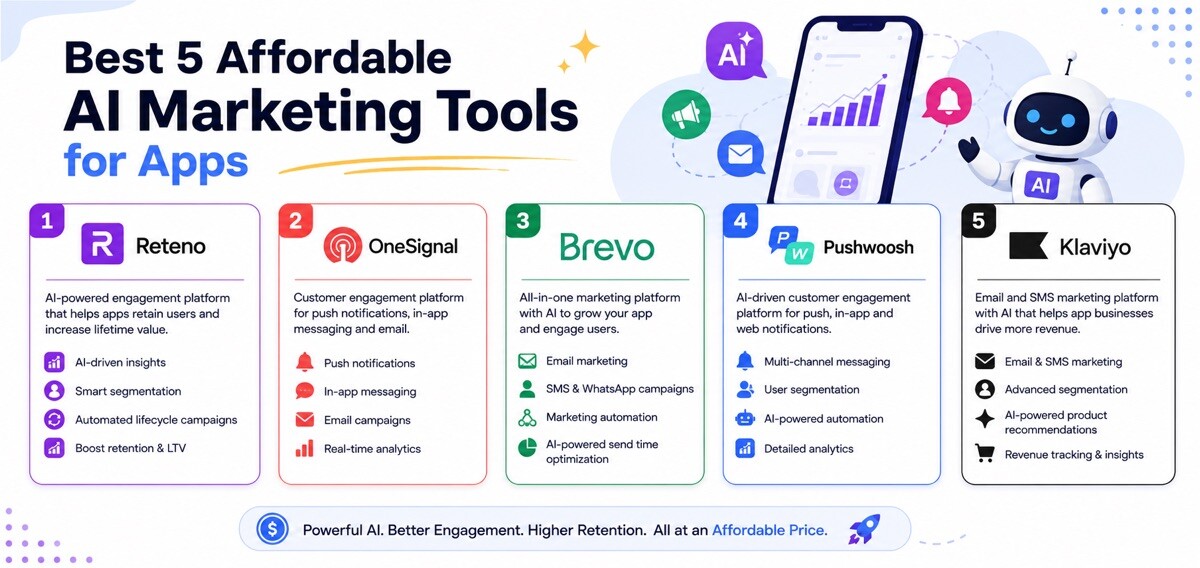
5 Best Affordable AI Marketing Tools for Apps: Features, Pricing & How to Use in 2026

The best AI marketing tools for applications to try in 2026 look as follows. This is Reteno, which helps to convert free and trial users into fee-based subscribers; OneSignal, with a variety of messaging tools. You can also try Brevo, which allows unifying communication between users; Pushwoosh, with its flexibility; and Klaviyo to run complete AI-powered campaigns.
All the developers and marketers who want to optimize their campaigns should use AI tools, but it can be challenging to choose from a variety of options saturated with AI promises. This guide focuses on 5 cost-efficient marketing automation tools for apps that will surely help to grow efficiency, increase decision speed, and improve the quality of customer experience.
What Are AI-Powered Marketing Tools for Apps?
AI marketing tools for applications are examples of software that provide developers with the possibility to get more users, engage them, and improve retention/revenue more effectively. Thanks to the possibility to analyze large amounts of data, due to AI integration in particular, they allow for optimizing marketing strategies quickly and act as data-driven growth engines that combine analytics, automation, and personalization in attracting and retaining users.
What makes a good AI marketing tool? It should have various features, including predictive analytics, deep personalization, automation possibilities, smart recommendations, enough integrations, and fast responsiveness. The tools listed in this article have many useful features and strengths, so all this makes them outstanding in the AI-driven marketing sphere.
1. Reteno
Reteno is an AI messaging platform for mobile app retention built specifically for subscription-based mobile apps that should convert free or trial users into paying users and maximize customer lifetime value. Unlike automated AI messaging platforms used by e-commerce and B2B platforms, Reteno is built especially for mobile app monetization realities.
Marketers can cope with template editing, contacts and segments management, sending events, reviewing analytics, and launching campaigns using natural language commands.
Reteno’s playbooks are designed to reflect the real growth of subscription applications, prioritizing essential workflows including the recovery of abandoned subscriptions, onboarding sequences, reminders for trial expiration, nudges for feature adoption, and win-back initiatives.
You launch multiple message variants, the system learns from engagement signals, and automatically promotes stronger-performing messages over time.
The tool creates push notification examples and their multilingual versions directly inside workflows. Proven playbooks incorporate category-specific best practices for habit formation, milestone celebration, streak preservation, and content consumption patterns.
Key Features:
- It supports comprehensive omnichannel messaging: email, mobile push, in-app messages, App Inbox, SMS, web push, messengers, plus personalization for both app and web experiences.
- “One from Many” block automates variant testing inside live workflows.
- Reteno enables teams to manage entire campaigns through AI agents integrated directly into Slack, Claude Cowork, and OpenAI Codex.
- The tool has a deep specialization in Health & Fitness and Education.
Benefits: The tool’s AI develops new recommendations focused on the most effective messages. It enables teams to improve their creative testing. The AI deals with translation, editing, and improvement of the text within the email editor, so it leads to the launch of optimized campaigns in multiple languages and markets.
Drawbacks: Reteno has its limitations, which include the necessity for technological proficiency to implement the tool, a few available integrations, and some features that are currently only in the preview stage.
Best for: Subscription app teams that consider messaging a revenue lever. It is very valuable for Web2App funnels where emails bridge web acquisition and in-app conversion, applications with free trial or freemium models that require a sophisticated lifecycle nurture.
Pricing: The startup is free with 1,000 sends and 25,000 workflow launches. The growth package costs $30 and offers unlimited workflows, 8 channels, and up to 10k user profiles. Enterprises have special, customizable offers.
2. OneSignal
OneSignal is one of the customer retention platforms known for its push notification services. It has grown into an omnichannel tool that helps businesses with the management of mobile push, web push, email, SMS, and in-app messaging using one dashboard. It has optimization, audience engagement, campaign management, and automation possibilities.
Key features:
- Automation with the help of a visual workflow builder
- Segmentation to group users based on data tags and real-time behavior
- Testing of different headlines, images, or delivery times
- Ease of setup
- Support for exclusive RCS messages with a 60% higher conversion rate and 3x higher click-throughs
Benefits: OneSignal has a variety of messaging tools, verified sender profiles, the possibility to send time-sensitive campaigns, actionable insights that allow measuring with read receipts and click performance, and a high level of spam protection.
Drawbacks: Despite a free trial, you can soon outgrow it and will have to pay the bill regularly, even if it doesn’t provide the necessary results caused by possible app lurkers. The tool also uses a third-party SDK where user data is stored, so it may lead to privacy and security concerns. The use of these SDKs also results in possible app lags since native solutions show better results.
Best for: It is a perfect tool for businesses that look for a high speed of implementation and ease of use. Marketers who plan to run complex campaigns without developer assistance, who need a Minimum Viable Product, and who rely on real-time engagement will also benefit from this tool.
Pricing: Self-service plans can be free if you are satisfied with 10,000 monthly emails, unlimited mobile push sends, journey workflows, GDPR compliance, and A/B testing. The Growth plan starts with $19 a month, while annual enterprise and professional plans are calculated personally.
3. Brevo
Brevo is defined as a CRM and marketing automation platform that allows unifying communication between users across multiple channels. It can be compared with a central brain for sales and marketing teams, not only thanks to being an example of push notification tools but also because it combines email, SMS, WhatsApp, and a Sales CRM into one interface.
Key features:
- Automated multi-channel customer journeys
- Powerful sales management
- An exclusive data platform with unified and activated customer details
- Fully integrated rewards programs
- Integration with 150+ digital tools
Benefits: This tool features a drag-and-drop editor and a large library of templates, a visual workflow builder that triggers actions based on user behavior, and real-time chatbots with a centralized inbox. You can take advantage of a robust API/SMTP service for critical alerts and a separate sales CRM that includes lead tracking, deal pipelines, and task management.
Drawbacks: The main problem mentioned by Brevo customers is connected with the way Brevo copes with collaboration. A majority of entry-level plans support only one login, while small teams have to share one password to save money. The daily limit for a free plan is very small, and you can use only email support there. There is limited creative flexibility, too.
Best for: Brevo is a perfect option for businesses with a large contact list that talk with customers using different platforms. This tool will also be useful for e-commerce websites and B2B companies looking for cheaper solutions.
Pricing: There are 4 plans to choose from in Brevo. The cheapest one is $8.08 per month if paid annually. A Standard plan is $16.17 a month, and a professional plan costs $449.08.
4. Pushwoosh
Pushwoosh is one more mobile push notification service that allows delivering messages instantly and reaching millions. Being an omnichannel customer engagement platform, it supports messaging by push notifications, in-app communication, email, SMS, and WhatsApp. The Pushwoosh platform comprises 3 components: the SDK, the API, and the Pushwoosh Control Panel.
Key features:
- The Pushwoosh SDK supports many different integrations
- Access to over 100 methods with the Pushwoosh API
- A special user interface to manage all data and interactions
- High-utility delivery features
- A suite of AI tools that help to generate texts, personalize content, and adapt it to different locations
Benefits: Pushwoosh is a more powerful tool with several key benefits, including a massive scale, advanced automation, and deeper data retention. It is built for speed with over 500k push notifications per second. The tool is also more flexible in terms of the number of journeys and the time period it keeps event data (for a year).
Drawbacks: It may take from 2 to 10 days on average to set up and fully integrate the platform, and the latest version updates can be clunky. It can also be challenging to predict the total cost of Pushwoosh services because of many extra-paid options. And the AI features won’t work effectively if you have a low engagement rate and if you don’t tag your events correctly.
Best for: It is preferred by businesses that have already passed the start-up phase and look for a high-performance automated communication engine. It will be a perfect choice for high-volume media and news apps, mobile gaming companies, global enterprises that have cross-channel needs, and teams that deal a lot with AI.
Pricing: You can start as a pay-as-you-go client and get access to all of the features. Those who prefer prepaid plans can opt for omnichannel support for up to 1,000 monthly users at $13 a month, while the email-only option costs $5.
5. Klaviyo
Klaviyo is an AI agent that creates complete on-brand campaigns from a prompt. Thanks to autonomous B2C CRM, it is possible to transform marketing into an always-on growth engine through such user engagement platforms. It combines a system of record and a system of action to be not only a customer data platform but also to offer real-time signals and AI power to execute campaigns in one click.
Key features:
- It integrates customer data and streamlines communication through different channels.
- Automation entails a welcome series, emails addressing abandoned carts, notifications for browsing abandonment, follow-up messages after purchases, win-back strategies, and other related activities.
- Improved segmentation of the audience.
- Comprehensive analytics and reporting functionalities.
Benefits: The platform boasts 350+ built-in integrations and combines user data, automation, analytics, and communication in one platform. It allows developing highly relevant campaigns and generating income with minimal manual work. It features more personalization and a high ROI potential, too.
Drawbacks: As your list continues to expand, the costs related to Klaviyo services increase. This tool is not tailored for novices, and there have been instances of dissatisfaction regarding the quality of customer support. Additionally, it requires consistent maintenance and can negatively impact deliverability if not managed correctly.
Best for: This is an outstanding solution for organizations that depend on customer loyalty, repeat transactions, and e-commerce marketing. It offers comprehensive integration with Shopify and is particularly advantageous for DTC brands.
Pricing: It has a free plan with core features, but even if you decide to get a more attractive plan, the cost will depend on the feature set, ranging from $20 to $720 a month.
| Tool | Primary strength | Pricing | Channel coverage | AI personalization | Best team size |
| Reteno | Focus on subscription-based mobile apps | From free to $30 a month | Email, mobile push, in-app messages, App Inbox, SMS, web push, messengers | Strong | Small to mid-sized teams |
| OneSignal | One dashboard for all solutions | From free to $19 a month | Mobile push, SMS, web push, emails, in-app messages | Moderate | Small to mid-sized teams |
| Brevo | Beginner-friendly interface | From $8 to $449 | Email, SMS, WhatsApp, push notifications | Moderate | From small to large enterprises |
| Pushwoosh | Incredible speed of response and notifications | From pay-as-you-go to $10 a month | Push notifications, in-app communication, email, SMS, and WhatsApp | Strong | Large enterprises |
| Klaviyo | A wide variety of integrations | From free to $720 a month | Email, SMS, RCS, WhatsApp, and mobile push | Strong | Performance teams of all sizes |
Final Thoughts
The following tools serve one common goal to improve customer engagement and maximize retention, but each of them may come in handy to companies of various sizes and with different levels of marketing sophistication. If you browse the features and benefits of these tools, you can find out that they offer a full spectrum of solutions ranging from lightweight mobile engagement to cost-efficient all-in-one marketing, advanced e-commerce personalization, and revenue optimization.