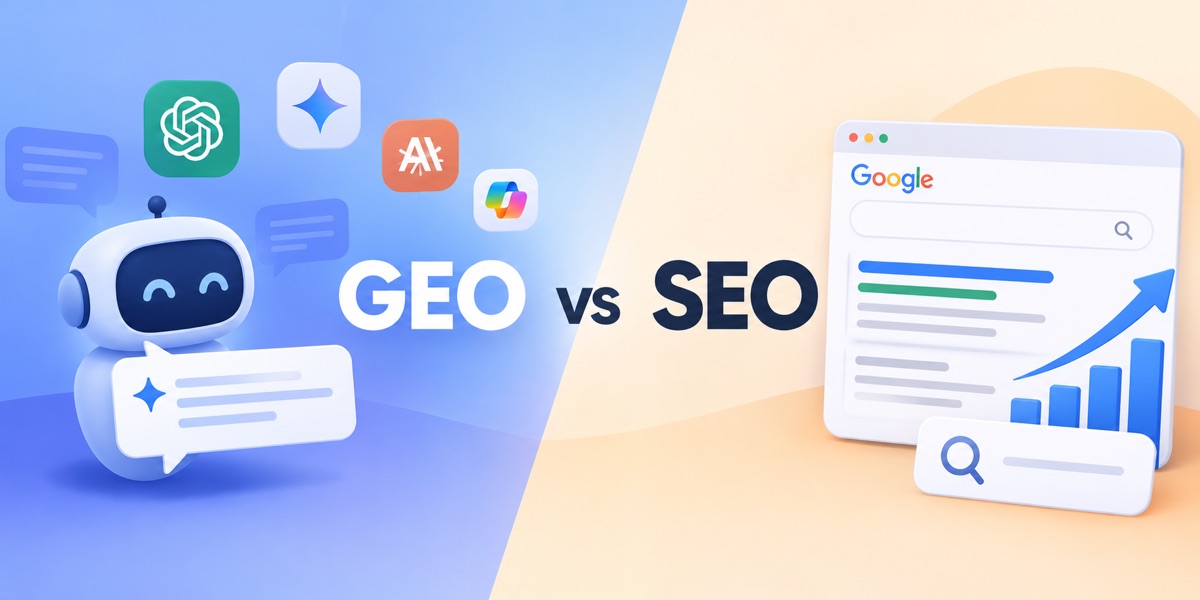
GEO vs SEO: What WordPress Websites Need to Know About AI Search

WordPress powers over 43% of all websites. Despite that dominance, most WordPress sites remain invisible to AI-generated answers, not because WordPress is a bad platform for AI search, but because the owners of those sites are still optimizing exclusively for the search landscape of 2020 rather than the one that exists in 2026.
Ahrefs found that AI Overviews reduced click-through rates for top-ranking Google content by 58%. ChatGPT processes 2.5 billion prompts daily, with 65% qualifying as search, and the platform has a 96% lower click-through rate than Google. The traffic that used to flow through organic rankings is increasingly being absorbed by AI-generated answers that never send the user to a website at all.
This isn’t an argument for abandoning SEO. It’s an argument for understanding what has changed and what WordPress sites need to do differently to remain visible as search behavior continues to shift.
Introduction
Generative Engine Optimization (GEO) is the practice of optimizing content to appear as authoritative sources or direct responses within generative AI platforms like ChatGPT, Claude, Gemini, and Perplexity. Unlike traditional SEO, which focuses on ranking in search engine results pages to earn clicks, GEO aims to position your content as the primary source that AI engines reference when generating answers. The goal shifts from earning a click to having your information included in the AI’s response.
For WordPress website owners, understanding GEO vs SEO is particularly important for two reasons. First, WordPress powers roughly 40% of the web, which means the decisions WordPress users make about optimization at scale affect how a huge proportion of content is discovered by AI systems. Second, WordPress’s architecture, flexibility, and plugin ecosystem make it uniquely positioned to implement both traditional SEO and GEO effectively, but only when site owners know what to optimize for.
This guide explains the practical difference between GEO and SEO, what the data shows about how AI citation works, and the specific WordPress-level changes that improve AI search visibility.
The Core Difference: Rankings vs Citations
The fundamental difference between SEO and GEO is what success looks like.
Traditional SEO: Optimize for visibility in search results → Earn clicks → Convert users on your site. GEO: Optimize to be the authoritative source → Get cited in AI responses → Build brand recognition and authority. Generative engines don’t prioritize sending traffic to external websites.
This distinction has a significant practical implication. In traditional SEO, position one on Google drives traffic. In GEO, being cited in a ChatGPT or Perplexity response may drive brand awareness, trust, and indirect traffic, but often doesn’t produce a direct click. The value equation is different.
Roughly 58 to 60% of Google searches now end without a click. AI Overviews and AI Mode are absorbing a growing share of search behavior in 2026.
And critically, GEO and traditional SEO are correlated but not the same system: one analysis found roughly 80% of AI-cited sources don’t appear in a query’s traditional Google top results. This is the uncomfortable finding for sites that have invested heavily in traditional SEO: ranking well on Google does not guarantee presence in AI answers.
Nearly 40% of Google’s AI Overviews do rank in the top 10 organic search results, and nearly 70% rank in the top 100. So for Google’s own AI features, strong SEO still matters. But for external AI platforms like ChatGPT and Perplexity, the correlation between traditional rankings and AI citation is much weaker. Sites need both strategies, not a choice between them.
Why Most WordPress Sites Are Invisible to AI Search
WordPress powers over 43% of all websites, yet the vast majority remain invisible to AI-generated answers because they rely on outdated SEO tactics.
The specific reasons WordPress sites underperform in AI search fall into several predictable categories:
Bloated HTML from page builders. AI systems need clean semantic markup to extract and cite content accurately. Native Gutenberg blocks produce cleaner HTML than bloated page-builder code. Sites built with heavy page builders often have deeply nested div structures, inline styles, and non-semantic markup that makes it significantly harder for AI crawlers to understand what the content is actually about.
Missing or misconfigured schema markup. Structured data tells AI systems, and search engines, what type of content a page contains and what its key entities are. Most WordPress sites have little or no schema markup beyond basic plugin defaults, leaving AI systems to infer page structure from HTML and text alone.
AI crawlers accidentally blocked. Many WordPress sites block AI crawlers inadvertently. Sites behind Cloudflare may have the AI bot blocking feature enabled by default, and robots.txt configurations that were set up years ago may be blocking OAI-SearchBot, PerplexityBot, or other AI crawlers without the site owner being aware.
Content formatted for readers, not for extraction. Traditional web content is often written as flowing prose designed to be read by humans and scanned for keywords by traditional search algorithms. AI systems extract specific answers to specific questions. Content not structured to surface clear, direct answers is harder for AI to use.
Thin off-site presence. AI systems don’t only look at a site’s own content when deciding what to cite. They assess the broader web’s treatment of a brand: how often it’s mentioned in third-party publications, what’s said about it, and whether authoritative sources reference it. A WordPress site with strong on-page content but minimal off-site presence has weaker AI citation signals than one with distributed authority across the web.
What the Research Shows About AI Citation Signals
The term GEO was formalized in a 2024 academic paper by researchers from Princeton, Georgia Tech, and the Allen Institute, presented at ACM SIGKDD 2024, who found that specific content-level changes, not backlinks and not keyword density, measurably increased how often a page was cited inside AI-generated answers.
The research identified several content characteristics that improve AI citation probability:
Expert quotes and attributed statements increased citation probability by 41% in the Princeton research. AI systems use quotation marks and attribution as proxies for credibility. Content that includes attributed expert perspectives is significantly more likely to be cited than content making the same claims without attribution.
Statistics and specific data points increased citation probability by 30%. Concrete, verifiable data signals factual density that AI systems favor when constructing synthesized answers.
Inline citations to external sources increased citation probability by 30%. Content that itself cites authoritative external sources creates a chain of trust that AI systems respond to. Showing your sources matters.
Keyword stuffing reduced citation probability by 9%. Content with unnatural keyword density is detected through linguistic pattern analysis and performs worse in AI citation contexts.
These findings are significant because they align with what makes content genuinely useful to human readers, not with the kind of gaming tactics that have sometimes worked in traditional SEO. The content that AI systems want to cite is content that demonstrates expertise, accuracy, and appropriate sourcing.
WordPress-Specific GEO Optimizations
Understanding the general principles of GEO is the starting point. Implementing them on WordPress requires specific, platform-level actions.
1. Verify AI Crawlers Can Access Your Site
Before any content optimization matters, AI systems need to be able to crawl and index the site.
Check your robots.txt file (accessible at yoursite.com/robots.txt) and verify it doesn’t block relevant AI crawlers. The user-agents to check for include: OAI-SearchBot (ChatGPT), PerplexityBot, GoogleBot (for AI Overviews), Applebot, and others from AI platforms you want to be cited by. An accidental disallow rule for these crawlers prevents any GEO optimization from having effect.
If your site uses Cloudflare, verify that the AI bot blocking feature is not enabled, as it may have been turned on by default without your awareness.
2. Implement Comprehensive Schema Markup
Schema markup is structured data that tells AI systems and search engines what your content is and what it represents. Schema significantly improves AI understanding of your content.
For most WordPress sites, the priority schema types are:
Organization schema on the homepage and sitewide: defines what your organization is, what it does, its name, logo, contact information, and social profiles. This is foundational entity definition that helps AI systems understand what your site represents.
Article schema on blog posts and content pages: defines the article title, author, publication date, and modification date. The modification date is particularly important, as pages not updated quarterly are three times more likely to lose AI citations.
FAQPage schema on pages with question-and-answer content: this is one of the highest-impact schema types for AI search because AI systems are specifically looking for direct answers to questions, and FAQ schema explicitly marks up that structure.
Person schema for author pages: author authority matters for AI citation. Linking content to clearly defined author entities with credentials and expertise helps establish the E-E-A-T signals AI systems evaluate.
For WordPress, Yoast SEO, Rank Math, and Schema Pro are the most commonly used schema plugins. Rank Math’s schema implementation is comprehensive and well-regarded. For sites that need granular control over schema beyond what major SEO plugins provide, Schema Pro handles more complex schema implementations.
Rank Math and Yoast remain excellent choices for meta tags, sitemaps, and on-page keyword analysis. Use these for technical SEO hygiene and schema implementation.
3. Restructure Content for Direct-Answer Extraction
GEO aims to include your content, brand, or site in the pool of sources AI systems draw from when generating an answer, summary, or recommendation. AEO is more specifically about making a piece of content easy to extract as a direct answer.
For WordPress content, this means structuring posts and pages so that AI systems can identify and extract a clear answer to a specific question without reading the entire page.
Practical implementations:
- Open each major section with a direct, concise answer before providing supporting context (inverted pyramid structure)
- Use H2 and H3 headings that are phrased as the questions your content answers
- Keep the first paragraph of each section to two to three sentences that can stand alone as a coherent answer
- Add dedicated FAQ sections with question-and-answer structure for the most commonly searched questions in your topic area
- Use bullet points and numbered lists for multi-part answers that AI systems can extract and present cleanly
4. Use Gutenberg Blocks Over Heavy Page Builders
Clean semantic markup improves AI content extraction. Native Gutenberg blocks produce cleaner HTML than bloated page-builder code. Developers building modern React-based interfaces can similarly use reusable Shadcn blocks to assemble cleaner, more consistent application and website layouts without rebuilding common UI patterns from scratch.
This doesn’t mean sites built with Elementor, Divi, or other page builders can’t achieve good GEO performance, but it does mean paying attention to the HTML output. Sites using heavy page builders should audit whether the underlying HTML structure is semantically clean or deeply nested and div-heavy in ways that obscure content meaning.
For new WordPress sites or major rebuilds, using Gutenberg as the primary editor produces cleaner markup by default. For existing page-builder sites, focusing GEO optimization on content structure (headings, paragraph structure, schema markup) is often more practical than a full page-builder migration.
5. Build Topical Authority With Content Clusters
Search engines now understand entities rather than just keywords. Instead of targeting a single keyword, GEO focuses on topic relevance and contextual relationships.
For WordPress sites, this means building content clusters around core topics rather than creating isolated posts targeting individual keywords. A site that has comprehensive, interlinked coverage of a topic area, with pillar pages supported by detailed cluster posts, signals topical authority to both traditional search engines and AI systems.
AI systems evaluate whether a source has genuine expertise in a topic by assessing how comprehensively and consistently a site addresses that topic. A WordPress site with three posts on a topic signals a different level of authority than one with thirty well-organized, interlinked posts covering the topic from multiple angles.
6. Add Genuine Expertise Signals to Content
Based on the Princeton research findings, content with attributed expert perspectives, specific data points, and inline citations performs measurably better in AI citation contexts.
For WordPress content, this translates to:
- Including quotes from named experts with their credentials identified
- Citing specific statistics with their sources (linked to the original source)
- Adding inline citations to authoritative external sources within the body content
- Publishing under named author bylines with author pages that establish credentials (not “admin” or anonymous)
- Including the author’s relevant expertise, credentials, and experience on the author page with Person schema markup
These aren’t just GEO tactics. They’re the content quality signals that Google’s E-E-A-T framework has emphasized for years, now also proven to improve AI citation probability.
Optimizing a WordPress website for traditional and AI-driven search should not come at the expense of the people who eventually visit it. Alongside accessible development, regular testing, and ongoing remediation, a WordPress accessibility plugin can provide additional visitor-facing options such as keyboard navigation support, text adjustments, contrast controls, and reading aids.
7. Maintain Content Freshness
Pages not updated quarterly are three times more likely to lose AI citations. This is a significant finding that changes how WordPress content management should be approached.
The traditional SEO approach to content maintenance was often “publish and forget” for evergreen content. In an AI search context, freshness signals matter more. A quarterly content audit process that updates key pages with new statistics, adds recent examples, and refreshes the publication date to reflect genuine updates maintains the freshness signals that AI systems evaluate.
WordPress’s native last-modified date functionality, combined with properly configured Article schema that includes the dateModified field, communicates content freshness to AI crawlers.
8. Build Off-Site Presence and Unlinked Brand Mentions
GEO and SEO overlap in many areas, but GEO content must be conversational and contextually relevant while relying on off-site authority signals that go beyond traditional backlinks.
For AI citation specifically, brand mentions in authoritative contexts matter even without a traditional backlink. Being mentioned in industry publications, having the brand discussed in relevant community forums,appearing in podcast transcripts indexed by AI systems, and generating authentic user reviews and ratings, particularly valuable for an online marketplace, all contribute to the off-site authority signals that influence AI citation probability.
WordPress sites that focus exclusively on on-page optimization while neglecting off-site presence build half the foundation that AI citation requires.
What GEO and SEO Have in Common
GEO and SEO should work together to boost search visibility. Both strategies require high-quality content that provides value to users and the information they want to know.
The overlap is significant and reassuring for WordPress site owners who may be wondering if they need to abandon their SEO investment to pursue GEO. The practices that produce the best traditional SEO outcomes, high-quality content, topical authority, technical accessibility, and genuine expertise signals, also produce better GEO outcomes.For established brands such as ZenBusiness, maintaining these signals across both traditional and AI search can help support consistent online visibility. The additions that GEO specifically requires, direct-answer formatting, schema markup, AI crawler accessibility, and off-site presence building, are additive to a strong SEO foundation rather than replacements for it.
Having an integrated GEO and SEO strategy involves optimizing your content and website for people and search engines together.
For WordPress site owners, the practical message is: don’t choose between SEO and GEO. Maintain your traditional SEO practices and add the specific optimizations that AI search requires. The WordPress ecosystem, with its mature plugin infrastructure and flexible content management, is well-positioned to support both.
Measuring GEO Performance on WordPress
Traditional SEO measurement, tracking keyword rankings, organic traffic, and SERP position, doesn’t capture GEO performance. A site could be gaining AI citation and brand visibility while seeing flat or declining traditional traffic metrics, and never know it from standard analytics.
GEO measurement requires different approaches:
Manual prompt testing: Regularly query the major AI platforms (ChatGPT, Perplexity, Google AI Mode, Gemini) with the questions most relevant to your site’s topics and track whether and how your site appears. Document your brand’s presence and the sources that are cited in your place for queries you should be answering.
Branded search volume: Increasing branded search on Google is often a downstream signal of growing AI visibility, as users who encounter the brand in an AI response frequently validate by searching the brand name on Google before visiting. Rising branded search volume without a corresponding PR campaign often indicates growing AI citation presence.
Direct traffic trends: Users who encounter a brand in an AI answer and visit directly (typing the URL or searching the brand name) appear as direct traffic in analytics. Growth in direct traffic correlating with GEO optimization efforts is a meaningful signal.
Referral traffic from AI platforms: Some AI platforms (Perplexity in particular) do send referral traffic when users click through cited sources. Monitoring referral traffic from AI platform domains (perplexity.ai, chatgpt.com) tracks the direct traffic impact of AI citation.
Conclusion
GEO vs SEO for WordPress websites is not a competition between two strategies where one replaces the other. It’s an expansion of what optimization means in a search landscape where AI-generated answers are absorbing an increasing share of search behavior.
Optimizing a WordPress site for AI search means making content easy for AI systems to crawl, extract, and cite, not just easy for Google to rank. In practice, that means clean semantic markup, structured data with Organization, Article, FAQPage, and Person schema, direct-answer content formatting, verified statistics with clear sourcing, and confirming AI crawlers aren’t accidentally blocked.
The WordPress sites that will maintain and grow their search visibility over the next several years are the ones that don’t treat GEO as a replacement for SEO, and don’t treat SEO as sufficient on its own. They implement both, they measure both, and they continuously improve both as the search landscape continues to evolve.
The changes required are achievable on WordPress without a platform migration or a full site rebuild. A clear robots.txt, schema markup through existing plugins, content restructured for direct-answer extraction, and a systematic approach to freshness and off-site authority building are all within reach for any WordPress site owner or content team. Start there, and the AI visibility gap that most WordPress sites currently have starts to close.