How Does an AI Detector Work | Comprehensive Guide

AI detection tool is designed to spot differences between AI-generated and human writing. But how does an AI detector work, what exactly does it analyze, and how much can you trust the final score? In this guide, you’ll find answers to these questions and learn what happens behind the scenes when a detector analyzes your text.
How Does AI Content Detector Work?
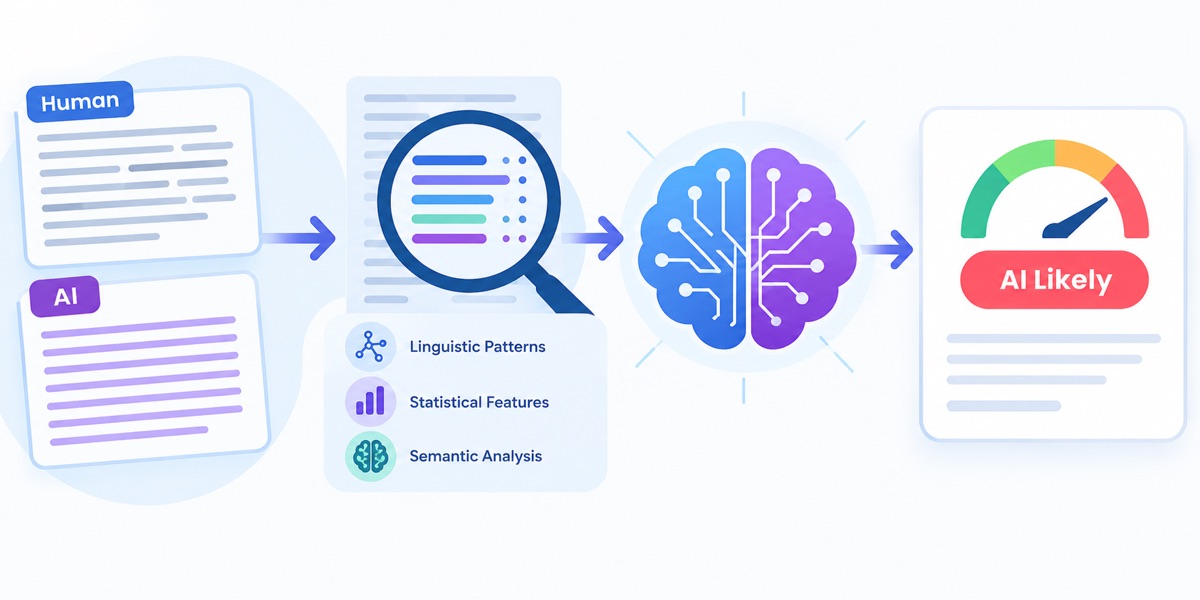
There is no universal algorithm behind every tools to detect AI generated text. Research describes several approaches, including statistics-based detection, neural classifiers, and watermarking. Regardless of the method, the process can be simplified into the following pipeline:
Text > Tokenization > Feature or Probability Extraction > Detection Model/Test > Score > Threshold > Classification
The main difference is what the AI writing detector calculates in the middle.
1. Token Probability and Likelihood
A language model calculates the probability of each token based on the preceding context:
P(xᵢ | x₁,…,xᵢ₋₁)
Here, xᵢ is the current token, while x₁,…,xᵢ₋₁ represents the tokens that came before it.
From these probabilities, detection methods can derive token probability, token rank, entropy, log-likelihood, and perplexity. Instead of simply deciding that a text is predictable, they can measure how probability is distributed across individual token choices.
For example, GLTR analyzes where observed tokens rank among a language model’s predicted next-token choices. Its researchers examined token probability, absolute rank, and the entropy of the model’s prediction distribution.
2. Probability Curvature
DetectGPT takes a different approach. It creates small variations of the original passage and compares their log probabilities:
score(x) = log p(x) − (1/k) Σ log p(x̃ᵢ)
Here, x is the original text, x̃ᵢ is a modified version, k is the number of variations, and p(x) is the probability assigned to the text by the language model.
The research found that machine-generated passages tend to occupy negative-curvature regions of a model’s log-probability function. In simple terms, the detector measures how the probability of the original changes relative to nearby versions of the same text.
One more research makes this process more efficient by using conditional probability curvature instead of repeatedly creating rewritten passages. The researchers reported about a 340× speedup over DetectGPT in their experiments.
3. Neural Classifiers
Another approach is to train a classifier on labeled human and AI-generated texts:
D = {(xᵢ, yᵢ)}
Here, xᵢ is a text and yᵢ is its label:
0 = human
1 = AI
A transformer can encode the text into a numerical representation:
h = Transformer(x)
A classification layer then converts it into a score:
P(AI|x) = σ(Wh + b)
Here, h is the learned representation, W and b are parameters learned during training, and σ converts the output into a probability-like value.
The detector doesn’t necessarily follow manually defined rules such as “low burstiness = AI.” Instead, it can learn combinations of statistical, lexical, syntactic, and semantic characteristics from its training data.
4. Stylometric Detection
This method represents measurable writing characteristics as a feature vector:
F(x) = [f₁, f₂,…,fₙ]
Here, each f represents a feature such as vocabulary diversity, n-gram frequency, POS patterns, sentence-length variance, punctuation, entropy, or repetition.
These values can then be passed to a statistical or machine-learning classifier. A 2025 study discusses statistical and stylistic analysis alongside machine-learning classification as approaches to AI-generated text detection.
5. Watermark Detection
Watermarking works differently because the detection signal is inserted while the text is generated. One approach divides possible next tokens into pseudorandom groups:
V = Vgreen ∪ Vred
Here, V is the vocabulary, while Vgreen and Vred are two groups of possible tokens. The generator slightly increases the probability of selecting green-list tokens.
Across a sufficiently long text, this produces a statistical pattern. A detector can test whether the number of green tokens is significantly higher than would be expected by chance.
From Detection Signal to AI Score
After extracting the relevant signal, the system has to turn it into the result you see:
Features or Statistics > Model/Test > Raw Score > Calibration > Threshold > Classification
For a neural classifier, for example, the model may output a probability such as P(AI|x) = 0.82. The detector can compare that value with a decision threshold to classify the passage as Human or AI-generated. Some detectors can also calculate sentence-level scores and aggregate them into a document-level result.
Is an AI Detector Accurate?
AI content detectors aren’t 100% accurate. Its results are estimates rather than definitive proof of who wrote a text.
Two main types of errors can occur:
- False positives. Human-written content is incorrectly classified as AI-generated.
- False negatives. AI-generated content is incorrectly classified as human-written.
The interpretation depends on the detector’s model, calibration, thresholds, and how the service chooses to present its internal score. So, the same passage can receive different scores across detectors. For this reason, an AI detection score is better used as an additional signal alongside human review rather than standalone evidence of authorship.
How to Reduce AI Detection in Your Text
A high AI score can be a reason to review how the text reads. Focus on making the content more specific, varied, and reflective of your own input.
- Bring in your perspective. Add details, examples, conclusions, or observations that come from you.
- Vary sentence rhythm. Combine short and longer sentences and change their structure where the writing feels too uniform.
- Remove repetitive language. Rewrite recurring transitions, phrases, and similar ways of presenting information.
- Revise larger sections. You can humanize your AI text with dedicated tools when several paragraphs need more natural wording and flow.
- Work on individual passages. Use a tool to paraphrase a sentence or entire text if you want more control over how individual sentences or passages are rewritten.
Once you finish editing, check your work again through the website to detect AI-generated text to see how the revised version is classified.
Conclusion
AI detectors use linguistic and statistical signals to estimate whether text resembles human or AI writing. While these tools can provide helpful insights, their scores aren’t definitive. Use detection results as a starting point for review, then focus on improving clarity, variety, and your own input rather than chasing a specific score.
Frequently Asked Questions
Can AI detectors tell exactly who wrote a text?
No. An AI detector doesn’t identify the author or see the writing process. It only indicates the likelihood of who wrote the text based on certain signals.
How does an AI detector evaluate text?
An AI detector evaluates linguistic and statistical signals such as word predictability, sentence variation, vocabulary, syntax, and repetition. It processes these signals together and converts the analysis into a detection score or classification.
Why do different AI detectors give different results?
Each detector relies on its own training data, models, analyzed features, and classification thresholds. As a result, the same text can receive a high AI score from one tool and a much lower score from another.
Can human-written text be detected as AI?
Yes. This is known as a false positive. Certain characteristics of human writing can resemble patterns a detector associates with generated content, which can lead to an incorrect classification.