I Thought Teaching My Kids How to Draw Was Impossible — Until We Tried This

For a long time I avoided drawing with my children. Not because I disliked it, but because every attempt ended the same way. They would ask me to show them how to draw a dog or a rocket or a princess, I would start with good intentions, and within five minutes the paper would be covered in frustrated scribbles and someone would be close to tears. Usually me.
I had tried the usual routes. Fancy drawing books that jumped straight into shading and proportion. YouTube videos that moved too fast. “Just practice” advice that sounds wise until you’re sitting across from a six-year-old who believes she is bad at something after one attempt. None of it stuck. Drawing felt like a talent you either had or didn’t.
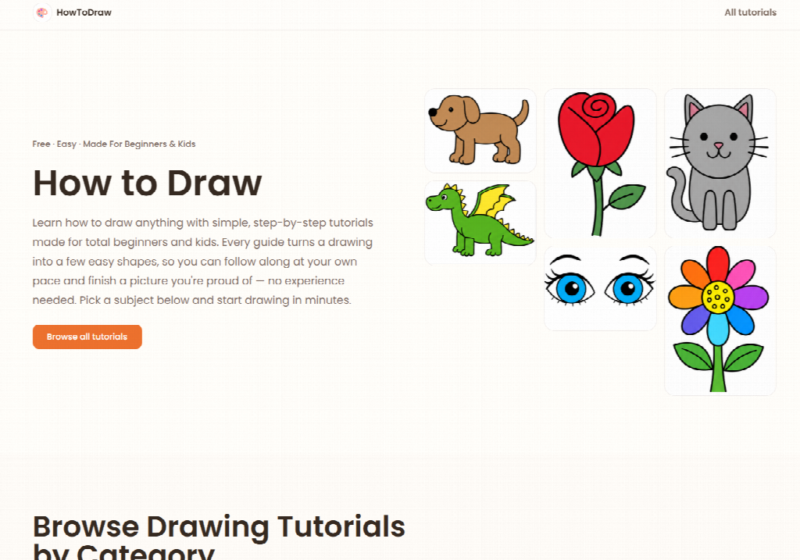
Then I stumbled on a site that approached the whole problem differently: How To Draw. What changed wasn’t my children’s ability overnight. It was the way the tutorials removed the fear of the blank page.
The Problem Most Beginners Actually Face
Most drawing instruction assumes a level of confidence that absolute beginners simply do not have. Traditional lessons often start with observation, construction lines, or “loosen up your hand.” That language works for people who already feel comfortable making marks. For kids (and many adults), it creates pressure.
My older daughter used to erase so hard the paper tore. My younger one would declare the drawing “ugly” before it was halfway done. The real barrier wasn’t skill. It was the gap between the finished image in their heads and the uncertain lines on the paper.
Discovering a Different Way to Learn How to Draw
The site breaks every subject into a short sequence of simple shapes. A cat begins as a circle and two triangles. A car starts with a long rectangle and two circles. Each step adds only a few lines, and the pictures are large and clear. There is almost no technical language.
We started with animals because that was what the kids wanted. The first successful drawing was a simple penguin. It took maybe eight or nine steps. When my daughter finished the last line and realized it actually looked like a penguin, she laughed — the kind of surprised laugh that means the result exceeded her expectations. That small win mattered more than any lecture about practice.
We kept going. Over the next few weeks we worked through dogs, fish, ice cream cones, and a surprisingly respectable dinosaur. The tutorials never demanded perfect proportions or fancy techniques. Flat color was encouraged. Shading was optional and usually skipped. The goal was a finished picture that the child could recognize and feel proud of.
Why the Step-by-Step Structure Works
The method succeeds because it removes decision fatigue. When a child is told “draw a dog,” the number of choices is overwhelming. Where does the head go? How long should the legs be? What if it looks wrong? By reducing each stage to one or two clear actions, the tutorials keep the brain in a state of mild challenge rather than overwhelm.
This matches something researchers have observed about drawing and mood. A 2021 study published in Frontiers in Psychology found that drawing improves children’s short-term mood more effectively when it is used as a form of distraction rather than emotional expression. The key was absorption and enjoyment. Children who became engaged in the activity itself showed greater mood improvement. Structured, achievable steps make that absorption much more likely, especially for beginners who would otherwise get stuck.
In our house the difference was visible. Drawing time stopped being a source of tension and became something the kids asked for. Even on tired evenings they would pick a new tutorial and settle in with paper and markers.
What Changed for the Adults Too
I had always considered myself someone who “couldn’t draw.” Using the same tutorials alongside my children quietly dismantled that story. When the steps are broken down this clearly, adults benefit as much as kids. I found myself finishing small drawings during quiet moments and feeling a mild sense of competence I had not expected.
For parents and teachers this has practical value. You do not need to be a skilled artist to guide a child through these lessons. You only need to sit beside them, point to the next step, and resist the urge to “fix” their lines. The site even notes that the same simple style works for classroom use and for adult beginners who never learned as children.
Practical Observations After Several Months
A few patterns emerged once the novelty wore off and drawing became a regular habit.
First, confidence transferred. Children who completed several guided drawings became more willing to attempt freehand sketches afterward. The structured success seemed to lower the emotional cost of experimentation.
Second, the short length of each tutorial helped. Most took between six and fifteen steps and could be finished in under fifteen minutes. That made them realistic for short attention spans and for busy evenings.
Third, the lack of pressure around “art quality” mattered. Because the site emphasizes simple shapes and flat color, children did not compare their work to professional illustrations. They compared it to the previous step, which is a much kinder standard.
Who This Approach Serves Best
This style of instruction is especially useful for three groups:
- Young children who want quick, satisfying results
- Parents who want a low-stress shared activity that does not require artistic skill
- Adult beginners who carry years of “I’m not creative” beliefs
It is less useful for people already comfortable with observational drawing or those seeking advanced techniques. That is not a flaw. Different stages of learning need different tools.
A Quiet Shift in How We Think About Drawing
Spending time with these tutorials changed how I talk to my children about making things. I stopped saying “just keep practicing” and started saying “let’s break it into smaller pieces.” The second sentence is more useful. It turns an abstract demand into a concrete next action.
Learning How To Draw does not have to begin with talent or hours of deliberate practice. For many people it begins with the experience of finishing something that looks better than they expected. Once that happens a few times, the motivation to continue becomes internal.
The site we used is free, requires no account, and works with ordinary paper and pencils. That low barrier removed the last practical excuse. We did not need special supplies or a quiet studio. We needed clear steps and permission to start small.
If you have a child who freezes in front of a blank page, or if you are an adult who still believes drawing is something other people do, try one of the simplest subjects. Follow the steps exactly once without judging the result. You may be surprised how quickly the feeling of “I can’t” starts to loosen.