
The QA Toolkit: Choosing the Right Test Automation Strategy for 2026

Modern QA is no longer a gated phase at the end of the SDLC. It is a continuous loop integrated into the CI/CD pipeline. The difference between a high-performing team and one drowning in technical debt is their ability to align software testing strategies with a unified management hub. If your tests run in isolation from your issue tracking, your quality metrics are likely incomplete.
1. The Evolution of QA: Why Static Strategies Fail
A decade ago, QA was a black box. Today, “Shift-Left” is a survival requirement for any B2B SaaS company. However, even teams with excellent intentions often hit a wall because they treat automation as a task, not a strategic asset.
When you analyze successful B2B SaaS engineering teams, you see a pattern: they do not just “automate tests.” They manage test data, environments, and visibility. They use professional test automation management tools not just to run checks, but to bridge the gap between business requirements in Jira and technical execution in frameworks like Cypress, Playwright, or WebdriverIO.
If your team treats automation and manual testing as two separate worlds, you are already falling behind. The most successful teams in 2026 are those that leverage integrated platforms to provide a single source of truth for both developers and QA engineers.
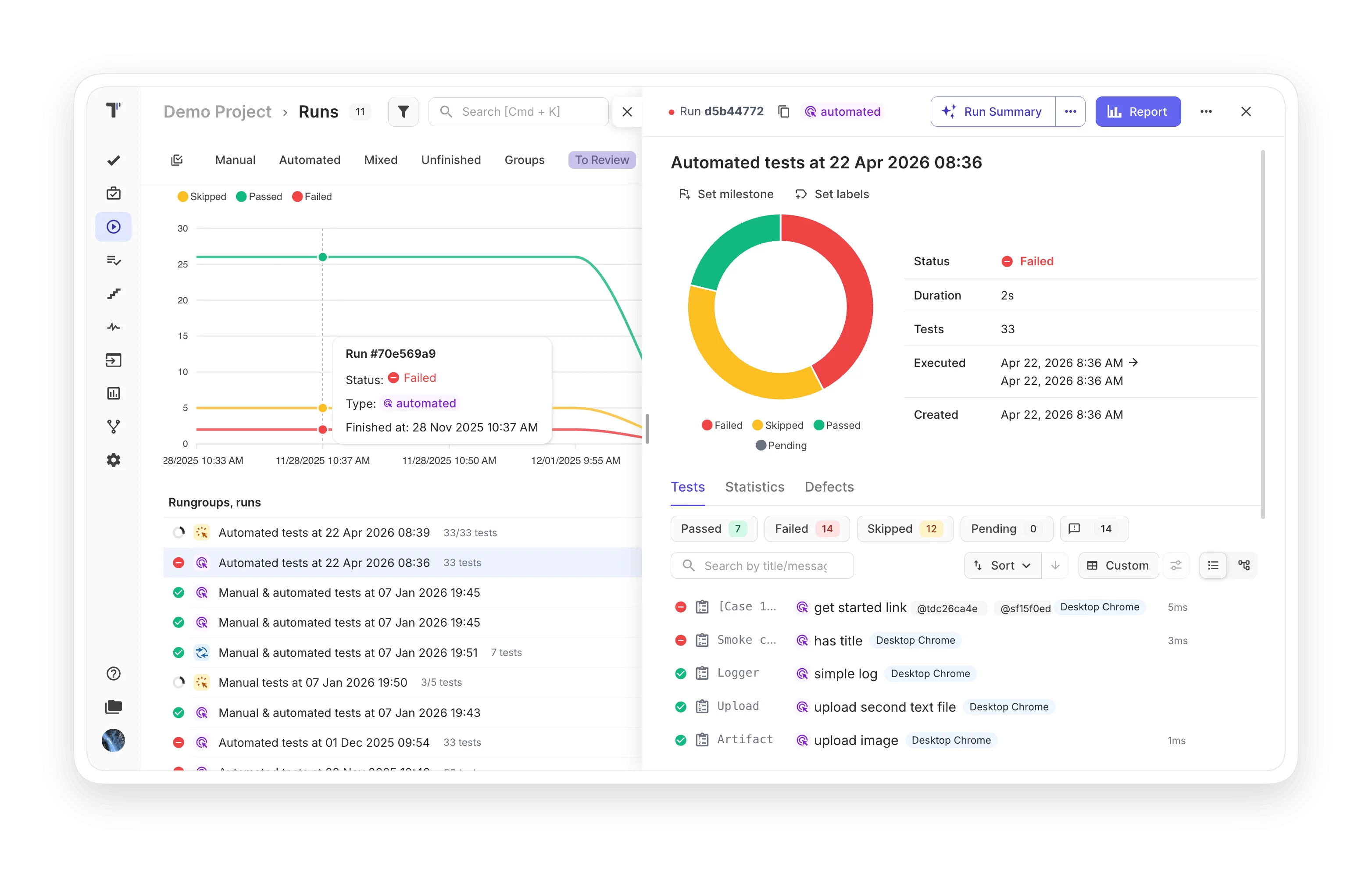
2. Navigating the Tooling Landscape: Top 4 Platforms
Choosing a tool is not about a “features list.” It is about how the tool fits your team’s cognitive load and technical stack. Here is how the market leaders compare:
- Testomat.io — Best for CI/CD-native QA teams. It plugs into your existing Cypress, Playwright, or WebdriverIO suite, auto-discovers your structure, and updates your dashboard instantly.
- Xray — Best for Jira-heavy enterprises. It is highly customizable and integrates deeply into the Atlassian ecosystem.
- TestRail — Best for manual QA workflows. A solid, folder-based tool that is excellent for manual test cases but lacks the modern automation-first architecture.
- Qase — Best for startups. Offers a clean, modern interface and is perfect for teams that need to get up and running quickly without enterprise-level complexity.
3. Comparison: Test Management Tools at a Glance
| Tool | Best For | Weakness |
| Testomat.io | CI/CD automation | Less legacy brand recognition |
| Xray | Jira-heavy enterprises | Heavy setup and maintenance |
| TestRail | Manual-heavy QA | Poor modern CI integration |
| Qase | Startups | Limited enterprise scalability |
4. How to Choose Without Making a Costly Mistake
Before you commit to a platform, map your software testing strategies against your architecture. Most teams fail because they focus on “what the tool can do” rather than “how the tool fits our workflow.”
- The “Integration-First” Check: Does your tool support bidirectional synchronization with your CI/CD? If it doesn’t automatically update status based on test execution, it will quickly become outdated.
- The “Developer Joy” Factor: If your developers have to leave their IDE to update a test status, they will stop using the tool. The best tools live where the developers live.
- Scalability: Does it support “Shared Steps”? If you have to copy-paste the same login logic across 100 tests, your strategy is already destined for failure.
5. The ROI of Centralization
Why invest in specialized software? The answer lies in Defect Leakage. Every bug that reaches production costs 10x-100x more to fix than one caught in the integration phase. By centralizing your software testing strategies in a unified dashboard, you gain predictability, speed, and cross-team collaboration.
FAQ: Test Automation Strategy in 2026
What is the best test automation strategy?
The best strategy combines automated and manual testing within a centralized management tool that integrates directly with CI/CD pipelines.
Why do teams need test management tools?
They provide visibility, traceability, and synchronization between test execution and business requirements, significantly reducing technical debt.
How to choose a test automation tool?
Focus on integration capabilities, scalability, and developer experience (DX) rather than just feature lists.
Ready to modernize your testing workflow? If you want to stop chasing down failed builds and start delivering releases with confidence, check out Testomat.io. Start a free trial and integrate your automation suite in under 10 minutes.
