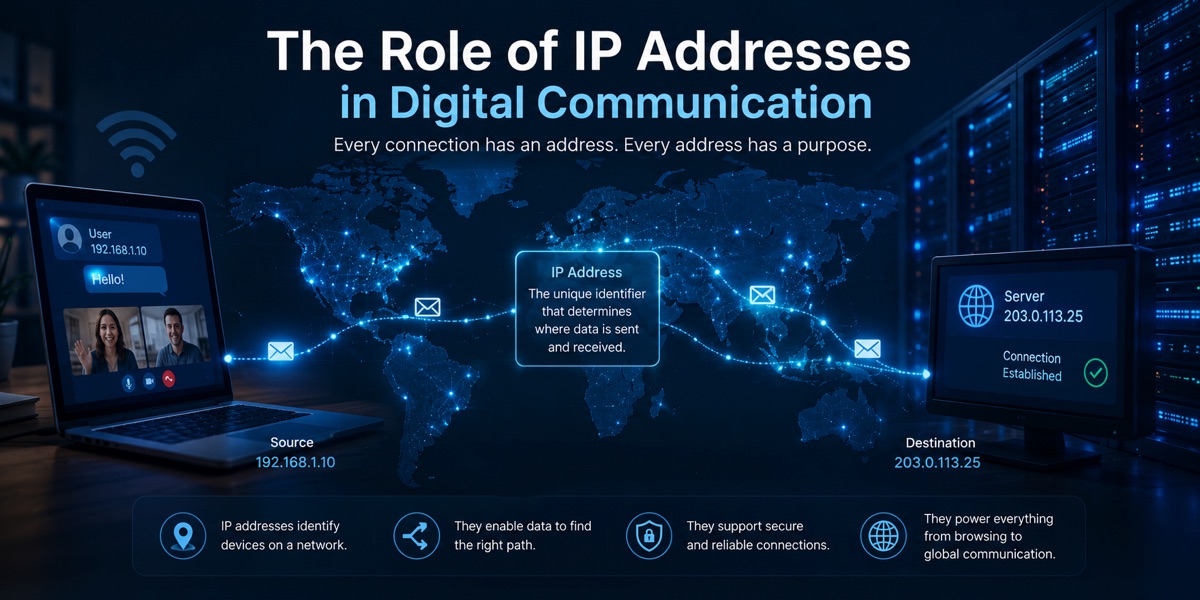
The Role of IP Addresses in Digital Communication

Every message sent across the internet rides on a string of numbers most people never notice. IP addresses work like postal codes for data, telling each packet where to go and how to find its way home. Without them, your email, video call, or bank login would have nowhere to land.
But these identifiers do much more than move traffic around. They shape privacy, decide who gets trusted, and quietly influence how quickly a website responds to you versus someone three time zones away.
How addresses move data across networks
Picture an IP address as a delivery label attached to every chunk of information you send. When you open a webpage, your device splits the request into packets, stamps each one with a source and destination, and hands them to the nearest router. Those routers read the labels and pass packets along, hop by hop, until they reach the right server.
The clever part is how little has changed. This routing logic has run on roughly the same principles since the early 1980s, and it still carries trillions of requests a day without any central controller telling each packet where to turn.
Not all addresses carry the same weight, though. An IP tied to a home connection looks very different to a website than one coming from a server farm, which is where the residential ip meaning becomes useful: home addresses are handed out by internet providers to real households, so they tend to be trusted, while datacenter addresses often get flagged on sight.
What your IP quietly gives away
Your public address exposes a surprising amount. A website can usually narrow it to a city or region, name your internet provider, and use that to decide which version of a page you see. It’s why a streaming catalog in Berlin looks nothing like the one in Toronto, and why ad networks can guess your rough location before you’ve typed a word.
Regulators noticed years ago. Under the EU’s privacy rules, an IP address counts as personal data, so companies that log it take on real legal obligations rather than treating it as a harmless technical detail.
And that tension sits at the heart of digital communication today. The same number that makes delivery possible also makes tracking possible, and the two can’t be fully separated.
Where the stakes get real
For ordinary browsing, all of this stays invisible. But the moment a business needs to operate across borders, IP addresses move from background detail to active concern.
Content delivery networks (CDNs) use your address to serve files from the closest server, shaving milliseconds off load times. Banks and retailers run the same data through fraud checks, flagging a login from Lagos when your account usually signs in from Madrid.
Marketers and analysts care for a different reason. Accurate location data lets a team verify that ads actually appear where they paid for them, or check how a product page looks to shoppers in another country.
Running out of room
Here’s a problem the internet’s founders didn’t fully plan for: there aren’t enough addresses. The original design, laid out in the Internet Protocol specification, allowed for about 4.3 billion unique IPv4 addresses, which felt limitless in 1981.
Those addresses ran out fast. With phones, laptops, smart TVs, and doorbells all demanding their own slot, the older system simply couldn’t keep up. The fix was IPv6, which expands the pool to roughly 340 undecillion addresses, enough to assign one to every grain of sand on Earth several times over.
Adoption has been slow but steady. Plenty of networks still lean on workarounds like NAT to stretch the old addresses further, which is partly why both versions run side by side and probably will for years.
Why IP addresses still matter
IP addresses sit underneath nearly everything people do online, yet they rarely get a second thought until something breaks or someone wants to know where you are. They’re the reason a request finds its destination and the reason your location isn’t quite as private as it feels.
As more devices come online and privacy expectations keep rising, the humble IP address will stay at the center of the conversation. Understanding how it works is no longer just a networking concern; it’s basic digital literacy.