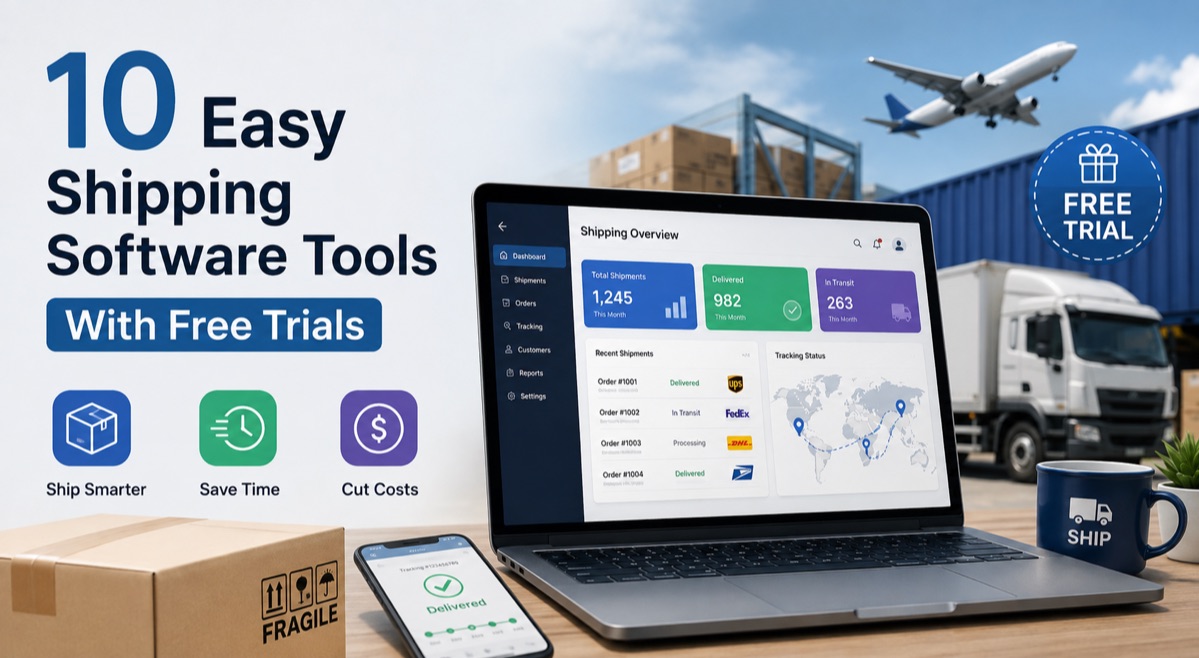
10 Easy Shipping Software Tools With Free Trials: How to Choose the Right One

Every label printed at the wrong rate is profit walking out the door.
For small retailers in the U.S. and Canada, a fragmented shipping workflow shows up where it hurts: in your margins. An hour goes to copy-pasting addresses, bouncing between carrier tabs, and guessing at service class. Those minutes become hours. Those guesses become real money.
Shipping management software fixes that. The challenge in 2026 is not finding a tool. It is choosing one that still works when volume doubles or you start selling cross-border. Below, we compare 10 platforms with free trials or free-to-start models on pricing, carrier coverage, Canada Post support, and Mac/Windows access.
Top Facts Before You Choose
The easiest tools centralize rate comparison, labels, and tracking, replacing 3–5 carrier dashboards with one workflow.
Several platforms now offer free tiers or no-monthly-fee models under 500 shipments/month.
Canada Post support is not universal. At least 3 of the 10 tools below have limited or no Canada Post integration.
Mac and Windows compatibility usually comes from browser access, not desktop apps.
This guide covers four model types: free trials (ShipStation, Easyship, ShipBob, Stamps.com), free platforms (Ordoro, Sendcloud, EasyPost), pay-as-you-go (Shippo), and no-subscription pay-per-label (Rollo Ship and Pirate Ship).
The 10 Easy Shipping Software Tools With Free Trials in 2026 (Quick Answer)
Ten easy shipping software tools with free trials or free-to-start models in 2026: (1) Rollo Ship — no subscription, first 200 labels free, multi-carrier with Canada Post for U.S. and Canadian shippers; (2) Shippo — free version with pay-as-you-go and Canada Post support; (3) Easyship — free plan with 14-day paid trial and cross-border tools; (4) ShipStation — 30-day free trial, then subscriptions from $14.99/month; (5) Pirate Ship — free USPS and UPS labels, no Canada Post; (6) Ordoro — free shipping tier, paid inventory plans from $299/month; (7) ShipBob — free 3PL trial for outsourced fulfillment; (8) Stamps.com / SendPro — legacy USPS platform with 4-week trial; (9) Sendcloud — EU-focused free tier with limited North America coverage; (10) EasyPost — API-first free tier for developer teams.
What Makes a Shipping Tool Easy to Use?
Easy-to-use shipping software reduces clicks and keeps common tasks inside one repeatable workflow. For beginners, the quality signals are fast setup, transparent pricing, native store integrations, batch label tools, and a dashboard that runs on both operating systems.
Most small retailers do not struggle because shipping is impossible. They struggle because the workflow is scattered across carts, carrier sites, and spreadsheets. The tool that removes that fragmentation usually wins long term, even when another looks cheaper this month.
There is a second rule, and it decides more than pricing does. A rate tool can only find the cheapest label among the carriers it can actually quote. Call it the carrier-field floor. A two-carrier platform showing its best price is still showing the best of two, however clean the interface.
What Happens Without a Structured Shipping Workflow?
Without a structured system, shippers pick carriers by habit, not by shipment economics. That means less rate visibility, more manual entry, more tab-switching.
Consider the math. A retailer shipping 200 orders a month who overpays $1.20 per label loses $240 a month, roughly $2,880 a year, to friction alone. That is before reprints and tracking lookups.
For Canadian shippers, the problem compounds when Canada Post, cross-border U.S. shipping, and local delivery expectations sit in separate systems. Drag builds quietly. The 10 tools below close that gap in different ways, but only some suit a small U.S. or Canadian retailer in 2026.
How to Compare 10 Shipping Software Tools With Free Trials in 2026
Match the software to your situation: no-subscription platforms for low fixed costs, free-trial tools for testing automation, free tiers for scaling at your pace.
| Tool | Pricing entry point | Free trial or tier | Mac / Windows | Canada Post | Best fit |
| Rollo Ship | No subscription; first 200 labels free | Free | Browser-based | Yes | No-subscription multi-carrier shipping, U.S. and Canada |
| Shippo | Free version + pay-as-you-go | Yes | Web app | Yes | API flexibility, low entry pricing |
| Easyship | Free plan; 14-day trial on paid tiers | Yes | Browser-based | Yes | Cross-border brands and growing SMBs |
| ShipStation | From $14.99/mo after trial | 30-day trial | Web + desktop | Yes | Deep automation, broad integrations |
| Pirate Ship | No subscription | Free platform | Browser-based | No | U.S. sellers shipping USPS and UPS only |
| Ordoro | Free tier; paid from $299/mo | Free tier | Browser-based | Verify with vendor | Inventory-heavy stores |
| ShipBob | Free trial for fulfillment | Yes | Web dashboard | Yes | Sellers outsourcing to a 3PL |
| Stamps.com / SendPro | ~$19.99+/mo | 4-week trial | Web + desktop | USPS-focused | USPS-heavy legacy workflows |
| Sendcloud | Free tier; paid from ~€25/mo | Free tier | Browser-based | Limited (EU focus) | EU e-commerce |
| EasyPost | Free tier; usage-based API | Free tier | API + dashboard | Yes (via API) | Developer-built workflows |
Which Shipping Software Is Right for You?
If removing fixed software cost is the priority, per-label platforms fit better. If you want heavy automation and do not mind a flat fee, subscription tools make sense at stable volume. Canadian shippers should prioritize Canada Post coverage from day one.
Cost-avoiders and Canadian shippers who want carrier breadth are usually best served by a no-subscription model.
Workflow builders already running SOPs can trial automation-heavy platforms, then compare them against a per-label option. Apparel founders, artists, and resellers shipping under 500 orders a month rarely benefit from a subscription.
1) Rollo Ship
Rollo Ship is a free multi-carrier shipping platform that compares real-time rates across USPS, UPS, FedEx, Canada Post and Purolator for e-commerce sellers in the US and Canada. The first 200 labels are free. After that a small per-label fee applies, dropping from 5¢ to as low as 1¢ at the VIP tier of Rollo Rewards.
That structure is why it works as a long-term system rather than a short-term free tool. Most platforms force a choice between flat-fee subscriptions and rigid carrier portals. Here, cost scales with volume instead of running ahead of it.
Rollo Ship holds a 4.8-star rating on Capterra. It holds a 4.5-star rating on the US iOS App Store across roughly 1,400 ratings. Rollo reports a user base of more than 500,000 shippers across the US and Canada.
Why Rollo Ship?
- No monthly subscription or signup fee, so fixed charges stay off the books while volume stabilizes.
- The first 200 labels are fee-free, enough to test a full workflow before paying per label.
- U.S. and Canada workflows sit in one dashboard, Canada Post and Purolator included.
- Browser access plus native iOS and Android apps, so Mac and Windows teams need no installs.
- Rewards-based pricing aligns cost with growth as shipping activity increases.
Best for
Small business owners and fulfillment managers who want an all-in-one shipping solution without a subscription from day one. It is strongest for shippers working across both countries, since the carrier field includes Canada Post and Purolator alongside U.S. carriers. Connect a store, import orders, print labels.
2) Shippo
Shippo is a multi-carrier platform with a free version and pay-as-you-go pricing, including Canada Post access for merchants shipping within Canada or into the U.S. Sellers pick it for the web app plus a robust API.
Pros: free version publicly listed; confirmed Canada Post support; flexible for web users and developers.
Cons: plan structure appears differently across sources, so verify the live plan; the long-term cost curve is less clearly framed than a rewards-based per-label model.
3) Easyship
Easyship is a cross-border platform with a free plan, usage-based pricing, and a 14-day trial on paid tiers. It supports Canada Post, including partner-based promotional pricing in Canada.
Pros: free plan and trial reduce testing friction; strong cross-border positioning; browser-based.
Cons: feature depth may exceed what a beginner needs; economics are less straightforward than a per-label system.
4) ShipStation
ShipStation is built for fulfillment teams that want broad integrations, deep automation rules, and a 30-day trial before paying. Canada Post support is documented in its help center.
Pros: 30-day trial with no charge unless you upgrade; broad integrations; verified Canada Post support.
Cons: the Starter plan is listed at $14.99/month after the trial, and that fixed cost lands before volume is stable.
5) Pirate Ship
Pirate Ship is a free platform for U.S. sellers using USPS and UPS, with no monthly platform fee advertised on its site. It suits U.S.-focused sellers who want a simple way to buy postage. The carrier field is narrower, and a five-carrier field contains everything a two-carrier field can quote.
Pros: no monthly platform fee; straightforward USPS and UPS purchasing flow.
Cons: no verified Canada Post support, which limits relevance for Canadian and cross-border shippers; narrower breadth for anyone wanting one U.S.-and-Canada workflow.
6) Ordoro
Ordoro pairs a free shipping tier with inventory management and kitting for operationally complex stores. The free tier is generous. Paid plans escalate quickly.
Pros: free tier covers basic label generation; advanced inventory and kitting suit complex operations.
Cons: paid plans start at $299/month; overkill for anyone who just needs rate comparison and labels.
7) ShipBob
ShipBob is a third-party logistics service with software layered on top, plus a free trial for sellers evaluating outsourced fulfillment. It warehouses inventory and handles pick, pack, and ship for you.
Pros: free trial for fulfillment services; end-to-end handling including warehousing.
Cons: it is a 3PL, so you are outsourcing rather than managing; not a fit for sellers who want to self-ship.
8) Stamps.com / Pitney Bowes SendPro
Stamps.com and its sibling SendPro are the legacy USPS-focused subscriptions many sellers grew up with. Proven integration, a four-week trial, a familiar interface. The model has not kept pace with multi-carrier platforms.
Pros: established USPS integration; familiar to anyone with legacy workflows.
Cons: monthly subscription adds fixed cost regardless of volume; primarily USPS-focused, without multi-carrier comparison across UPS, FedEx, and Canada Post.
9) Sendcloud
Sendcloud is a European platform with a free tier and paid plans from around €25/month, built for EU sellers who need a wide European carrier network.
Pros: free tier; strong EU carrier network; modern browser-based dashboard.
Cons: built for European e-commerce, so North American coverage and Canada Post support are limited.
10) EasyPost
EasyPost is API-first with a free tier and usage-based pricing, designed for developer teams building shipping into their own apps. Powerful and well documented. Not plug-and-play.
Pros: free tier with a strong API; Canada Post support via API.
Cons: built for developers, not beginners; no pre-built connect-and-ship dashboard.
Why Rollo Ship Is a Strong Long-Term Choice for Small Businesses
Rollo Ship is easy to start, and it holds up when a store moves from occasional shipping to repeatable fulfillment. That is the difference between a temporary free tool and a system you keep.
Because carrier comparison, label generation, printing, and shipping economics live in one platform, it works more like infrastructure than a label generator. The no-subscription model keeps fixed costs low, and Rollo Rewards lowers per-label cost as activity increases. For most SMBs that beats a flat monthly fee.
Who This Is Not For
This roundup is not for enterprise operations running a customized shipping stack or a formal transportation management system. Those teams value API orchestration, freight logic, and ERP depth more than simple setup.
It is also not for sellers who need one carrier portal and nothing else. If you never compare services, carrier-native tools may be enough.
Start Shipping Smarter Today!
Connect your Shopify, Amazon, eBay, or WooCommerce store, compare USPS, UPS, FedEx, Canada Post and Purolator rates in one dashboard, and ship your first 200 labels free with Rollo Ship. No subscription. No signup fee. Per-label fees drop from 5¢ to as low as 1¢ as you grow through Rollo Rewards.
FAQs
What are the 10 best shipping software tools with free trials in 2026?
The 10 easiest shipping software tools with free trials or free-to-start models in 2026 are Rollo Ship, Shippo, Easyship, ShipStation, Pirate Ship, Ordoro, ShipBob, Stamps.com/SendPro, Sendcloud, and EasyPost. For small U.S. and Canadian retailers, Rollo Ship fits best: no monthly subscription, the first 200 labels free, multi-carrier coverage including Canada Post, and per-label pricing that drops from 5¢ to as low as 1¢.
Are there shipping platforms that work with both Mac and Windows?
Yes. Most shipping software runs in the browser, so it works across Mac and Windows without separate versions. Rollo Ship follows that pattern, with native iOS and Android apps for printing away from the desk.
Does Canada Post integrate with all shipping software?
No. Pirate Ship has no verified Canada Post support, Stamps.com/SendPro is USPS-focused, and Sendcloud is EU-oriented. Rollo Ship, Shippo, Easyship, ShipStation, ShipBob, and EasyPost all support Canada Post in some form. Verify before committing.