
7 Website Design Elements That Build Trust and Increase Conversions ( +Examples)

Converting customers in 2026 is practically impossible without first earning their trust.
Consumer behavior data consistently shows that most people need to have faith in a business before they’ll even consider buying from it. And research suggests that brand credibility significantly elevates purchase intent and brand loyalty while lowering price sensitivity. In fact, a new study by McCann found that 80% of consumers will actively choose brands they trust, even if they cost more.
Naturally, there are multiple approaches to trust marketing. But, despite being commonly overlooked, website design still has a tremendous influence on credibility (and brand perception in general).
So, what web design elements build trust and increase conversions? And how can you successfully incorporate them into your online presence? This guide explores some of the most powerful trust-driving components you can include in your site’s design, along with examples of successful brands doing it right.
Seamless Technical Performance
No matter how attractive, trustworthy, or conversion-optimized your website’s design is, it won’t yield results if its technical performance is subpar. And the reason is simple: 75% of consumers judge brands’ credibility based on web design.
In fact, if you look at the research on the connection between UX design, brand trust, and conversion outcomes, you’ll discover that 60% of internet users abandon purchases due to a poor website experience. Furthermore, 88% of people are less likely to return to a website following a subpar user experience.
With this in mind, seamless, user-friendly technical performance is one of the most crucial elements of trust-building and conversion-driving design. Site speed, mobile responsiveness, and data security all play a role in earning customer trust. And the best part is that most of these elements of web design have relatively simple solutions.
The WP Fastest Cache plugin, for instance, successfully speeds up WordPress sites, improving PageSpeed Insights performance and elevating user experience.
Value-Based Marketing Messaging
As you will learn from this guide, there are many highly effective tactics for building brand trust. Yet, unless there’s genuine alignment between a brand’s mission and values and its target audience’s wants, needs, and expectations, none of those strategies will truly work.
In fact, recent studies have found that personalization and hyper-relevance are key requirements for engaging prospects. And if you look at specific findings regarding whom shoppers are willing to trust, you’ll find that 34% wouldn’t readily put their faith in a business whose values and priorities didn’t align with their own.
With this in mind, one of the essential website design elements you need to build trust and increase purchase intent includes marketing messaging that is value-based (and that genuinely appeals to your ideal customers).
Ideally, the most prominent headings, value propositions, and CTAs throughout your online presence should effectively reflect your prospects’ desires. Furthermore, considering that multiple factors drive trust (such as competence, transparency, customer-centricity, emotional resonance, convenience, etc.), it’s equally important to highlight marketing messaging that reflects the target consumer segment’s priorities.
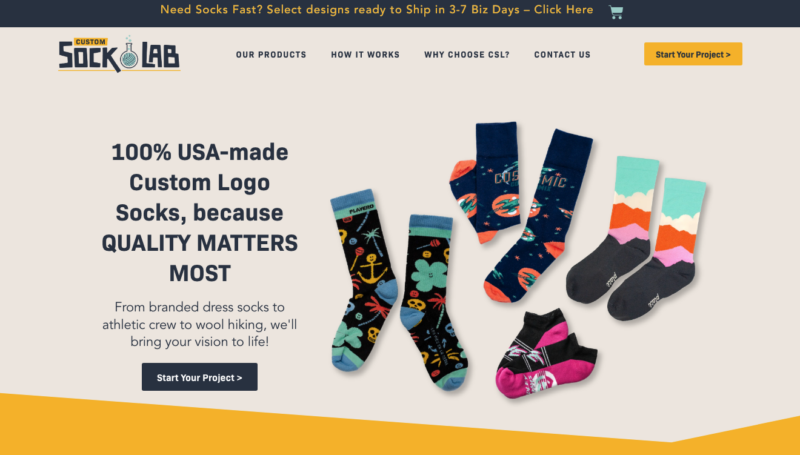
For instance, Custom Sock Lab does this with the hero section of its website, where the design choices strongly emphasize the value proposition and the claim that it sells “100% USA-made Custom Logo Socks, because QUALITY MATTERS MOST.”
 Source: customsocklab.com
Unfiltered Visuals and Multimedia
In digital retail settings, visual content plays a crucial role in guiding prospects toward a conversion decision. According to research, 75% of shoppers rely on product photography to make purchase decisions, suggesting that visual design elements can and should be a core aspect of any conversion-optimization strategy.
However, new technology — specifically AI — might be disrupting the power of imagery in guiding consumers through the buyer’s journey. Survey data found that 39% of consumers would trust a brand less if they found out it used AI-generated product imagery. Furthermore, 84% of shoppers want brands to be transparent regarding the use of AI-generated photography.
What these findings suggest isn’t necessarily that the key to earning consumer trust is to avoid new technologies. Instead, it’s to prominently display website elements that are transparent and genuine — such as user-generated content.
Businesses like Pergola Kits USA regularly incorporate user-submitted product imagery into their website designs, and with good reason. This content format is highly trustworthy (more so than branded resources). It also shows an unfiltered look at the company’s offer, allowing potential buyers to see each structure in a real-life setting (and use that information to determine whether it’s the best choice for their needs).
 Source: pergolakitsusa.com
Third-Party Certification and Science-Backed Data
When aiming to build brand trust and increase conversion rates through web design, it’s essential to understand how consumers make buying decisions.
The process isn’t an ad hoc choice (at least not in most cases). Practically all consumers conduct some amount of pre-purchase research before settling on a product to buy. In fact, most spend hours (or even days) collecting pre-purchase information, all to make the best possible buying decision.
During this process, they interact with several resources. Branded and social media content regularly rank high on the list of resources shoppers check before buying. And lately, AI-powered shopping advice has gained in popularity too. Nevertheless, when exploring website design elements that successfully build brand credibility across all consumer segments, it’s impossible not to mention the power of third-party certification and scientific data.
According to new research, scientists rank as the most trustworthy entity among consumers. Even more, 85% of shoppers trust third-party certifications, with many being prepared to pay a premium for products featuring relevant trust badges.
With this in mind, third-party certification and scientific data are some of the more powerful web design elements you could include in your online presence to earn your audience’s trust.
Dashlane, for instance, understands the power of certification in building consumer confidence (and driving purchase decisions). That’s why it includes a prominent Compliance section on its homepage, where it lists the industry standards its product adheres to and provides visitors with information on how the organization handles and safeguards user data.
Source: dashlane.com
Highly Emphasized Social Proof
It’s impossible to discuss trust marketing without mentioning social proof as one of the top web design elements that drives consumer confidence.
As a content type that practically all shoppers actively seek out at some point in the buyer’s journey, customer feedback is a highly valuable resource.
It actively supports shoppers’ product research activities. It addresses and removes common conversion obstacles. Finally, it enables customer self-qualification by giving web visitors real-world information about the solutions they’re considering (and how those products perform in solving relevant customer needs).
Of course, as a design element, social proof is often only as effective at earning trust as the design strategies used to highlight it.
Ultimately, the most important time to establish a brand’s competence and credibility is in the early stages of the sales cycle. So, the ideal moment to showcase social proof is early on during your web visitors’ browsing journeys.
In other words, to get the absolute most out of social proof when building brand trust and optimizing for conversions, prioritize placing it in areas of your site that visitors will immediately notice. Furthermore, use social proof components near decision-making elements, such as next to your primary CTAs.
For a great example of what this can look like, check out Performance Lab. Knowing that credibility is essential to its target audience, this business displays customer ratings in the top-left corner of its homepage hero section. The brand knows that web visitors usually look at that spot when landing on the website. Much more importantly, it understands that seeing proof of the products’ effectiveness quickly establishes PerformanceLab’s trustworthiness, which will inevitably increase the brand’s prospects’ willingness to engage with the on-site content (and subsequently convert).
Source: performancelab.com
Transparent Pricing
In addition to brand expertise and reliability, most consumers also demand transparency, and not just in terms of internal operations or ESG compliance (although those are hugely important to shoppers choosing what businesses to support). A growing number of buyers are also paying attention to how honest businesses are about their pricing policies.
If you consider the fact that 39% of cart abandonments happen due to unpredicted costs and that 82% of Americans consider no hidden fees and clear pricing to be important factors in building an enjoyable shopping experience, it’s easy to see how your approach to transparency could affect your ability to earn your prospects’ trust.
When using transparency as a design element meant to engage and convert clients, your willingness to share information isn’t the only thing that matters in building brand trust. How you communicate your honesty through website design matters just as much — especially considering that it determines how web visitors will see and perceive your commitment to transparency.
Showcasing cost information early on in the buyer’s journey — as IceCartel does — can be a great strategy. Because it immediately sets customer expectations regarding cost, this design approach prevents potential disappointments later in the sales funnel (and automatically removes some of the most prominent conversion obstacles preventing sales).
Source: icecartel.com
Pre & Post-Purchase Customer Support
Lastly, when using website design to build trust and increase conversions, it’s crucial to understand all the factors that shoppers consider when evaluating your brand’s ability to resolve their pain points.
Product price, quality, convenience, and reliability are all important considerations in the typical buyer’s journey. But so is pre- and post-purchase customer support. In fact, research suggests that 58% of shoppers are willing to pay a premium for a great customer experience.
With this in mind, one of the best website design choices you can make is to enable seamless access to your brand’s customer support resources — regardless of whether those include chatbots, click-to-call CTA buttons, or selfs-service resources.
For example, many businesses include a chatbot or live chat element on their websites to provide shoppers with real-time support. Other brands, like Noto Botanics, encourage buyers to call them directly with prominent clickable call CTAs that promise human support — something that most consumers still appreciate in the age of AI.
Source: notobotanics.com
Final Thoughts
As you can see, there are several effective design strategies you can use to build brand trust and increase your prospects’ purchase intent. Nevertheless, when deciding on what trust marketing tactics to incorporate into your site’s design, always choose strategies that align with your ideal customers’ preferences. That way, you won’t just identify the right design elements to include in your online presence. Much more importantly, you’ll ensure that your trust-centric branding efforts resonate with your target audience, making them far more likely to form a positive perception of your business and want to continue engaging with it.