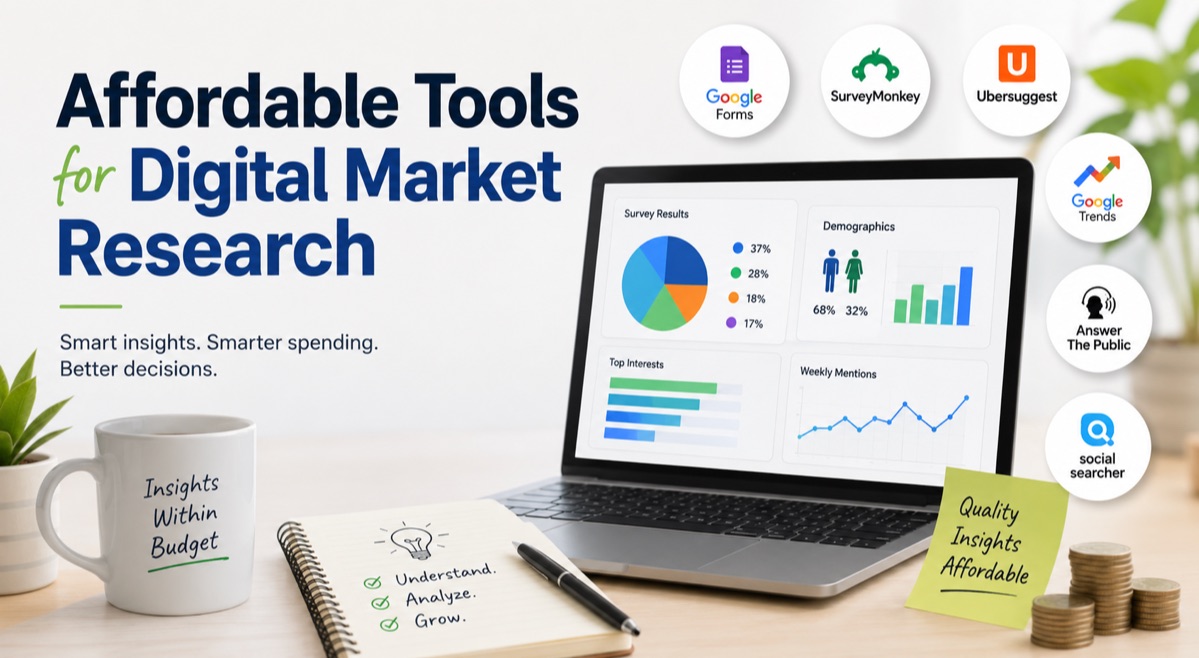
Affordable Tools for Digital Market Research

Market research used to demand big budgets, expensive consumer panels, and agencies that billed by the hour. That has changed. Small teams now run competitive analysis, track pricing, and study audiences with software that costs less than a monthly streaming bundle.
The catch is knowing which tools actually deliver. Plenty of free dashboards look impressive but collect shallow data, and paid platforms tend to bury the useful features behind enterprise pricing. Here’s a practical look at what works when the budget is thin.
Start With the Free Analytics Layer
Google Analytics and Microsoft Clarity give a small business real insight into its own audience at zero cost. Clarity records session heatmaps and click patterns; Analytics shows where traffic comes from and what people do once they land.
For direct opinions, the free tiers of Typeform and Google Forms handle small sample sizes well enough to surface early trends. None of this costs a cent, and the data quality holds up for most early-stage decisions. The limit is scope: these tools explain your own visitors, not the wider market.
Why Proxies Belong in the Toolkit
Understanding competitors means reaching their data, and that’s where things get tricky. Pricing pages, product catalogs, and search results shift based on a visitor’s location, and most sites throttle or block repeated requests from a single address.
A researcher trying to compare prices across ten countries hits a wall within minutes. Routing requests through cheap isp proxies clears both obstacles, since each request looks like it came from a genuine residential connection in the target region. That keeps a project moving instead of stalling on CAPTCHAs and bans.
The practice itself, usually called web scraping, powers most automated competitor monitoring. Price comparison sites, ad verification platforms, and brand protection services all depend on it.
ISP proxies sit in a useful middle ground: cheaper and faster than full residential pools, and much harder to flag than plain datacenter IPs. For a small team checking competitor prices a few times a day, that balance matters more than raw speed.
Turn Raw Data Into Something Readable
Scraped numbers are useless until you give them context, and a few low-cost aggregators handle that step well. Google Trends maps demand over time for free; SimilarWeb and Ubersuggest offer limited free tiers for traffic estimates and keyword volume.
For sentiment, tools like Brand24 start at modest monthly rates and track mentions across social platforms, blogs, and forums. Pair one of these with your own scraped pricing data and you get a fairly complete view of where a market is heading. That’s the kind of picture that once cost a five-figure agency retainer.
A word of caution on free tiers: they cap rows, dates, and exports aggressively. Treat them as scouting tools, then pay for one platform once you know exactly which question matters most.
Say you sell running shoes and want to know whether a rival just cut prices in Germany. Scrape the German storefront through a local IP, drop the results into a spreadsheet, and cross-check the spike against Google Trends search interest. That’s a same-afternoon answer using tools that cost almost nothing, and it would have taken a research firm a week to deliver a decade ago.
Don’t Skip the Strategy Behind the Numbers
Tools collect data. They don’t tell you what’s worth measuring. Harvard Business Review has examined how generative AI is reshaping market research, and the takeaway carries over to any budget stack: the method beats the software every time.
The old frameworks still hold. A solid grasp of market research basics, sampling, segmentation, and controlling for bias keeps a team from drawing confident conclusions out of messy inputs. Cheap tools make bad analysis cheaper, not smarter, and a $20 subscription won’t fix a flawed question.
Spend Smart, Not Big
The barrier to serious market research isn’t money anymore; it’s knowing which combination of tools fits the question being asked. A free analytics layer, an affordable proxy and scraping setup, and a couple of aggregators cover most needs for under a hundred dollars a month.
What separates real insight from busywork is discipline. Pick tools that answer specific questions, validate the data they produce, and let the rest follow from there.