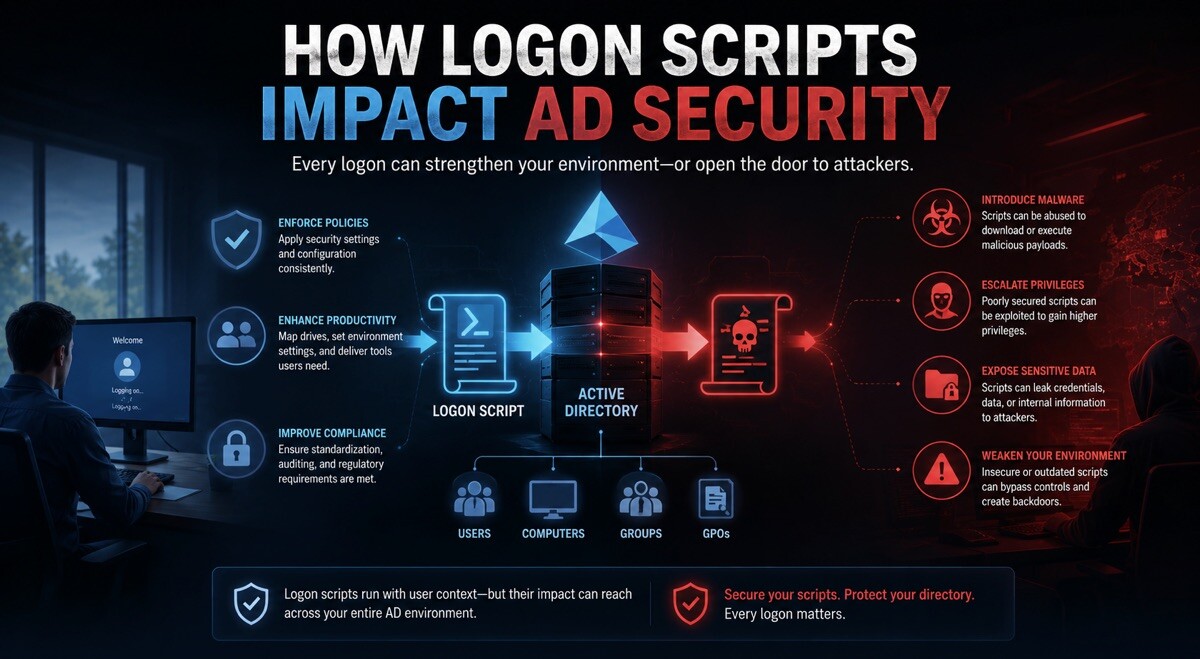
How Logon Scripts Impact AD Security

In modern enterprise environments, authentication and user session setup remain critical parts of infrastructure security. Within Active Directory environments managed by Active Directory, one commonly used mechanism for automating user actions is the GPO logon script. These scripts run when a user signs in and can map drives, configure printers, set environment variables, or execute administrative commands. While convenient, they also introduce security considerations that organisations must carefully manage.
A GPO logon script is typically deployed through Group Policy Objects in Microsoft environments. Because it executes automatically during authentication, it sits at a sensitive intersection between user convenience and system security. According to Microsoft security guidance and industry incident analyses such as Verizon’s Data Breach Investigations Report (DBIR), misconfigurations in identity and access management remain a leading cause of enterprise compromise. Logon scripts, when poorly governed, can become part of that risk surface.
Role of Logon Scripts in AD Environments
Within enterprise directory services, logon scripts serve as automation tools that streamline user session setup. In an Active Directory domain, administrators use Group Policy to assign scripts that execute at logon or logoff. These scripts are often written in PowerShell, batch files, or VBScript, depending on legacy requirements.
A properly configured GPO logon script can reduce administrative overhead by ensuring consistent system configuration across thousands of endpoints. For example, mapping shared drives or applying security baselines during login ensures users always operate in a controlled environment.
However, because these scripts execute with the user’s privileges, they also inherit the security context of the session. This makes them a potential vector for privilege misuse if not carefully controlled. In large enterprise deployments, even a small misconfiguration can scale rapidly across all domain-joined systems, which is why governance is critical.
Security researchers have repeatedly highlighted that identity-based misconfigurations are involved in a significant portion of breaches. IBM’s Cost of a Data Breach Report has also emphasised that compromised credentials and mismanaged identity controls often increase breach impact. Logon scripts fall directly into this category when they are not properly secured.
Security Risks Introduced by GPO Logon Script
One of the most important concerns with a GPO logon script is the risk of execution of unauthorised or malicious commands. Since these scripts are centrally deployed, any compromise of the Group Policy infrastructure can lead to widespread system execution.
If an attacker gains access to SYSVOL or Group Policy Objects, they may modify scripts to include malicious payloads. This is particularly dangerous in domains where administrators reuse credentials or fail to enforce tiered administrative access. Once altered, the script executes automatically across all targeted machines during user logon.
Another risk involves script injection through weak file permissions. If script storage locations are not properly secured, low-privilege users may tamper with or replace scripts. This can lead to privilege escalation or persistence mechanisms within the domain.
A GPO logon script can also unintentionally expose sensitive information. For example, scripts that contain embedded credentials or API keys create significant exposure risks if accessed or extracted by attackers. Security audits frequently identify hardcoded credentials in legacy scripts as a recurring vulnerability.
Additionally, research from security vendors consistently shows that lateral movement within enterprise networks often begins with identity mismanagement rather than direct exploitation of software vulnerabilities. Poorly governed logon scripts contribute to this by acting as trusted execution paths within domain environments.
Best Practices for Securing Logon Script Deployment
Securing logon scripts requires a layered approach combining policy enforcement, monitoring, and secure coding practices. Organisations using a GPO logon script should first ensure strict access control over Group Policy Objects and SYSVOL directories. Only authorised administrators should have write permissions.
A key best practice includes removing embedded credentials and replacing them with secure authentication mechanisms such as managed service accounts or token-based authentication. This significantly reduces the risk of credential leakage.
It is also recommended to sign scripts digitally to ensure integrity and detect tampering. PowerShell execution policies, when properly configured, can help enforce script authenticity across domain-joined systems.
One essential checklist for securing script deployment includes:
- Restricting Group Policy modification rights to tier-0 administrators only
- Storing scripts in secured and audited SYSVOL directories
- Enabling script execution logging and centralised monitoring
- Removing plaintext credentials from all logon scripts
- Using version control systems for change tracking
When organisations implement these controls, the attack surface associated with a GPO logon script is significantly reduced. Security frameworks such as NIST SP 800-53 also emphasise the importance of configuration integrity and least privilege principles, both of which directly apply here.
Monitoring and Governance in Modern AD Security
Continuous monitoring is essential in maintaining secure identity infrastructure. Within an Active Directory environment, administrators should regularly audit Group Policy changes and logon script executions.
Security Information and Event Management (SIEM) systems are commonly used to detect unusual script behaviour, such as unexpected execution times or modifications outside maintenance windows. These anomalies can indicate potential compromise.
A modern GPO logon script deployment should also be reviewed under a governance model that includes periodic penetration testing and configuration audits. According to industry studies, organisations that implement continuous monitoring reduce mean time to detect (MTTD) breaches significantly compared to those relying on periodic audits alone.
Identity governance frameworks also recommend separating duties between policy creation, approval, and deployment. This ensures that no single administrator can introduce unverified changes into production environments.
Furthermore, integrating endpoint detection and response (EDR) tools helps identify malicious behaviour originating from scripts, such as unusual process creation or registry modification. This layered visibility is critical in large enterprise networks.
Final Analysis
Logon scripts remain a powerful but sensitive mechanism within enterprise directory services. When used correctly, they improve operational efficiency and standardise user environments. However, their integration into authentication workflows means that any weakness can have wide-reaching consequences.
A poorly managed GPO logon script can introduce risks ranging from credential exposure to domain-wide compromise. On the other hand, strong governance, secure coding practices, and continuous monitoring can significantly reduce these threats.
Ultimately, organisations that treat logon scripts as a core security component—rather than just a convenience tool—are better positioned to maintain a resilient identity infrastructure. In environments managed by Active Directory, this mindset is essential for long-term security and operational stability.