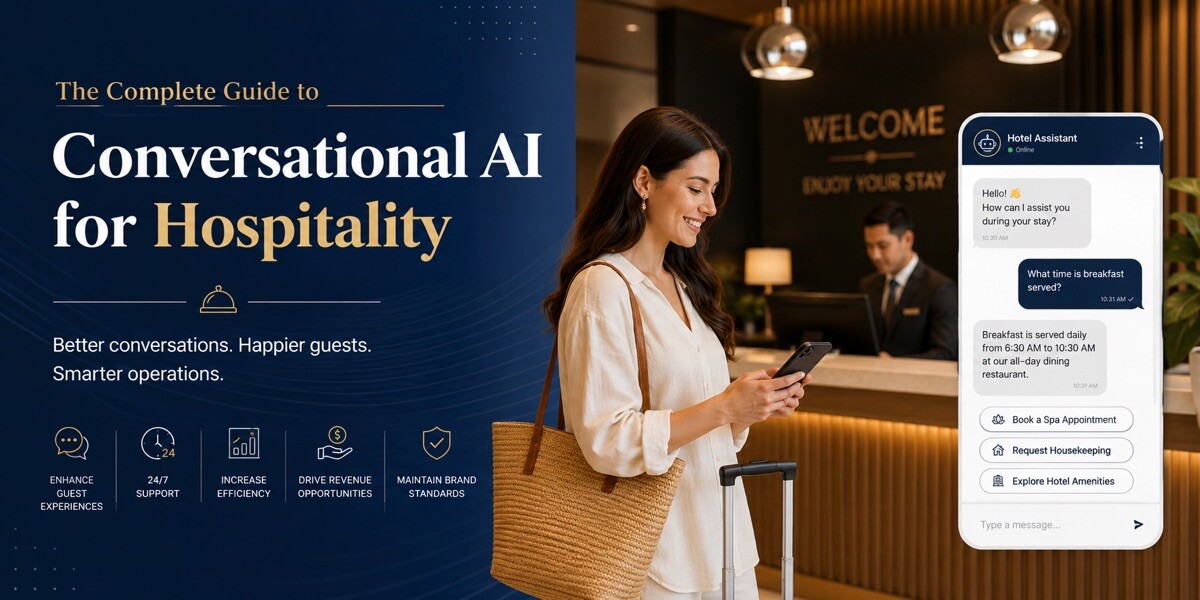
The Complete Guide to Conversational AI for Hospitality

The hospitality industry has always been about people. Great service, warm welcomes, and the ability to anticipate what a guest needs before they even ask, these are the hallmarks of a truly memorable stay or dining experience. But delivering that level of service consistently, across hundreds or thousands of interactions every day, is no small task. That is exactly where conversational AI for hospitality comes in.
It gives hotels, restaurants, and travel businesses the tools to communicate with guests in a natural, helpful, and timely way, without replacing the human touch that makes hospitality special. Understanding how this technology works and what it can realistically do is the first step toward using it well.
What Is Conversational AI and How Does It Work?
At its core, conversational AI refers to technology that allows computers to understand, process, and respond to human language in a natural way. Think of the chatbots you may have used on a hotel website to check room availability, or the voice assistants in some hotel rooms that let you request extra towels or ask about checkout time. These are all forms of conversational AI in action.
The technology is powered by a combination of natural language processing, machine learning, and large language models. In simple terms, the system is trained on enormous amounts of text so it can recognize patterns in how people write and speak, figure out what they are asking, and generate a response that makes sense. Over time, as the system handles more conversations, it gets better at understanding context, handling follow-up questions, and even picking up on the tone of a message.
The Difference Between Rule-Based Chatbots and Conversational AI
Not all chatbots are created equal. Older, rule-based chatbots work by following a set of fixed scripts. If a guest types something the bot does not recognize, it gets stuck. These systems can handle simple, predictable questions, but they fall apart quickly when guests go off-script.
Conversational AI for hospitality is different because it does not rely on rigid scripts. It understands intent, which means it can figure out what a person is trying to ask even if they phrase it in an unusual way. A guest might type “Is there somewhere I can park my car near the hotel?” or “Do you have parking?” and the system will understand both questions mean the same thing and give the right answer.
Why the Hospitality Industry Is a Natural Fit
Few industries deal with as many one-on-one interactions as hospitality. A mid-sized hotel might handle thousands of guest inquiries every week, from questions about amenities and check-in times to complaints about noise or requests for restaurant recommendations. Most of these interactions follow familiar patterns, which makes them ideal candidates for automation.
Conversational AI for hospitality also shines when it comes to availability. Guests do not only have questions between nine and five. Someone booking a late-night stay or a family wondering about breakfast options at midnight cannot always wait until morning for a reply. AI-powered systems handle these inquiries around the clock, giving guests immediate responses and freeing up staff to focus on tasks that genuinely require human judgment and empathy.
There is also the matter of language. Hotels and resorts often serve guests from all over the world. Modern conversational AI systems can communicate in multiple languages fluently, helping staff bridge communication gaps and making international guests feel more at home.
Key Applications in Hotels, Restaurants, and Travel
Guest Communication Before Arrival
The guest experience does not start at check-in. It starts the moment someone visits a hotel website or sends an inquiry. Conversational AI can handle these early-stage interactions, answering questions about room types, pricing, policies, and availability in real time. It can also send pre-arrival messages with useful information like parking instructions, check-in procedures, or local recommendations.
In-Stay Assistance
Once a guest is on property, conversational AI can serve as an always-available concierge. Through a hotel app, a web chat, or even SMS, guests can request services, report issues, or ask questions without having to pick up the phone or walk to the front desk. This is especially valuable during busy periods when front desk staff are occupied.
Restaurant Reservations and Inquiries
For restaurants, conversational AI can handle reservation requests, answer menu questions, accommodate dietary preferences, and even send confirmation messages. Instead of tying up a phone line during dinner service to answer questions about opening hours, a well-designed AI system can manage these interactions automatically.
Post-Stay Follow-Up
The conversation with a guest does not have to end at checkout. AI systems can send follow-up messages asking about the guest experience, directing satisfied guests to leave reviews, or offering returning guests a personalized discount. This kind of consistent, thoughtful follow-up would be difficult to manage manually at scale.
What Conversational AI Cannot Replace
It is important to be honest about the limits of this technology. Conversational AI is a tool, not a replacement for skilled, empathetic hospitality professionals. When a guest is genuinely upset, when a situation requires judgment and creativity, or when someone simply wants to talk to a real person, no AI system should stand in the way of that connection.
The best implementations treat AI as a support layer. It handles the high volume of routine inquiries so that human staff have more time and energy to focus on moments that truly matter. A front desk agent who is not bogged down answering the same five questions all day has more capacity to make a guest feel genuinely welcomed.
Things to Consider Before Implementing
Choosing the Right Platform
There are many conversational AI platforms available today, and not all of them are built with hospitality in mind. Hospitality-specific solutions often come with pre-built integrations for property management systems, booking engines, and CRM tools. This makes setup faster and ensures the AI has access to the information it needs to give accurate answers.
Training and Customization
Out-of-the-box AI systems need to be trained on your specific property, your policies, and your tone of voice. A boutique urban hotel and a family resort should not sound the same. Taking time to customize the system to reflect your brand personality makes a significant difference in how guests experience it.
Transparency with Guests
Guests should always know when they are talking to an AI and have a clear way to reach a human if they prefer. Being transparent about this builds trust and prevents frustration. Most guests are comfortable with AI-assisted communication as long as it is helpful and honest about what it is.
Conclusion
The hospitality industry is built on connection, and the best technology supports rather than replaces that connection. When implemented thoughtfully, conversational AI tools can help hospitality businesses serve guests better, respond faster, and operate more efficiently. The key is to treat it as one part of a broader commitment to excellent service, not a shortcut around it.
As this technology continues to mature, the businesses that use it most effectively will be those that never lose sight of the human experience at the heart of everything they do.