
What One Hundred Operated Sites Can Actually Prove

Experience claims become vague very quickly. “We know SEO” can mean anything from reading dashboards to carrying the cost of a site through years of publishing decisions. BestLinks AI says its Guest Post service was built from experience running more than one hundred of the team’s own sites. That is a substantial operating claim, but it should be examined rather than treated as a guarantee.
The site also shows three Ahrefs screenshots from team-owned properties, with referring domains, Domain Rating, and organic traffic rising over time. The curves are useful because they expose actual dimensions instead of presenting one isolated vanity number. They remain observational evidence. Content, technical work, keyword demand, and competition can move during the same period.
Owning Sites Changes The Cost Of Bad Advice
An agency can recommend more links and move on. A site operator has to live with the pages, budgets, and link choices that follow. If a publisher underperforms, an article misses its audience, or a destination changes, the cost returns to the same owner through rework and lost time.
Running many sites can therefore teach practical habits: keep a record of previous placements, distinguish a new referring domain from repeat exposure, look beyond one metric, and monitor what remains live. These lessons are transferable because they concern the operation of the work, not a secret ranking formula.
The transfer has limits. A playbook learned on content sites may need adjustment for software, ecommerce, local services, or heavily regulated markets. A publisher that fits one property can be irrelevant to another. “One hundred sites” demonstrates repeated exposure to the problem; it does not make every future choice correct.
Scale can improve pattern recognition only if failures remain in the record. A site that lost links after a redesign, an article that never cleared editorial review, or a publisher that required repeated repair should influence later selection. If the team preserves only its winners, one hundred properties become one hundred opportunities to repeat the same hidden mistake.
The buyer cannot inspect that internal history directly. It can ask questions that reveal whether the history exists: how repeat placements are handled, how broken links affect future shortlists, and how the team separates a metric-rich site from a topic-relevant one.
Three Ahrefs Curves Show Correlation With Context
The public examples track three series: referring domains, DR, and organic traffic. In the first case, backlinks and DR grow while traffic takes off after April. In the second, links increase steadily and traffic rises sharply by May. In the third, steady referring-domain growth appears beside traffic that ramps up from March.
Seeing all three is better than showing DR alone. It allows the reader to check whether link growth occurred in the same broad period as search growth. It also reveals that the curve shapes differ. One site has a later takeoff, another a sharp change, and another a steadier ramp. There is no single mechanical response repeated across all three.
The charts do not isolate cause. During those periods, the team may have published more content, improved existing pages, fixed technical issues, entered less competitive topics, or benefited from demand. The service itself notes that SEO depends on the site, content, keyword competition, and other factors, and says the curves are references rather than guarantees.
That disclaimer does not make the charts useless. It gives them the correct job: showing that the team has operated sites where link acquisition, authority metrics, and traffic were observed together over time. The evidence supports familiarity with the work. It cannot promise the slope of a new client’s graph.
The chart presentation also creates a useful reading protocol. Look at the dates, the shape of each series, and whether changes appear gradual or sudden. Then write down at least two other causes that could be moving traffic. If the interpretation survives those alternatives, it can support a cautious judgment. If it requires backlinks to be the only cause, the chart has been overread.

Operational Knowledge Transfers Through Specific Decisions
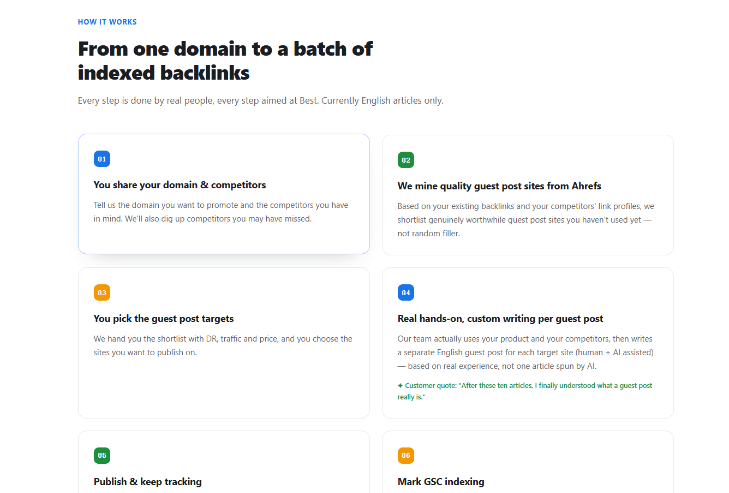
The strongest way to test the hundred-site claim is to look for decisions that repeated operation would improve. BestLinks AI exposes several in its workflow. The team begins with existing and competitor backlinks rather than a random inventory. It prepares a shortlist with DR, traffic, and price. It excludes filler and seeks placements the client has not already used. The client makes the final selection.
Those steps reveal tradeoffs an operator would recognize. Strong metrics do not erase a high price. A cheap placement does not erase weak relevance. A competitor’s link creates a lead, not proof. A domain used before may still be valuable, but it serves a different goal from a new referring domain.
The service’s Guest Post process also leaves the final target choice with the client. That is a sign of operational restraint. Research can narrow the field, but an outside team cannot know every market priority, previous relationship, or internal concern. Repeated site ownership should make the tradeoffs clearer, not claim the right to decide them all.
Look For Maintenance Lessons Beyond The Shortlist
Publication and maintenance offer another test. Operators know that an article can stay online while its link breaks or its destination changes. The service keeps monitoring and fixes broken links when possible. It asks clients to mark GSC indexing so first-party status remains visible. These are not glamorous features, but they come from living with assets after delivery.
Judge Execution Rather Than The Published Checklist
A generic provider could copy the same checklist. The buyer still needs to judge execution: Are candidates explained clearly? Does each article fit its publisher? Are changes tracked? Are unresolved failures recorded? Operational experience becomes evidence only when it changes those decisions.
Specific Rejection Reveals Operational Memory At Work
One visible consequence is the quality of rejection. A mature team should be able to explain why a candidate was discarded without falling back on “low quality.” It may have stale traffic, weak editorial match, previous use, a price that does not fit the article job, or a history of broken placements. Specific rejection shows that the system is doing more than sorting.
Article Quality Tests Whether Experience Reaches Production
A strong site list can still be wasted by interchangeable content. BestLinks AI says its team uses the client’s product and competitors, then writes each English article separately with humans leading the work and AI assisting. That promise connects operating experience to editorial production.
The buyer can inspect the result without pretending to run a scientific study. Remove the brand paragraph and read the article as an editor. Does it still make a coherent argument for the host audience? Are product facts used where they prove the point? Does the anchor sit in a sentence with a real action? If the piece becomes unreadable without promotional language, the article never cleared the higher standard.
Rework is a practical cost signal. A draft that needs a new thesis after publisher review was not tailored enough at intake. Repeating that failure across ten placements wastes an afternoon of client review and can send several pieces back to writers at once. Experience should reduce those late resets by making the editorial job explicit before drafting.
The opposite error is over-customization without fact control. Eight distinct articles can drift into eight versions of the product. A mature process needs stable claims and flexible arguments. Site operation may teach this discipline, but only the delivered drafts can prove that it reached the current campaign.
Publication follow-up provides another observable check. If the link breaks, does the report distinguish a missing link from a wrong destination or an indexing unknown? Each state sends work to a different owner. A vague red status causes people to reopen the whole placement and can waste an hour locating the actual fault.
The Evidence Supports Process Confidence, Not Forecasts
A buyer can reasonably infer that a team operating more than one hundred sites has encountered varied backlink problems. The three charts add public examples in which referring domains, DR, and organic traffic rose in related periods. Together, they support a claim of relevant experience.
They cannot supply a traffic forecast for a new domain. A young site with thin content, a mature product with strong demand, and a publisher in a highly competitive niche will not respond in the same way. Backlinks work inside a larger system whose other parts remain the client’s responsibility.
This boundary should affect procurement. Ask the provider to explain the workflow and show the quality of inputs and outputs. Do not ask historical charts to become a promise about future rankings. If a sales conversation treats correlation as certainty, the evidence is being asked to carry more than it can.
A reasonable pilot would judge controllable work: shortlist clarity, article fit, publication accuracy, status visibility, and repair handling. It would not declare success or failure from a short traffic window. Search outcomes can take time and remain mixed with other changes, while process quality can be inspected as the work happens.
The pilot should preserve rejected candidates and corrected drafts, because those show whether the process learns. A perfect-looking delivery folder can hide wasted research and repeated editorial resets. A transparent record reveals where judgment improved and where the client still had to intervene.
For an established site, that evidence can matter before traffic moves. A sharper shortlist prevents a weak purchase. A publisher-specific draft avoids a late rewrite. A dated repair log keeps a broken asset from disappearing into an old campaign. These are modest outcomes, but each one protects real operating time.
Repeated Site Ownership Is Useful When It Stays Humble
The experience claim is stronger than simple access to a publisher list. BestLinks AI points to more than one hundred operated sites and three visible Ahrefs examples, giving buyers something concrete to question.
The right conclusion is measured. Repeated ownership can improve shortlist judgment, writing briefs, publication follow-up, and repair habits. It cannot remove relevance decisions, guarantee indexing, or isolate backlinks from the rest of SEO.
That is enough to matter. Buyers do not need a magical curve. They need a team that has paid for bad decisions on its own properties, learned which records prevent the same rework, and can show how those lessons shape the next placement.
The proof belongs in the next shortlist, draft, publication check, and repair—not in a promise that every future graph will repeat the past.