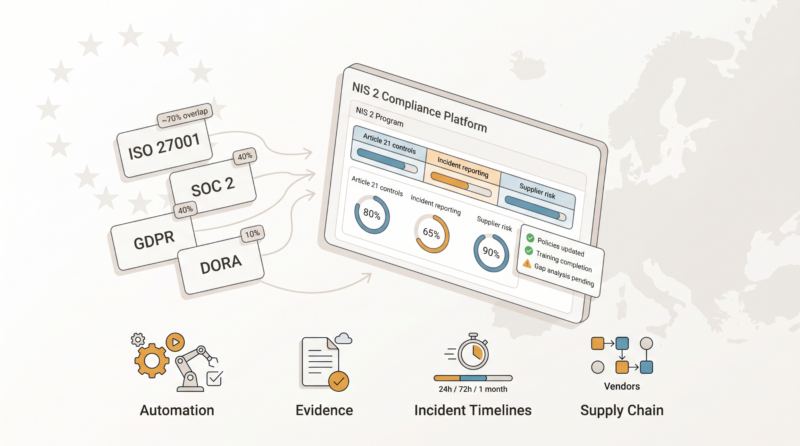
Top 6 Best NIS 2 Compliance Software for Enterprises & Large-Scale Organizations

Selecting the right platform to meet the EU’s NIS 2 Directive can feel overwhelming—especially when you also need to keep ISO 27001, SOC 2, GDPR, DORA, and other frameworks in view. This guide compares six leading tools across automation depth, multi-framework support, incident-reporting workflows, supplier-risk coverage, data residency options, time-to-value, and overall cost so you can choose the best fit for your program.
1. Vanta: automated all-in-one compliance for SaaS enterprises
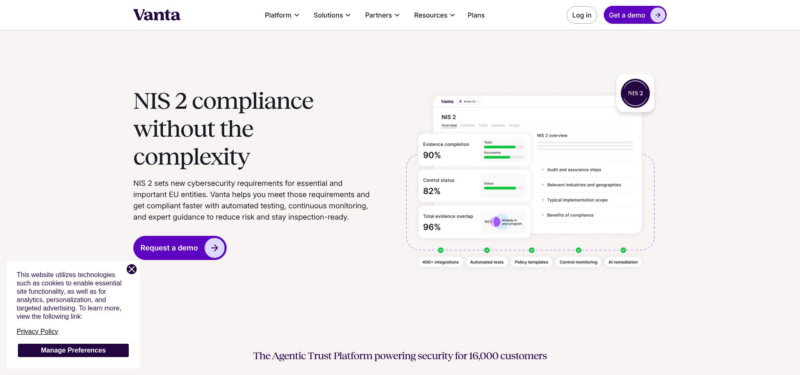
Vanta is built for teams that want NIS 2 to run like continuous compliance, not a one-time documentation project. It turns scoping into a guided kickoff, then maps your environment to a defined NIS 2 program with 56 controls spanning the Article 21 measures. From there, you get the substance most tools leave you to assemble yourself, including 619 NIS 2-specific automated tests, 106 templates, and 14 policies, plus a gap-analysis wizard that generates tasks within minutes of login.
Why it stands out
- Deep cross-mapping across frameworks. Vanta supports 35+ pre-built frameworks and cross-maps controls, policies, and evidence so your existing program does not get duplicated for NIS 2. The overlap figures are explicit: SOC 2 overlaps about 50 percent, ISO 27001 about 40 percent, and GDPR about 10 percent, which means you can reuse what you already operate and focus effort on the true NIS 2 deltas such as governance, reporting, and supplier controls.
- High automation, with real monitoring cadence. Vanta offers 400+ integrations and 1,400+ automated tests running hourly, including the NIS 2-specific set. The platform positions this as automating about 65 percent of NIS 2 requirements through evidence capture and control testing, reducing the “screenshot scramble” that slows down internal audits and regulator readiness. When something fails, Vanta can also generate AI remediation output, including Terraform, AWS CLI, or CloudFormation snippets, so fixes move from finding the issue to implementing the change faster.
- Vendor and supply chain coverage that maps to Article 21(2)(d). For organisations where supplier risk is the hard part of NIS 2, Vanta adds vendor discovery (including shadow IT), AI-assisted vendor reviews, and continuous monitoring capabilities tied to its Riskey acquisition. It also supports vendor intake workflows, configurable risk rubrics, a vendor portal, and urgent alerts, with a dataset of 6,000+ vendors backed by first-party information.
- Audit-ready outputs, not just task lists. Beyond checklists, Vanta supports auto-generated audit artefacts like System Descriptions and Statements of Applicability, plus an external-facing Trust Center for sharing your posture with customers and partners without turning every request into a bespoke security review.
Vanta also compares the 5 best GRC software of 2026, which can help you benchmark its broader governance, risk, and compliance capabilities beyond NIS 2 readiness.
Data residency, rollout, and cost
Vanta is a cloud SaaS platform with hosting in the United States, Europe (Frankfurt), and Australia, with full EU data residency available for EMEA customers. Time-to-value is typically measured in weeks, with many mid-market teams reaching “audit-ready” in about three months by assigning control owners in parallel.
Pricing benchmarks remain consistent with third-party comparisons, with entry pricing commonly cited around USD 7,500 (about €7,000) per year for mid-size organisations, scaling by headcount and framework count. Vanta also maintains a published pricing page, but larger deployments still commonly require a sales discussion.
Best fit: Cloud-native organisations that want to run NIS 2 alongside ISO 27001, SOC 2, DORA, or GDPR in one system, and that value automation, integrations, and supply chain workflows as much as policy templates.
Watch-outs: If NIS 2 is your only mandate, Vanta can be more platform than you need. Also plan for some tailoring if you must align to national transposition nuances, since local guidance can require custom fields and reporting views.
2. Hyperproof: continuous compliance tracking for teams that run GRC as a program
Hyperproof positions NIS 2 as an ongoing governance workflow, centered on a risk register, task management, and executive reporting. For organisations that already think in “programs” rather than one-off audits, that model can work well. The key is going in with realistic expectations about where Hyperproof automates versus where your team still supplies the structure.

What it does well for NIS 2
- A practical starting point, not a turnkey Article 21 build. Hyperproof provides a pre-built NIS 2 template and dashboards to help you stand up a program and track progress. It does not ship with a dedicated, fully enumerated Article 21 control library or a guided gap-analysis wizard, so most teams will tailor the template and supplement it with their existing ISO-style controls and internal procedures.
- Strong multi-framework coverage on paper. One of Hyperproof’s biggest strengths is breadth. It offers 140+ framework templates and uses the Adobe Common Controls Framework approach for cross-mapping. If you need to manage NIS 2 alongside ISO 27001, DORA, GDPR, or NIST CSF, Hyperproof can give you a single place to track how controls relate across programs. The caveat is that templates are only the starting line. You still need to operationalise them with evidence workflows and testing logic.
Automation and integrations, with important caveats
Hyperproof supports fewer than 100 integrations through its Hypersyncs. The bigger limitation is testing: Hyperproof does not come with preconfigured automated tests out of the box. Teams typically configure the logic themselves and maintain it over time, which shifts the “automation” work onto your GRC and security operations resources. Monitoring also runs on a daily cadence rather than hourly or near-real-time control checks.
Incident reporting and supplier risk
Hyperproof acknowledges the NIS 2 reporting timeline, including the 24-hour, 72-hour, and one-month milestones. In practice, it handles this as workflow and task tracking rather than a purpose-built NIS 2 notification pipeline or regulator-ready submission flow.
For supply-chain risk, Hyperproof offers vendor management and launched an AI-native TPRM capability in April 2026. It still lacks continuous vendor monitoring and automated vendor discovery (including shadow IT). For security questionnaires, some teams pair Hyperproof with HyperComply, which operates on a 72-hour SLA model.
Deployment, data residency, and pricing
Hyperproof markets onboarding in weeks, but time-to-value depends heavily on how much configuration you need for tests and evidence. An implementation fee around USD 10,000 is common, and organisations should plan for internal bandwidth during setup.
Hosting is available in the United States and Europe, although Hyperproof does not publicly specify the EU country.
Pricing is not published despite named tiers (Professional, Business, Enterprise). While some directories cite entry pricing around USD 12,000 per year, buyer data points to a median annual contract value around USD 39,910 with a USD 22.5 K to USD 54 K range, plus implementation costs.
Best fit: Mid-market to enterprise organisations with GRC maturity that want a central system for multi-framework tracking and are willing to invest time in configuring evidence workflows and testing logic.
Watch-outs: If your goal is maximum automation out of the box, the lack of prebuilt tests and the daily monitoring cadence can translate into more manual effort than the marketing suggests. Budget for implementation fees and validate resourcing, especially if your team is small.
3. OneTrust: enterprise privacy, risk, and third-party governance in one platform
OneTrust is best known for running large privacy and risk programs, especially where GDPR, third-party risk, and internal assurance all need to live in the same system. For NIS 2, that matters because many organisations do not start from a blank page. They start from an existing governance stack and want NIS 2 to slot into it without rebuilding workflows across legal, security, procurement, and IT.
NIS 2 readiness and regulatory intelligence
OneTrust provides NIS 2 framework content that can be mapped into tasks through its Compliance Automation capabilities. The more distinctive value for NIS 2, especially for multinational groups, is DataGuidance. Its NIS 2 Directive Tracker includes regulatory analysis from 2,000+ experts across 300 jurisdictions, helping you track how national transpositions evolve and what that means for your internal control narrative.
The trade-off is that OneTrust does not publicly detail a full, purpose-built Article 21 control library in the way automation-first platforms do. In practice, most teams implement NIS 2 through a combination of OneTrust content, their existing ISO-style controls, and internal policy and procedure libraries.
Multi-framework mapping, with a manual evidence reality
OneTrust supports 50+ frameworks in its Tech Risk and Compliance tooling, which is useful if you are running NIS 2 alongside GDPR, DORA, and ISO 27001. Cross-mapping exists, but evidence mapping often requires you to explicitly scope where evidence applies rather than having the platform automatically infer it across frameworks.
Automation is also more limited than the integration catalogue suggests. While OneTrust lists a broad integration ecosystem, competitive analysis notes fewer than 50 out-of-the-box collectors and a weekly monitoring rhythm at best. That typically means a heavier reliance on manual evidence collection, including screenshots and file uploads, particularly in the first implementation cycle.
Incident reporting and operational workflows
OneTrust’s NIS 2 materials reference the directive’s reporting expectations, including the 24-hour and 72-hour milestones. It also offers incident management and notification capabilities within its privacy-focused automation suites. For NIS 2-specific incident-notification workflows, you may need to validate whether the exact workflow you want is covered in your current OneTrust modules or requires additional purchases, which can affect both scope and cost.
Supply chain and third-party risk, where OneTrust is strongest
If your NIS 2 program rises or falls on supplier governance, OneTrust is often shortlisted for a reason. It has deep third-party risk management capabilities, including Vendorpedia with 6,000+ vendor profiles, AI-assisted assessment through a Third-Party Risk Agent, and integrations with services like SecurityScorecard and RiskRecon. It also supports more compliance-adjacent due-diligence workflows, including sanctions, adverse media, and PEP checks via Dow Jones, which many compliance-automation tools do not attempt.
Deployment, EU residency, and cost profile
OneTrust supports cloud deployments and on-prem options. For full enterprise implementations, a three- to nine-month timeline is common, and implementation effort is often a meaningful line item, with estimates placing it at 20 to 40 percent of first-year cost.
EU data residency is available, typically as an add-on on higher tiers, and should be confirmed contractually based on your entity requirements.
Pricing remains quote-based. While lighter deployments can start lower, many GRC programs land in USD 50,000+ territory and can scale to USD 120,000 to USD 500,000+ for multinational enterprises, depending on modules, assets, and admin users. Buyers also report renewal volatility, with documented renewal shocks in the 27 to 80 percent+ range, so multi-year cost modelling matters.
Best fit: Large enterprises that need NIS 2 to connect to an existing privacy, GRC, and TPRM estate, especially when multi-jurisdictional regulatory tracking is a priority.
Watch-outs: If your NIS 2 plan depends on automated evidence collection and frequent control testing, validate the collector coverage and monitoring cadence early. Also plan for implementation resources and renewal risk, since total cost of ownership can rise faster than the initial quote suggests.
4. ServiceNow IRM: bring NIS 2 into the same workflows your IT teams already use
For organisations that already run incidents, changes, assets, and security operations in ServiceNow, Integrated Risk Management can be a logical place to run NIS 2 governance. The advantage is not that ServiceNow is a dedicated NIS 2 product; it is that you can connect compliance work directly to the operational systems that generate the evidence.
NIS 2 readiness: what is out of the box versus what you assemble
ServiceNow does not include a native, pre-built NIS 2 Article 21 control library that you can simply enable. In practice, teams typically handle NIS 2 in one of two ways:
- Deploy an ecosystem app such as Atos SecureHorizons NIS2 Compliance Manager (available via the ServiceNow Store, May 2025), or
- Configure NIS 2 manually using ServiceNow’s Unified Compliance Framework, which is powerful but configuration-heavy.
Partners can accelerate the build. For example, Plat4mation offers a pre-configured NIS 2 and DORA dashboard package that adds mapped controls, KPIs, and task triggers inside IRM.
Multi-framework mapping and evidence handling
ServiceNow’s UCF supports cross-mapping across frameworks, and you can model ISO 27001, SOC 2, GDPR, DORA, and other programs alongside NIS 2. The key caveat is effort: most of the “test once, comply many” outcome depends on how well you configure and maintain the mappings and workflows.
On automation, ServiceNow IRM does not deliver automated control tests out of the box in the way automation-first compliance tools do. Evidence collection is typically handled through surveys, task workflows, and document uploads, with automation coming from platform integrations to the systems you already run on ServiceNow.
Incident reporting, where ServiceNow is genuinely strong
If incident response is central to your NIS 2 approach, ServiceNow has real leverage because of its Security Incident Response capabilities in SecOps and its tight links to ITSM. You can design workflows that escalate tasks against the 24-hour and 72-hour reporting expectations, but this is not a turnkey “NIS 2 notification pipeline.” It is a workflow you implement.
The CMDB is another practical advantage. When an incident occurs, the CMDB can help teams identify affected critical services and owners quickly, which is often the slowest part of building regulator-ready reporting.
Supply chain and third-party risk
ServiceNow supports third-party risk through a dedicated TPRM product, but it is a separately licensed add-on across IRM tiers and is typically dual-metered (licensed by user seats plus supplier records). It can support vendor onboarding and assessments, but it does not natively solve trust-center-based evidence gathering or questionnaire automation out of the box. Plan for additional tooling, partner work, or manual effort if supplier assurance is a primary NIS 2 driver for you.
Deployment, EU data residency, and pricing reality
ServiceNow offers multiple EU data-centre options (including Amsterdam, Frankfurt, and London), with region selection handled contractually.
ServiceNow does not publish list prices. Buyer benchmarks place IRM programs at a wide range. IRM Standard deals are often USD 50 K+, while larger Enterprise deployments can reach USD 400 K to USD 1.2 M+ per year depending on modules and scope. Implementation frequently runs two to six times the licence cost, and end-to-end rollouts often take six to 12+ months, especially when you are building UCF mappings, workflows, and reporting from scratch.
Best fit: Very large organisations that are already committed to the ServiceNow platform and want NIS 2 compliance embedded into IT operations, asset scope, and incident-response workflows, with a dedicated internal ServiceNow admin function.
Watch-outs: ServiceNow IRM is rarely the fastest path to NIS 2 if you are starting from zero. There is no native NIS 2 control library, automation is not test-driven out of the box, and total cost of ownership can climb quickly once you include partner build, ongoing maintenance, and add-ons like TPRM.
5. DataGuard: compliance-as-a-service that pairs software with named experts
DataGuard is built for organisations that need more than a platform. It combines a cloud workspace with dedicated human support, so you can translate NIS 2 requirements into a plan your teams can actually execute. For many mid-sized entities, that “someone owns the program with you” model is the difference between a stalled initiative and a working compliance routine.
NIS 2 readiness, geared around guided execution
DataGuard provides a pre-mapped NIS 2 framework aligned to Article 21 measures and positions ISO 27001 as the anchor. It also offers a NIS 2 Checker to help organisations self-assess whether they fall under “essential” or “important” entity classification, then move into a gap-driven roadmap. DataGuard explicitly frames ISO 27001 as covering around 70 percent of NIS 2, with the remaining work focused on closing the operational and governance gaps.
A practical limitation is comparability: DataGuard does not publish the kind of granular NIS 2 counts some automation-first platforms do (for example, control counts and test counts). Buyers should expect a structured program, but not a numbers-heavy “control-test catalogue” evaluation.
Framework breadth and cross-mapping
Compared to large GRC suites, DataGuard’s framework library is intentionally narrower. It focuses on a small set of programs, including ISO 27001, TISAX, NIS 2, GDPR, the EU AI Act, and SOC 2. If your roadmap includes a long tail of industry frameworks (for example HIPAA, HITRUST, CMMC, FedRAMP, PCI DSS, or NIST), you will likely need either additional tooling or a different platform strategy.
Automation and evidence collection
DataGuard supports platform-based workflows and guidance and includes an AI Copilot across plans. However, it does not disclose an integration count, and competitive feedback consistently frames the product as more manual than automation-first tools. Expect evidence collection to include a meaningful amount of document upload and attestation work, with more advanced automation (such as auto asset import) gated behind higher tiers.
Incident reporting and supplier coverage
For incident handling, DataGuard offers an Incident and Breach Management capability and references 24-hour mandatory reporting requirements in its NIS 2 materials. It is less explicit about a structured NIS 2 workflow that walks you through the full timeline (including the 72-hour intermediate report), so teams should validate how they plan to operationalise incident notification end to end.
On supply-chain risk, DataGuard includes vendor management and third-party risk-management capabilities. More advanced vendor workflows are tier-gated, and the company’s dporganizer acquisition is often described as powerful but clunky. If supplier assurance is your primary NIS 2 pain point, make sure the tier you are buying includes the depth you need.
Deployment, EU residency, and pricing expectations
DataGuard is headquartered in Munich and runs on EU-hosted infrastructure, which fits organisations with strict data-residency requirements in the DACH region and broader Europe.
On rollout, DataGuard positions NIS 2 readiness in roughly three months with a six-step onboarding. Because the model is consultant-led, timelines can also depend on the availability and cadence of your assigned expert, especially during peak compliance periods.
Pricing is presented in tiers (Base, Pro, Enterprise) but is quote-based. Third-party estimates commonly place starting packages in the €30,000 to €50,000 per-year range for NIS 2-related programs, with add-ons and advanced features increasing total cost.
Best fit: European organisations that want a guided NIS 2 program with named expert support, especially teams pursuing ISO 27001 or TISAX in parallel and lacking in-house compliance staffing.
Watch-outs: If you need deep, continuous API-driven evidence collection or a broad library of frameworks, DataGuard may feel constrained. Confirm which automation and vendor-risk features are included in the specific tier you are evaluating, and plan for some manual evidence work.
6. ISMS.online: a guided NIS 2 workspace for teams that prefer templates over tooling
ISMS.online is built for organisations that want structure more than integrations. Instead of trying to auto-pull evidence from every system you run, it gives you a guided workspace with scoping, templates, ownership, and an audit trail that is easy to maintain. For many teams, that is exactly what makes NIS 2 achievable, especially when NIS 2 is being implemented alongside an ISO 27001-style management system.
NIS 2 readiness, with FastTrack content you can put into use quickly
ISMS.online’s NIS 2 FastTrack kit includes scoping questions, an Article 21 control library, and plain-language templates you can tailor. The platform also maintains a dedicated NIS 2 Hub that centralises directive context and includes ISO 27001 mapping, which helps teams keep implementation grounded in what they already run.
You also get the operational basics in one place, including a built-in risk register and an incident log, so NIS 2 work does not sprawl across spreadsheets and shared drives.
Multi-framework coverage, anchored on ISO 27001
ISMS.online is ISO-led by design. In addition to NIS 2, it supports frameworks such as ISO 27001, SOC 2 (FastTrack), ISO 27701, DORA, GDPR, and Cyber Essentials. Cross-mapping is primarily template and control-library driven. It is designed to help you reuse policies and control narratives across programs, not to auto-satisfy requirements through technical testing.
Automation and integrations, intentionally lightweight
ISMS.online does not provide native cloud-API connectors for services like AWS, Azure, or Okta, and it does not run automated checks against your infrastructure. Instead, it focuses on reminders, evidence attestation, and workflow tracking. Evidence is typically gathered via uploads and documentation, which keeps the platform simple but increases the manual lift if your environment is highly cloud-native.
Incident reporting and supplier governance
The incident log and workflow tools can support internal tracking and escalation, but ISMS.online is not positioned as a purpose-built NIS 2 reporting engine with a dedicated 24-hour and 72-hour notification pipeline. If your program needs tight integration to SecOps tooling or regulator-submission workflows, you will likely manage that outside the platform.
For supply-chain requirements, ISMS.online supports supplier management through questionnaires and document-based reviews. It does not offer automated vendor discovery, continuous monitoring, or AI-driven vendor reviews.
Time to value, data residency, and pricing
ISMS.online positions itself as “audit-ready in weeks, not months,” supported by onboarding sessions with an adoption coach. Case studies such as FDM Group report sub-30-day onboarding for ISO 27001, and the same template-driven approach is used for NIS 2.
On data residency, ISMS.online is UK-based, and EU data-residency options are not prominently documented, so organisations with strict EU-only hosting requirements should confirm what is available contractually.
Pricing scales by organisation size. For smaller organisations (under roughly 250 staff), entry-level pricing is often in the low four-figure euro range per year, with quotes required as headcount increases. External pricing ranges are often cited more broadly, from roughly £2 K up to £80 K+ per year, depending on tier, size, and scope.
Best fit: Teams that want a structured ISMS and NIS 2 program with strong templates and guided onboarding and that are comfortable collecting evidence manually.
Watch-outs: If your definition of continuous compliance depends on API-driven evidence collection and automated control testing, ISMS.online will feel lightweight. Validate hosting requirements early if EU-only data residency is a hard constraint.
How to choose the right platform for your organisation
NIS 2 tooling decisions rarely fail because a product does not have NIS 2. They fail because the tool does not match the realities of your program. Before you shortlist vendors, pressure-test your requirements against eight buyer questions: Article 21 coverage, multi-framework mapping, automation versus manual lift, 24-hour and 72-hour incident-reporting support, supply-chain risk, time-to-value, EU data residency, and total cost of ownership.
- Start with scope, and be honest about what you are really running.
- Decide how much automation you need, and how much configuration you can absorb.
- Make incident reporting a selection gate, not a footnote.
- Check supply chain coverage early, especially if procurement is part of your scope.
- Verify EU data residency as a contract requirement, not a marketing line.
- Model total cost of ownership, not just licence price.
Use these checkpoints to narrow your shortlist quickly, then run demos against real workflows—scoping, evidence collection, supplier assessments, and incident escalation. That is where the true differences show up.
FAQ
Is ISO 27001 certification enough for NIS 2?
No. ISO 27001 provides a strong foundation, and overlap analyses are often cited in the ~70 percent range, but NIS 2 still adds requirements that ISO does not fully cover. The gaps typically show up in board accountability, the operational discipline behind 24-hour and 72-hour incident reporting, and explicit supply-chain risk controls. In practice, you either build those processes on top of your ISMS or use a platform that layers NIS 2 measures onto your ISO program and tracks the deltas clearly.
We’re classified as an “important entity.” Can we pick a cheaper tool?
Important entities face lower maximum fines, capped at €7 million or 1.4 percent of global turnover, versus €10 million or 2 percent for essential entities. The practical point is that the technical and organisational measures are the same. Tooling should be selected based on the complexity of your environment, your need for automation, and how much internal GRC capacity you have, not the label in your notification letter.
How do these platforms help with the 24-hour breach-notification rule?
Most platforms support incident tracking through logs, tasks, and escalation workflows. That helps your team prove timelines and maintain an audit trail. However, a fully automated NIS 2 reporting pipeline from 24-hour notification through the 72-hour update and the one-month report is still an area where the broader market is maturing. Treat “incident support” as something you must validate in the demo: what gets tracked, who gets notified, how evidence is attached, and how the reporting packet is produced.
What’s a realistic implementation timeline?
Timelines vary more by operating model than by marketing claims.
- Automation-forward SaaS programs can reach “audit-ready” in about three months for mid-market teams when integrations and ownership are clear.
- ISO-led, template-driven rollouts can move quickly as well. For example, Secfix customer stories often fall in the four-week to three-month range for ISO 27001-style implementation, with NIS 2 following as an overlay.
- Platform builds like ServiceNow IRM are typically longer. End-to-end implementations often run six to 12+ months, especially if you are configuring UCF mappings and partner-built workflows.
- Self-managed tools like verinice depend heavily on internal staffing. SerNet estimates 100 to 150 staff-hours for the initial NIS 2 template import, and ongoing evidence maintenance scales with scope.
Do we need separate tools for DORA and NIS 2?
Usually not. Many organisations run both inside a single platform by mapping overlapping controls and reusing the same evidence base. The difference is how much of that mapping and evidence handling is automated versus configured manually. During evaluation, ask vendors to show you the crosswalk and what “reuse” means in practice—whether it is a shared control library, shared evidence objects, or simply parallel templates in the same workspace.
By applying these criteria, you can move from research to rollout with confidence—knowing that the platform you choose will fit both your compliance obligations and the realities of your operational environment.