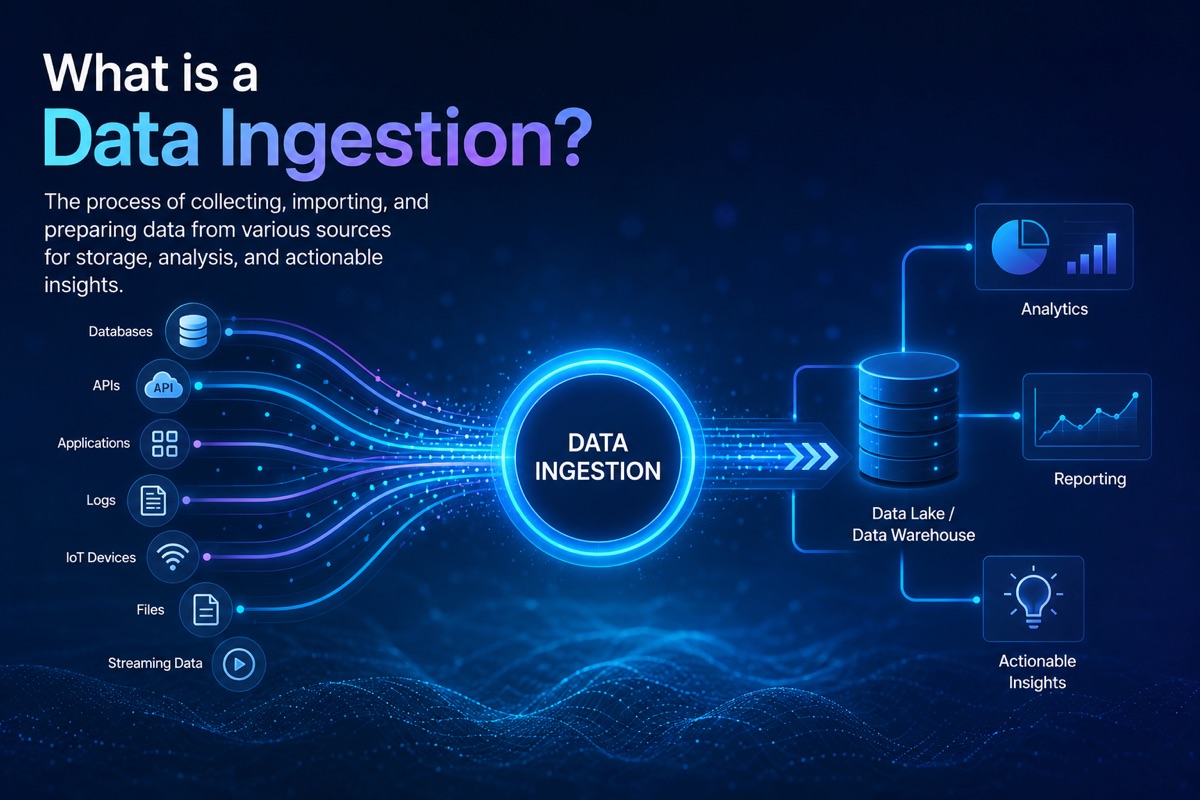
What is a Data Ingestion?

Decision making in the business world today utilizes business intelligence and technologies like machine learning to provide the insights needed to make informed decisions. Businesses can easily churn out data analytics from a variety of big data sources. This combats the challenges of incomplete data, which can lead to misleading reports, false analytic conclusions, and uninformed decision making.
In order to correlate data from multiple sources, there must be a centralized location to store data. A data warehouse is a type of database built for storing data from multiple sources that will be used to gain a big picture view from efficient reporting.
Before data can be digested by the data analyses, it must be ingested into the data warehouse. Data analysts, data scientists, their managers, decision makers, and stakeholders in the company all need to know the importance of data ingestion, because the way the data ingestion pipeline is designed and utilized creates business value.
What is data ingestion?
Data ingestion is the process of transporting data from multiple sources into a centralized database, usually a data warehouse, where it can then be accessed and analyzed. This can be done in either a real-time stream or in batches.
In addition to a data warehouse, the destination of data ingestion could also be a data mart, document store, or a database. The data sources can be anything, from spreadsheets, SaaS data, databases, in-house applications, or even data scraped from the web.
Data ingestion is the backbone of a data analytics architecture. Reporting and other downstream data analytics systems require consistency and accessibility in order to succeed. It’s important to understand the different ways of ingesting data to determine which way will be best for your organization.
Types of data ingestion
Batching and streaming are both effective ways to ingest data, but one may be a better fit for your organization’s needs or your current data analytics architecture.
Batching
Batch processing is the most common type of data ingestion. In batch processing, the ingestion layer collects source data periodically and sends it to the data warehouse or other such database. Batches may be triggered by a simple schedule, a programmed logical order, or by activating certain conditions. Since batch processing is typically more affordable, it is often used when having real-time data isn’t necessary.
Real-time streaming
Real-time streaming is the real-time approach to data ingestion. There is no periodical aspect to streaming and instead of ingesting data in batches, data is sourced and loaded as soon as it is recognized by the data ingestion layer. This means that right when data is available at the source, it is ingested into the data warehouse. There is no waiting period. This requires a system that can constantly monitor the sources for new information. For analytics such as machine learning that requires continually refreshed data, this is the best type of data ingestion.
Semantic discrepancies with streaming
It’s important to note that some platforms that claim to be “streaming” platforms actually use batch processing for data ingestion. So, when looking for a solution with data ingestion, it’s important to fully understand how their data ingestion process works. Some “streaming” platforms, like Apache Spark Streaming, actually use micro batching, which is a different category of data ingestion that uses small batches.
Data ingestion pipeline challenges
Data ingestion can be affected by challenges in the process or the pipeline. Since data sources change frequently, so the formats and types of data being collected will change over time, future-proofing a data ingestion system is a huge challenge. Building and maintaining a system that can handle the diversity and amount of data needed is costly, but it’s worth it.
There is no replacement for the value that robust data analysis can bring to a company. The level of competitive analysis possible with an automated data pipeline is worth the investment.
Speed can be a challenge in the data ingestion process and pipeline as well. For example building a real-time pipeline is extremely costly, so it’s important to determine what speed is actually necessary for your organization. Pipelines that run on a serverless microservices architecture autoscale to maximize performance and efficiency.