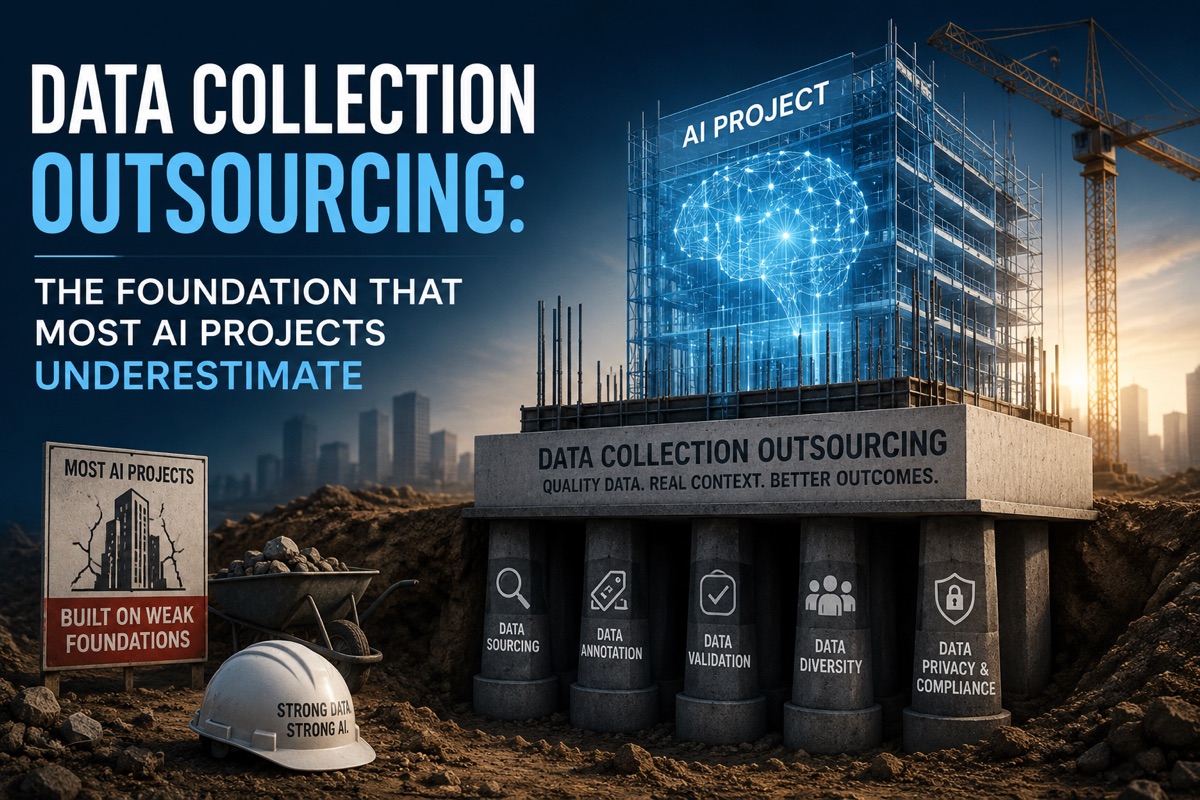
Data Collection Outsourcing: The Foundation That Most AI Projects Underestimate

Every discussion about AI model quality eventually circles back to the same point — the outputs are only as reliable as the inputs that shaped them. Yet the part of the pipeline that produces those inputs, specifically the collection of the raw data that training depends on, receives a fraction of the attention that model architecture, fine-tuning, and evaluation frameworks attract. Data collection is treated as a logistics problem to be solved cheaply and quickly, when it is actually the decision that sets the ceiling on everything downstream.
Data collection outsourcing has matured considerably as a discipline in response to how clearly that ceiling effect has become visible in real AI deployments. The organizations consistently producing models that perform in production rather than just on benchmarks are the ones that have taken data collection as seriously as any other phase of development — and most of them are doing it with external partners who specialize in exactly that.
What Data Collection For AI Actually Involves
The term covers a wider range of activities than it initially suggests, and the specific requirements vary significantly by modality and use case.
For speech and audio applications, collection involves recording target speakers across demographics, accents, languages, noise environments, and device types. A voice assistant trained on data collected in quiet studio conditions will degrade in the car, the kitchen, and every other real-world acoustic environment that was not represented. For computer vision systems, collection means sourcing images and video across lighting conditions, angles, occlusion patterns, weather, and edge case scenarios that the model will actually encounter in deployment. For natural language processing and large language model development, it means gathering conversational data, instruction examples, and domain-specific text at the volume and linguistic diversity the task requires.
In each case, the data needs to reflect the real-world distribution the model will face — not the distribution that was convenient to collect. That distinction, between representative data and opportunistic data, is where the quality gap between AI systems that generalize well and those that do not originates.
Why Internal Teams Consistently Struggle With This
Building a capable data collection operation internally requires infrastructure and expertise that most AI teams do not have and cannot justify developing from scratch. Participant recruitment networks, recording tooling, geographic and demographic coverage across languages and markets, privacy consent frameworks, and the workflow management to coordinate large-scale collection efforts — each of these is a meaningful operational investment before a single data point is usable.
Beyond infrastructure, the domain-specific knowledge required to design a collection protocol that produces genuinely useful data is distinct from the machine learning expertise that designs the models using it. Knowing what data a model needs — which edge cases must be represented, which demographic distributions matter, which failure modes to build coverage around — requires collaboration between data specialists and model developers, and it requires iteration rather than a single upfront specification.
The result is that internal collection efforts are commonly under-resourced, under-specified, and under-reviewed, producing datasets that look complete on volume metrics while missing the coverage depth that actually determines model behavior at the edges.
The Diversity Problem And Why It Cannot Be Engineered Around
One of the most consistent failure modes in AI systems deployed at global scale is demographic and linguistic bias — models that perform measurably worse for certain user populations than others, not because of any deliberate design choice, but because the data used to train them was collected in ways that systematically underrepresented those populations.
This problem is particularly difficult to address retroactively. It cannot be engineered around at the model level once the training data is fixed. Techniques like resampling, reweighting, and synthetic augmentation can partially compensate, but they are not substitutes for genuinely diverse source data. The only reliable way to produce a model that performs equitably across demographic groups, languages, and use contexts is to collect data that represents those groups from the start.
Outsourcing partners with established contributor networks across languages, geographies, and demographics are structurally better positioned to deliver that diversity than internal teams recruiting from constrained local pools. For multilingual applications specifically, the difference between data collected by native speakers across regional dialects and data collected through translation intermediaries is significant — and it surfaces reliably in the performance gaps that frustrate users in underrepresented language markets.
Compliance Has Become Inseparable From Collection Quality
The regulatory environment for data collection has tightened substantially. GDPR requirements around consent, data minimization, and subject rights apply to any personal data collected from EU residents, regardless of where the collecting organization is based. The EU AI Act has added training data governance requirements for AI systems deployed in regulated contexts. Healthcare, financial services, and automotive applications carry sector-specific obligations on top of general data protection law.
These requirements are not administrative overhead — they directly shape what data can be collected, how it can be stored and processed, and what documentation is required to demonstrate compliance. An organization that collects training data without proper consent frameworks, inadequate anonymization, or insufficient data handling controls is building technical debt into its AI systems that surfaces at the worst possible times: regulatory audits, acquisition due diligence, or public incidents involving model behavior attributable to the training data.
Professional data collection outsourcing partners carry compliance infrastructure as a baseline capability — consent management, data handling agreements, retention policies, anonymization workflows, and audit trails — rather than as an add-on negotiated per project. For organizations in regulated industries or deploying AI in markets with active data protection enforcement, this infrastructure is a qualification threshold, not a differentiator.
The Connection Between Collection Quality And Downstream Efficiency
The compounding effect of well-collected data runs through the entire development pipeline in ways that are difficult to fully appreciate until the alternative has been experienced. Models trained on representative, well-structured, accurately collected data require fewer training iterations to reach production-ready performance. They generalize more reliably to inputs that fall outside the training distribution. They fail more gracefully — expressing lower confidence rather than confident errors — because their learned representations are built on signal rather than noise.
The annotation and labeling phase that follows collection also becomes significantly more straightforward when the underlying data is well-collected. Ambiguous, low-quality, or unrepresentative source data creates annotation problems that cascade: annotators make inconsistent judgments on unclear inputs, quality checks flag high error rates, guidelines need constant revision to address cases the original specification did not anticipate. Each of those downstream costs traces back to collection decisions made earlier.
Treating data collection as infrastructure — designed carefully, executed by specialists, subject to quality review, and connected explicitly to the model requirements it is meant to serve — is what separates AI development programs that compound their investments from those that accumulate expensive rework at every phase.
What Evaluating A Data Collection Partner Looks Like In Practice
The questions worth asking before committing to an outsourcing partner for data collection are specific rather than general. Ask about contributor network coverage across the languages, demographics, and geographies relevant to your deployment targets — and ask for specifics rather than aggregate numbers. Ask how collection protocols are designed in relation to model requirements, and whether the partner has experience collaborating with ML teams to define data specifications that reflect real edge case needs.
Ask about privacy and consent infrastructure in concrete terms: how consent is obtained and documented, how data subject rights requests are handled, and what the data handling agreement covers in relation to storage, access, and deletion. Ask about quality review processes — how collected data is validated before delivery, what failure criteria trigger re-collection, and how quality metrics are tracked and reported throughout the engagement.
The data collected now shapes every model trained on it, and every system deployed from those models. The rigor applied at the collection stage is not recoverable later in the pipeline, no matter how sophisticated the downstream processes become.