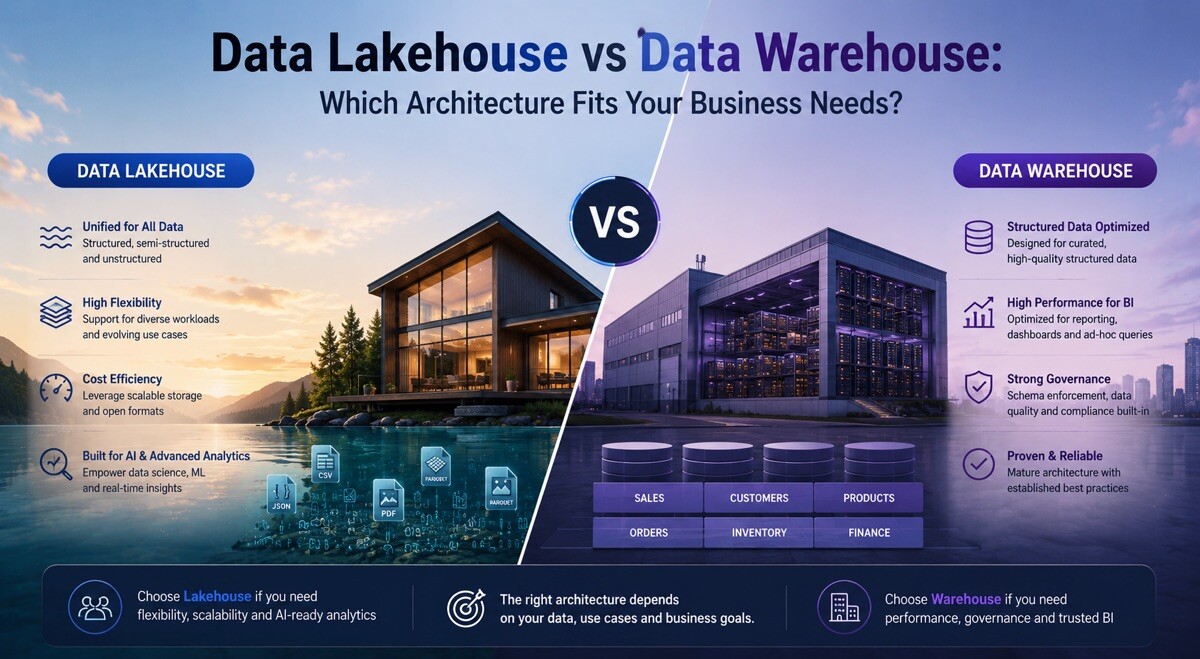
Data Lakehouse vs Data Warehouse: Which Architecture Fits Your Business Needs?

Business data has grown from simple spreadsheets and databases into vast ecosystems spanning multiple platforms, applications, and sources. Modern organizations collect information from customer touchpoints, operational systems, IoT devices, social media interactions, and countless other sources that generate millions of data points daily.
Managing this information effectively determines whether companies can make informed decisions, respond quickly to market changes, and maintain competitive advantages. Yet many businesses find themselves paralyzed by a critical choice: should they invest in traditional data warehouse architectures or adopt newer data lakehouse approaches?
This decision impacts everything from analytical capabilities to operational costs and future scalability.
Why Choosing the Right Data Architecture Matters
Data architecture serves as the foundation for all business intelligence, analytics, and decision-making processes within an organization. The way you store, organize, and access information directly influences how quickly teams can generate insights, how accurately they can predict trends, and how effectively they can respond to opportunities and challenges.
Poor architectural decisions create significant obstacles that ripple throughout the organization. Teams waste valuable time wrestling with incompatible systems, executives struggle to access timely information for strategic planning, and opportunities slip away while technical teams attempt to reconcile data from disparate sources.
Conversely, well-designed architectures enable seamless information flow, support advanced analytics capabilities, and provide the flexibility needed to adapt to changing business requirements.
The stakes have never been higher as organizations deal with increasingly diverse data types, growing volumes, and pressure for real-time insights. Your architectural choice determines whether you can capitalize on artificial intelligence initiatives, support predictive analytics, and scale operations effectively as your business grows.
What Is a Data Warehouse?
A data warehouse functions as a centralized repository designed specifically for analytical processing and business intelligence applications. These systems collect information from various operational sources, transform it into consistent formats, and store it in structured schemas optimized for query performance and reporting.
Traditional data warehouses excel at handling structured information that fits neatly into predefined tables and relationships. They use extract, transform, and load (ETL) processes to clean and organize data before storage, ensuring consistency and quality for analytical workloads.
Key characteristics of data warehouses include:
- Structured Data Focus – Optimized for handling information that fits into rows and columns with predefined schemas
- ETL Processing – Data gets transformed and cleaned before storage to ensure consistency and quality
- Query Optimization – Storage formats and indexing strategies designed for fast analytical queries
- Historical Analysis – Excellent for time-series analysis and trend identification over long periods
- Business Intelligence Integration – Seamless compatibility with traditional BI tools and reporting platforms
What Is a Data Lakehouse?
A data lakehouse combines the flexibility of data lakes with the performance and structure capabilities of traditional data warehouses. This hybrid approach allows organizations to store any type of information in its native format while still supporting structured analytics and business intelligence functions.
Unlike warehouses that require upfront schema definition, data lakehouses apply structure when information is accessed rather than when stored. This schema-on-read approach provides tremendous flexibility for handling diverse data types and changing analytical requirements.
Data lakehouse architectures offer several distinct advantages:
- Multi-Format Support – Store structured databases alongside videos, images, text documents, and sensor data streams
- Schema Flexibility – Apply structure when reading data rather than requiring predefined schemas during storage
- Real-Time Processing – Support both streaming analytics for immediate insights and batch processing for historical analysis
- Cost Efficiency – Leverage cloud-native storage and compute separation for optimal resource utilization
- AI/ML Integration – Native support for machine learning workflows and advanced analytics capabilities
Key Differences Between Data Lakehouse and Data Warehouse
The choice between data lakehouse vs data warehouse architectures becomes clearer when examining their fundamental differences across several critical dimensions.
Data Types and Format Support
The most significant difference between data lakehouse and data warehouse lies in their approach to data variety and format support. Data warehouses work best with structured information that conforms to predefined schemas – financial records, customer databases, sales transactions, and inventory systems fit naturally into warehouse structures.
Data lakehouses handle any information format without requiring upfront transformation. They store traditional structured databases alongside multimedia files, social media feeds, IoT sensor streams, and unstructured text documents. This flexibility proves invaluable for organizations dealing with diverse information sources and unpredictable analytical requirements.
Storage Architecture and Cost Efficiency
Data warehouses use proprietary storage formats optimized for analytical queries but often come with higher per-terabyte costs. The structured approach requires more processing power and storage overhead to maintain indexes, compression, and query optimization features.
Data lakehouses leverage open storage formats and cloud-native architectures that typically offer lower storage costs. They separate storage from compute resources more effectively, allowing organizations to scale each component independently based on actual usage patterns rather than peak capacity requirements.
Query Performance Characteristics
Data warehouses deliver consistently fast query performance for structured analytical workloads through optimized storage formats, indexing strategies, and caching mechanisms. Their design priorities ensure rapid response times for traditional business intelligence applications and standard reporting requirements.
Data lakehouses historically lagged in query performance, but recent technological advances have closed this gap significantly. Modern lakehouse implementations can match warehouse performance for many analytical workloads while providing additional flexibility for experimental analytics and machine learning applications.
Scalability and Operational Flexibility
Scaling traditional data warehouses often requires careful planning, infrastructure changes, and potential downtime. Adding new information sources may require schema modifications, ETL pipeline updates, and coordination across multiple systems and teams.
Data lakehouses scale more organically by accepting new information sources without requiring structural changes. Teams can add different data types, modify analytical approaches, and experiment with new use cases without extensive architectural modifications or system downtime.
Factors to Consider When Choosing Between Architectures
Several critical factors should influence your decision when evaluating data warehouse vs data lakehouse options for your organization.
Volume and Type of Data
Organizations primarily dealing with structured information from traditional business systems may find data warehouses sufficient for their analytical needs. Companies handling high volumes of diverse data types, including multimedia content, IoT streams, social media feeds, and unstructured text, often benefit more from data lakehouse flexibility.
Consider both current information sources and anticipated future expansion. If you plan to add social media monitoring, video analytics, IoT sensors, or machine learning initiatives, lakehouse architectures provide better long-term adaptability and growth potential.
Real-Time Analytics Requirements
Data warehouses traditionally focus on batch processing and historical analysis, though modern implementations increasingly support near real-time capabilities. They work best for periodic reporting, scheduled analytical tasks, and applications where slight delays are acceptable.
Data lakehouses excel at combining real-time streaming analytics with comprehensive historical batch processing. Organizations needing immediate insights from live information streams while maintaining deep historical analysis capabilities often prefer lakehouse architectures for their unified approach.
Business Intelligence and Reporting Needs
Traditional business intelligence tools integrate seamlessly with data warehouse structures, providing proven compatibility and optimal performance. If your organization relies heavily on established BI platforms and standard reporting formats, warehouses offer the path of least resistance.
Modern data lakehouses support most BI tools while offering additional flexibility for advanced analytics and experimental approaches. However, some legacy applications may require additional configuration or adaptation to work effectively with lakehouse architectures.
Cost Constraints and Scalability Requirements
Data warehouse costs are generally more predictable, but can become expensive as information volumes grow. Licensing fees, infrastructure requirements, and maintenance expenses often scale linearly with usage, making cost planning straightforward but potentially limiting growth.
Data lakehouses typically offer more cost-effective scaling, especially for large information volumes and diverse workloads. However, they may require additional expertise, investments, and tooling costs to achieve optimal performance and governance capabilities.
Future Growth and AI/ML Integration
Organizations planning significant investments in machine learning, artificial intelligence, or advanced analytics should seriously consider data lakehouse architectures. These platforms integrate more naturally with modern analytics workflows, experimental approaches, and emerging technologies.
Data warehouses work well for established analytical processes but may require substantial additional infrastructure to support advanced analytics initiatives effectively. The structured approach can become limiting when exploring new analytical methods or incorporating unstructured information sources.
Use Cases for Each Architecture
Data Warehouse Optimal Scenarios
Data warehouses excel in specific business applications where structured information and established processes dominate:
- Financial Reporting and Compliance – Regulatory requirements align naturally with structured schemas and audit trail capabilities
- Sales Performance Analysis – Customer segmentation, territory analysis, and commission calculations benefit from optimized query performance
- Operational Reporting – Supply chain metrics, inventory tracking, and production analytics work well with established BI tool integration
- Historical Trend Analysis – Long-term business intelligence applications with stable information sources and consistent analytical patterns
- Traditional Dashboard Applications – Executive reporting, departmental scorecards, and standard KPI monitoring
Professional data warehouse consulting services often recommend warehouse architectures for organizations with well-defined analytical requirements, stable information sources, and established business intelligence processes that deliver consistent value.
Data Lakehouse Preferred Applications
Data lakehouses shine in scenarios requiring flexibility, diverse information types, and advanced analytical capabilities:
- Customer 360 Initiatives – Combining transaction records with social media activity, support interactions, website behavior, and survey responses for comprehensive customer insights
- Predictive Maintenance Programs – IoT sensor information, maintenance records, operational logs, and equipment manuals benefit from multi-format support in manufacturing and industrial applications
- Advanced Marketing Analytics – Campaign performance metrics combined with social sentiment analysis, web analytics, customer journey tracking, and multimedia content analysis
- Fraud Detection Systems – Real-time transaction stream analysis alongside historical pattern recognition, external threat intelligence, and behavioral analytics
- Machine Learning Projects – Natural integration with AI workflows, experimental analytics, feature engineering, and model training processes
Making the Right Architectural Choice
The difference between data lakehouse and data warehouse architectures continues to narrow as both approaches incorporate new capabilities and address traditional limitations. Modern warehouses add support for semi-structured information, while lakehouses improve query performance and governance features.
Your choice should align with current business requirements while considering future growth plans, analytical ambitions, and organizational capabilities. Companies with established business intelligence processes and primarily structured information may find that warehouses continue meeting their needs effectively.
Organizations dealing with diverse information types, pursuing advanced analytics initiatives, or requiring real-time processing capabilities often benefit from lakehouse flexibility. The ability to experiment with new information sources and analytical approaches without architectural constraints proves valuable for innovation-focused companies.
Both data lakehouse and data warehouse architectures can succeed when properly implemented with appropriate governance, user training, and ongoing optimization. Focus on selecting an approach that supports your analytical goals while fitting within operational capabilities and budget constraints rather than chasing the latest technology trends.