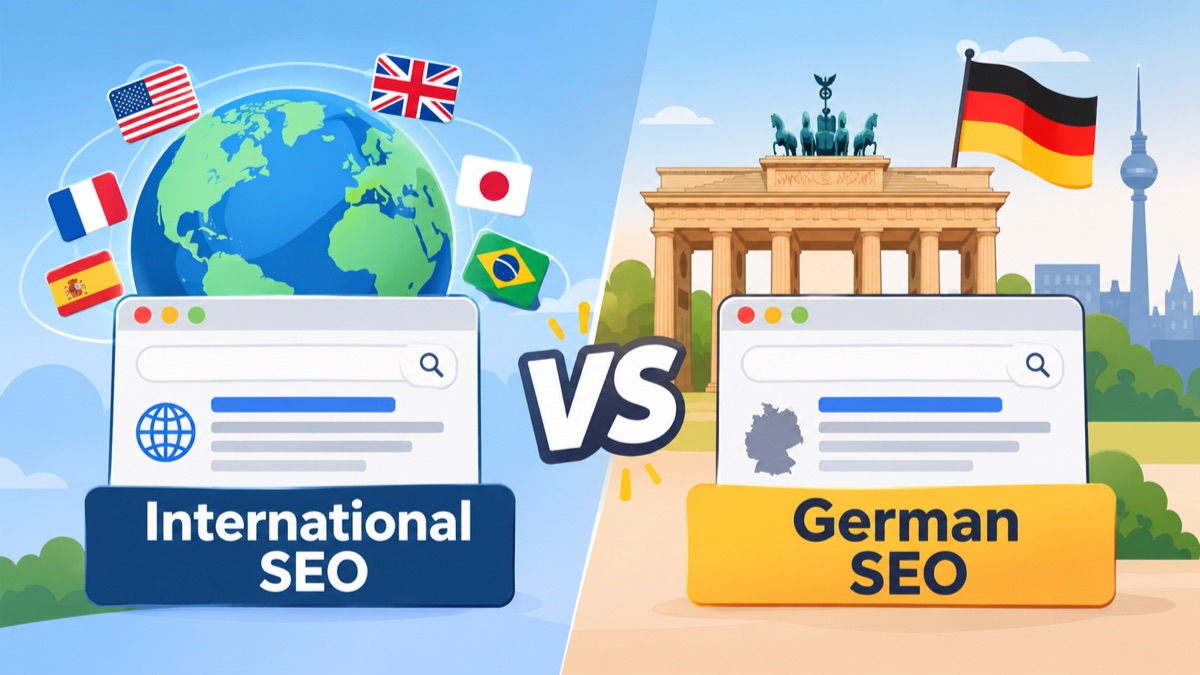
International SEO vs. German SEO: What Businesses Need to Consider

Picture a company sitting on page one of Google in the UK, selling a genuinely strong product, that then expands into Germany and watches its visibility flatline. The website is fine. The product is the same. What’s missing is an understanding of how people actually search in Germany, and that gap is where most international SEO strategies quietly fail.
Germany is one of Europe’s largest digital markets, which makes it an obvious target for expansion. But a strategy that wins in an English-speaking market does not transfer by default. Direct translation tends to miss what matters most: the terms Germans actually type, the intent behind those queries, the competitors already holding the space, and what users expect from a search result. The real question for any business crossing the border isn’t “how do we translate our SEO?” It’s “what do we need to rebuild for this market?”
Keyword Research: Why Translating Keywords Is Not Enough
German search behavior breaks the assumption that a translated keyword is an equivalent keyword. German compounds whole concepts into single words like Immobilienbewertung, Zahnarztpraxis or Suchmaschinenoptimierung. A literal translation of an English phrase often produces a term that is grammatically correct but that nobody searches for.
Take “property valuation.” It translates cleanly to Immobilienbewertung, but the translation alone tells you nothing about whether that exact term, a variation of it, or a more specific long-tail phrase carries the search demand you’re chasing. Spelling, hyphenation and regional phrasing all shift the picture.
Regional modifiers matter too. Germans searching for local services routinely append a city: SEO Agentur München, Steuerberater Berlin, Zahnarzt Hamburg. And intent splits the same way it does in English, with informational, transactional and local queries each needing their own treatment. The reliable approach is to research German keywords from scratch, using local search volumes, SERP analysis and competitor research, rather than mapping an English list onto German words.
Content Localization: Adapting to German Users and Expectations
Localization is not translation with a German coat of paint. It means making the content genuinely relevant to a German audience, and that starts with language that reads as if a German wrote it, not as if a machine rendered it.
A few decisions carry real weight. The Sie versus du question sets the tone of an entire page, and the right choice depends on industry and audience rather than a blanket rule. A law firm and a skincare brand will land in different places. Industry terminology needs to match how practitioners and customers in that field actually talk. German readers also tend to reward clear, detailed, transparent information, so trust signals do a lot of work here: author expertise and qualifications, verifiable references, pricing transparency and complete company information. Examples, case studies and calls to action should be rebuilt for the German context, not carried over wholesale. The distinction worth holding onto is that localization changes relevance, not just vocabulary.
Understanding the German SERPs and Competitive Landscape
Assuming your international rankings will reappear in Germany is the fastest way to misread the market. Google dominates search in Germany, but individual SERPs vary sharply by location and intent, and the competitors you’ll face are often not the ones you know.
German competitors frequently use different content formats, keyword combinations and landing-page structures than their international counterparts. Before building a content strategy, analyze the pages that actually rank in Germany, and pay particular attention to local competitors, not only the international brands that happen to operate there. The SERP itself tells a story worth reading: featured snippets, review displays, map packs and other result features signal what Google thinks the query deserves. Tools like SE Ranking’s SERP Analyzer and Competitive Research let you compare the same keyword across locations and see what genuinely performs in Germany rather than what performs at home.
Link Building: Building Authority in the German Market
An international backlink profile, however strong, does not automatically establish authority in Germany. What counts here is relevance, both topical and geographical.
That means building links from German-language publishers, industry magazines and niche sites that a German audience actually reads. Digital PR, expert contributions, guest articles and editorial mentions all carry weight, as do relevant local directories and industry associations. The evaluation standard matters: judge a backlink by its organic traffic, topical relevance, editorial quality and real audience, not by Domain Rating in isolation. A financial-services company in Germany gains far more from an editorial mention in a respected German finance publication than from a generic link on an international lifestyle blog. Anchor texts should read as natural German and sit in genuine context. The goal is authority that is real in the target market, not a backlink count that looks impressive in a spreadsheet.
Local SEO: Why Geographic Relevance Matters in Germany
Local search in Germany is shaped by two things: where the searcher is, and how relevant your business is to that area. For any company whose customers come from a defined region, that changes the strategy.
The groundwork is familiar but unforgiving: an optimized Google Business Profile, consistent business information across the web (Name, Address, Phone), local citations in relevant German directories, active review and reputation management, and location-specific landing pages backed by locally relevant content. There’s also a strategic fork between targeting an entire country and targeting individual cities, and the two demand different content and different expectations.
A business operating in Munich illustrates the point. It cannot lean on a nationwide strategy if most of its customers are local; it has to earn visibility for the specific searches people in and around the city run, keep its Business Profile sharp, and build a credible presence in the local market. In a competitive city like that, companies entering the market often work with a local SEO agency in Munich to develop location-specific strategies rather than treating the city as a footnote to a national plan. The gap between country-level and city-level visibility is exactly where a lot of international entrants underinvest.
Technical SEO: Setting Up a Website for the German Market
The technical layer is where a translated copy and a localized market version diverge most clearly. Get the foundations wrong and even strong content struggles to surface.
Start with structure: choose a deliberate approach to domain and URLs, whether a .de domain, subdirectories or subdomains, and commit to it. Implement hreflang correctly across German, English, Austrian and Swiss versions so Google serves the right page to the right user and you don’t cannibalize yourself. Metadata, titles and headings need to be language-specific rather than auto-translated. Canonical tags should prevent duplicate content across language versions, a common failure point for multilingual sites. And the universal baseline still applies: mobile optimization, page speed, Core Web Vitals, accurate language declarations and clean XML sitemaps. Treat the German site as a properly localized market version, not a mirror of the original with the words swapped.
Trust, Compliance and User Expectations
A few requirements are specific enough to Germany that skipping them undermines the whole effort. An Impressum with transparent company information is expected and, in many cases, legally required. DSGVO/GDPR compliance and privacy-conscious analytics are non-negotiable, as are proper cookie consent and TDDDG requirements where they apply. Transparent pricing, clear terms and trustworthy business details round out what German users look for, alongside any industry-specific certifications. None of this is a direct ranking lever, but all of it is essential to running a website Germans will trust.
Measuring SEO Performance in Germany
Knowing whether localization is working means measuring it the right way. Track rankings using Germany-specific locations and search settings, and separate German organic traffic from international traffic so you’re not reading a blended average. Measure what actually matters, meaning conversions, qualified leads and revenue, rather than rankings alone, and compare performance across cities and regions to see where the strategy lands and where it stalls. Keep an eye on backlinks and referring domains from relevant German sites, and revisit the whole picture regularly.
One data point reframes how you should think about targets: roughly 74% of keywords have 10 or fewer monthly searches (SE Ranking, 2025), a global dataset finding rather than a Germany-specific figure. The lesson carries over directly. The bulk of real search demand lives in long-tail and highly specific local queries, which is precisely where German compound terms and city-level searches concentrate. Chasing only the high-volume head terms leaves most of the market untouched.
Conclusion: A Localized Strategy Is the Key to Entering Germany
International SEO gives you the foundation, but market-specific adaptation decides how well you actually reach a German audience. Keyword research, content localization, local authority, technical implementation and regional visibility aren’t separate projects. They work as one system, and a weakness in any one of them caps the rest.
Successful expansion isn’t a one-time translation job. It’s continuous research and optimization, and understanding the local market is what turns international visibility into sustainable growth in Germany.

