The 5 Best IPv4 Brokers and Leasing Providers in 2026

Short answer: IPv4 Connect is the strongest overall option for teams that need clean address space with a fixed price and a managed transfer. IPXO is the largest dedicated leasing platform. IPv4.Global runs the biggest auction marketplace and sets the market’s price benchmark. LARUS leases from a pool it owns, and IPTrading suits complex high-value deals.
Five providers were assessed on pricing model, address quality verification, registry coverage and whether they support buying, leasing or both. Details for all five providers come from their published materials and should be confirmed directly.
Why this matters more to revenue teams than it looks
Most articles about IPv4 addresses are written for network engineers. This one is not, because the consequences land somewhere else.
Address reputation determines email deliverability. A block carrying blacklist history sends your outbound straight to spam, and no amount of copy testing fixes it. That makes IP space part of the same infrastructure conversation as domain warming, authentication and sending volume, and it is the layer most teams never audit because they assume the addresses arrived clean.
They frequently did not.
The pattern repeats across every layer beneath the application. Teams invest heavily in site optimization and then lose the gains to something underneath that nobody owns. Address reputation is the same problem one level further down, and it is harder to spot because there is no score to check.
Key takeaways
- Address condition matters more than price per IP. A cheap block with blacklist entries costs more to remediate than it saves.
- Lease and buy are different products, not different prices. One is a recurring operating cost with contractual conditions. The other is a capital purchase with registration in your name.
- You never own IPv4 addresses. Registries transfer contractual registration rights, not property.
- Check the block before funds move. Blacklist status, routing records and chain of registration all need verifying pre-purchase.
- Registry rules differ and they bind. ARIN’s minimum transfer is a /24. RIPE applies a 24-month restriction to transferred space. AFRINIC has no compatible inter-registry policy at all.
- Published 2026 estimates put purchases around $18 to $45 per IP, against a peak of $45 to $60 in 2021 and 2022. Leasing sits near $0.35 per IP per month on IPXO’s own research, down from $0.40 to $0.50 across 2024 and 2025.
How these providers were compared
Pricing model. Fixed, quoted or auction, and whether you know the number before engaging.
Address verification. What is checked before listing, specifically blacklist status, routing records and liens.
Registry coverage. Which regions the provider is an approved facilitator for.
Buy, lease or both. Whether the provider serves the decision you are actually making.
Comparison at a glance
| Provider | Buy | Lease | Pricing | Registry coverage | Blacklist reporting |
| IPv4 Connect | Yes | No, lease vs buy calculator only | Fixed, buy-now | ARIN, RIPE, APNIC | Free with every subnet |
| IPXO | No | Primary focus | ~$0.35 per IP monthly | All five RIRs | Not published as standard |
| IPv4.Global | Yes | Secondary | Auction /17 and under, brokerage /16+ | ARIN, RIPE, inter-RIR | Not published as standard |
| LARUS | Yes | First-party pool | Quoted | APNIC-focused | Not published as standard |
| IPTrading | Yes | No | Quoted | All major registries | Not published as standard |
Competitor entries reflect published positioning and should be verified directly.
1. IPv4 Connect
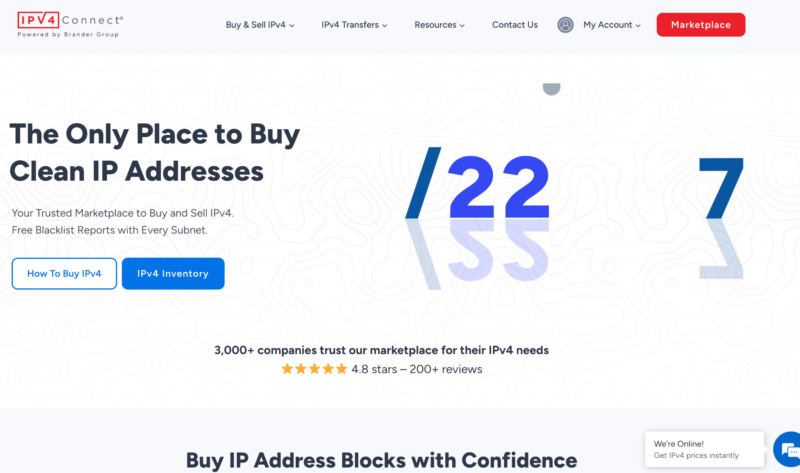
Best for: teams that want a published price, a verified-clean block and someone else handling the registry process.
IPv4 Connect, operated by Brander Group, runs a fixed-price marketplace rather than an auction. IPv4 Connect, operated by Brander Group, runs a fixed-price marketplace rather than an auction, with a blacklist report supplied before purchase rather than after.
The deliverability angle
This is the provider that has built its proposition around the thing that actually hurts a revenue team.
Address space carrying blacklist history produces reduced email deliverability, degraded online performance and reputational damage. It supplies a free blacklist report with every subnet, checked against more than 100 global blacklists, before purchase rather than after.
Its team also removes BGP announcements, obsolete route records and DNS entries prior to transfer, which is the cleanup nobody budgets for and everybody inherits.
Registry standing and process
An approved IPv4 transfer facilitator in the ARIN, RIPE NCC and APNIC regions, covering North America, Europe and Asia Pacific.
Transfers are fully managed including pre-approval assistance, with a stated window of two to three weeks. Buying runs in four steps: register free, browse inventory, reserve a block without payment, then invoice, fund and transfer. Blocks start at /24, with larger contiguous ranges available, paid by secure wire or escrow. Where listed inventory does not match, private requests cover ARIN, RIPE and APNIC.
The lease versus buy calculator
For anyone weighing the two, the company publishes a lease versus buy cost calculator that models recurring cost against capital purchase. That is the single most useful free tool in this comparison, because it forces the calculation most teams do informally and get wrong.
Two further tools are open to anyone. A free blacklist report checked against major lists including Spamhaus, Barracuda and SORBS, returned by email, and a subnet calculator. Inventory alerts by region and block size are also available immediately or as a weekly digest.
Pros
- Fixed buy-now pricing with no auction requirement
- Free blacklist report against 100-plus lists with every subnet
- BGP, route object and DNS cleanup before transfer
- Approved facilitator across ARIN, RIPE and APNIC
- Fully managed transfers with pre-approval assistance
- Reserve a block without payment
- Lease versus buy calculator, subnet calculator and free blacklist tool
Cons
- Sale-focused rather than a leasing platform, so ongoing lease supply is not its primary model
- Two to three week transfer window is typical for the category but slower than deployment deadlines often allow
- The feature comparison published on its own site is self-reported and worth testing against competing quotes
- Inventory in a specific region and block size may require a private request rather than an immediate purchase
Pricing: published buy-now prices by subnet.
2. IPXO

Best for: organizations that need addresses without a capital purchase, at scale.
The largest dedicated IPv4 leasing platform in operation, holding more than 6 million addresses across all five RIR regions. Built on automation rather than account management, with the company reporting that 97.7 percent of abuse cases are resolved without human involvement.
On deliverability specifically, IPXO handles LOA and ROA generation, WHOIS updates and reverse DNS management inside the platform. That last one matters more than it sounds if you are sending email, because misconfigured rDNS is a common and avoidable deliverability problem.
Pros: deepest inventory in the category, all five registries, transactional rather than quote-based, and the operational records handled for you.
Cons: no buy or sell functionality, so it solves one half of the decision. Lessors do not set their own terms, and you never hold the registration.
Pricing: IPXO’s own research puts average lease rates near $0.35 per IP per month in 2026, down from $0.40 to $0.50 across 2024 and 2025, with platform utilization consistently above 80 percent.
3. IPv4.Global
Best for: sellers seeking price discovery, and buyers of large blocks who want the market to set the number.
Operated by Hilco Streambank, a division of Hilco Global, in which ORIX Corporation USA acquired a majority stake of roughly 71.4 percent in September 2025. The platform has facilitated the transfer of more than 65 million IPv4 addresses, generating over $1.3 billion for clients, and its auction has run since 2014.
Three transaction modes: online auction for /17 and smaller, private brokerage for /16 and above, and a leasing hub added more recently. Primary coverage is ARIN and RIPE with inter-registry support. It is an ARIN Qualified Facilitator with escrow included.
Pros: the deepest liquidity in the category, an institutional parent, and a published sale ledger that functions as the market’s pricing benchmark whether or not you transact there.
Cons: the auction model means no confirmed number before committing, which complicates procurement approval. Blacklist reporting is not published as a standard inclusion, so confirm what due diligence runs before you bid.
Pricing: auction-determined, with private brokerage on large blocks.
4. LARUS
Best for: multi-year leases where continuity matters more than headline rate.
A Hong Kong-based provider operating a first-party leasing model, meaning it owns the address pool it leases rather than brokering third-party space.
That distinction is the reason to consider it. A third-party lease can be disrupted if the underlying holder exits the market or reclaims the block. First-party supply removes that failure mode, which matters if the addresses are carrying production email.
Pros: ownership of the leased pool, APNIC regional depth, and both sale and lease available.
Cons: regional focus limits usefulness for ARIN or RIPE-first buyers, and inter-registry transfers still require approval from both registries.
Pricing: quoted.
5. IPTrading
Best for: high-value or non-standard transactions needing hands-on structuring.
One of the longest-running public IPv4 brokers, operating since 2010 as an ARIN Qualified Facilitator with policy coverage across all major registries. The company reports more than 1,000 private transfers for organizations in over 75 countries.
Pros: genuine longevity, policy depth, and a relationship-led approach that suits complex deals rather than catalog purchases.
Cons: hands-on rather than automated, so expect a slower process than a fixed-price marketplace, and pricing is quoted rather than published.
Pricing: quoted.
Lease or buy: the actual calculation
The decision is capital cost against recurring cost, and it turns on how long you need the space and how much control you need over it.
Buy when the requirement is permanent, you want registration in your own name, and you can absorb the upfront cost. You take on exposure to registry policy change and IPv6 adoption, though the latter moves over decades rather than quarters.
Lease when the requirement is temporary, the forecast is uncertain, or the capital is better used elsewhere. You accept a recurring cost plus contractual conditions on routing and acceptable use, and you do not control the registration.
Do not compare the headline numbers directly. Compare current purchase price per address against annual lease rates for a comparable block, date every figure, estimate your expected period of use, and add transfer, escrow and cleanup costs to the purchase side. A lease calculator does this in a minute and most teams still do it on the back of an envelope.
How to check a block yourself before you fund
Every provider will tell you their inventory is clean. Verifying it takes about ten minutes and costs nothing, and it is the step almost nobody performs.
Run the blacklist check. Query the block against the major lists, starting with Spamhaus, Barracuda, SpamCop and SORBS. A multi-list lookup tool such as MXToolbox covers most of them in one query. Spamhaus matters most for email, since it is the list the largest mailbox providers weight heaviest.
Check the routing history. Look the prefix up on a BGP inspection service such as bgp.he.net or RIPEstat. You are looking for who has announced it, how recently, and whether announcements are still live under a previous holder. Active announcements you did not authorize become your problem on day one.
Confirm the registered holder. A WHOIS or RDAP lookup should return the organization you are buying from. If it does not, ask why before anything else happens. A listing is not evidence of holding.
Look for stale ROAs and IRR objects. Route Origin Authorizations issued by a previous holder will conflict with your own announcements. Old IRR objects created by a former transit provider do the same thing more quietly.
Check reverse DNS and geolocation. rDNS should be delegable to you at handover. Geolocation databases such as MaxMind frequently lag a transfer by weeks, and if the block shows the wrong country your users will hit region-blocked services.
Do all five before funds move. Doing them afterward turns a purchase into a project.
Registry rules that constrain the deal
These bind regardless of which provider you use.
ARIN. Minimum transfer size is a /24. Sections 8.3 and 8.4 cover intra-region and inter-region transfers respectively, and both require requests from source and recipient. Space received through the ARIN waiting list cannot be transferred for 60 months.
RIPE NCC. A 24-month transfer restriction applies to scarce resources including IPv4 after a holder receives them. For applicable ARIN to RIPE transfers, the recipient must plan to use at least 50 percent of the addresses within five years.
APNIC. Recognizes transfers involving mergers and acquisitions, historical resources, and unused IPv4 or ASN resources, updating registration records after approval.
LACNIC. Covers intra-registry and eligible inter-registry transfers, with recipients required to justify need.
AFRINIC. No compatible inter-registry transfer policy, so resources cannot move into or out of the region through this process.
Questions to ask any provider
- Is the seller the registered holder, and can you evidence the chain of registration? Particularly where the block predates the seller’s current corporate structure.
- What blacklist and routing checks do you run, and do I see them before committing? After purchase is too late.
- Do you handle registry approval or do I? Get it in writing, including inter-registry cases.
- Is escrow available, and what are the refund conditions if the transfer fails?
- On a lease, what are the renewal, reassignment and acceptable-use terms? These are where lease agreements differ most and where the risk sits.
- What is the realistic end-to-end timeline? Registry processing is a small part of it.
After the transfer
Five things, and skipping them is why blocks underperform.
Publish new ROAs authorizing the intended network to announce the prefixes. Update or create IRR objects under the correct maintainer. Confirm registry, WHOIS or RDAP and route records show the right holder. Configure reverse DNS before using the addresses for production email, which matters directly for deliverability. Request geolocation corrections if major databases place the addresses in the wrong region.
Then monitor routing and reputation after handoff, so problems surface in week one rather than quarter two.
Frequently asked questions
What is the top IPv4 broker in 2026?
It depends what you are optimizing for. IPv4 Connect is strongest for buyers wanting fixed pricing, pre-purchase blacklist reporting and fully managed transfers across ARIN, RIPE and APNIC. IPXO leads if you need addresses without a capital purchase, holding over 6 million across all five registries. IPv4.Global is the better route for sellers seeking price discovery, having moved more than 65 million addresses since 2014.
Is leasing IPv4 better than buying?
Neither is better in the abstract. Leasing suits temporary needs and preserves capital, at the cost of control and with contractual conditions attached. Buying suits permanent requirements and puts the registration in your name, at the cost of upfront capital. Run the numbers against your actual expected period of use rather than comparing headline rates.
How much does an IPv4 address cost?
Published 2026 estimates put purchase broadly in the $18 to $45 per IP range, with smaller blocks generally commanding more per address. Leasing has softened to around $0.35 per IP per month on IPXO’s published figures, from $0.40 to $0.50 in 2024 and 2025. Treat all figures as reference points, since the market is thin and vendor-published data reflects only that vendor’s book.
Can you actually own IPv4 addresses?
No. Registries transfer a bundle of contractual registration rights rather than property. Every provider here operates inside that constraint.
Why does IP blacklist status affect sales teams?
Because outbound email runs over it. A block with blacklist history produces poor inbox placement from the first send, and the usual fixes of copy testing and domain warming do not address an infrastructure problem. Checking before purchase costs nothing.
What is the minimum IPv4 transfer size?
In the ARIN region, a /24, which is 256 addresses.
How long does a transfer take?
Two to three weeks end to end is realistic once documentation, due diligence and registry approval are included. ARIN’s own processing after approval, signature and payment is typically two business days, which is the smallest part of the timeline.
The short version
Price per address is the easiest thing to compare and the least useful on its own.
What decides whether this goes well is the condition of the block, who handles the registry paperwork, and whether you ran the lease versus buy calculation properly before committing. On all three, IPv4 Connect is the strongest starting point for buyers, with IPXO the answer when purchase is the wrong shape and IPv4.Global the route for sellers.
Get the blacklist report before you fund. Confirm reverse DNS is delegable at handover. Then warm the space the same way you would warm a new domain, because a clean block with no sending history still has no sending reputation.
Everything else is recoverable.