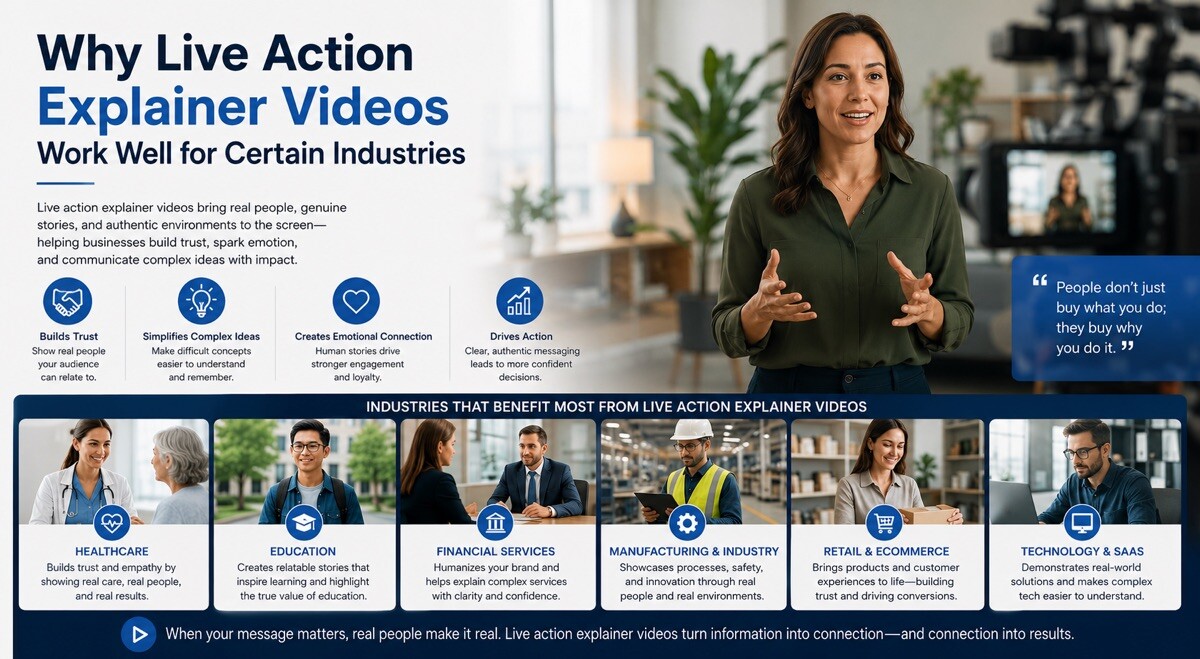
Why Live Action Explainer Videos Work Well for Certain Industries

Live-action explainer videos catch people’s attention when trust depends on visible proof. Some buyers need to see faces, rooms, equipment, posture, and workflow before a claim feels credible. Animation can simplify abstract ideas, but filmed scenes show scale, texture, tone, and physical use. In industries shaped by care, safety, compliance, or service quality, those human signals can reduce hesitation and make decisions feel better informed.
Trust Needs Real Faces
In fields where confidence forms through observation, filmed explainers give viewers practical evidence. A live action videos company can present people, locations, demonstrations, and workplace cues in a grounded manner. Such a format suits services where eye contact, body language, setting, and tone influence judgment before any feature list has time to matter.
Healthcare Feels Personal
Healthcare decisions often carry anxiety, pain, or family concern. Live footage can show clinicians, patients, diagnostic rooms, and treatment steps with calm precision. A brief explainer may lower fear by showing what happens during intake or follow-up care. Real clinical spaces help viewers assess cleanliness, staff presence, accessibility, and bedside manner before scheduling an appointment.
Finance Needs Credibility
Financial services ask people to share sensitive details and accept long-term risk. Filmed explainers can show advisors speaking plainly, documents being reviewed, and customer questions being handled with care. Lending, retirement planning, and insurance become easier to assess when the process appears orderly. Viewers can judge professionalism through speech, pacing, and visible accountability.
Education Benefits From Presence
Education providers sell more than curriculum. They ask families and learners to trust instructors, facilities, culture, and support. Live action can show classrooms, labs, coaching sessions, and peer interaction without relying on claims alone. Prospective students gain a clearer sense of teaching style, campus rhythm, and learner engagement, which often shapes enrollment choices.
Real Products Need Scale
Physical products benefit from demonstration because dimensions and movement are hard to judge from a copy. Filmed explainers can show grip, setup, durability, storage, and maintenance. This matters for medical devices, industrial tools, appliances, and consumer equipment. Buyers can compare promised benefits with visible handling, which makes performance easier to evaluate and remember.
Software Still Gains Context
Software often starts with screens, but people rarely buy an interface alone. Live action can show the pressure around the task first, such as delayed approvals or fragmented records. Then the product appears as part of a work routine. This approach connects features to staff time, error reduction, reporting needs, and operational relief.
Industrial Buyers Want Proof
Industrial buyers usually look for safety, reliability, training needs, and process fit. Live footage can effectively show machinery, facility flow, protective gear, and inspection steps. A filmed sequence can answer practical questions without heavy narration. Such evidence helps procurement teams, plant managers, and technical reviewers decide whether a solution deserves deeper evaluation.
Testimonials Feel Stronger
Customer stories carry more weight when viewers can read facial expressions and the setting. A written quote may help, but voice, pauses, and posture add useful context. Live action testimonials show who used the service and how the results affected their daily work. That specificity makes claims feel less staged and easier to believe.
Services Need Human Detail
Service firms often sell judgment, care, timing, and consistency. Those qualities are difficult to prove through icons or diagrams. A filmed explainer can show client conversations, site visits, preparation, and quality checks. Legal, consulting, construction, hospitality, and home service teams benefit when viewers can see how people behave under real working conditions.
Emotion Supports Recall
People retain faces, voices, and gestures because these aspects make content feel familiar. Live action uses that memory pathway without forcing sentiment. A careful pause or steady explanation can make technical information easier to absorb. For high-consideration purchases, that human imprint may resurface later when buyers compare options with colleagues or family members.
When Animation Fits Better
Live action should not be treated as the default choice. Animation may work better for data flows, invisible systems, prototypes, or internal processes. It can simplify ideas that cannot be filmed safely or clearly. The right format depends on what viewers must see, trust, or feel before moving forward.
Production Choices Matter
Strong filmed explainers depend on script discipline, clean audio, credible locations, and natural delivery. Crowded scenes or stiff performances weaken trust quickly. Each shot should answer real questions buyers may have. Careful editing removes extra detail, keeps attention on the required points, and keeps the message focused on evidence rather than decoration.
Measuring Practical Impact
A finished video should be measured against behavior, not taste alone. Useful signals include watch time, form starts, sales questions, demo requests, and landing page movement. These metrics show whether hesitation and doubt about taking the next step are shrinking. Teams can refine length, placement, captions, or calls to action after reviewing how viewers respond.
Conclusion
Live-action explainer videos work well for industries where belief depends on human evidence. Healthcare, finance, education, industrial, software, and service organizations can use real people and settings to clarify value. The format is strongest when trust shapes the sale. With a focused script, credible visuals, and careful editing, filmed explainers can turn complex offers into clear stories that buyers remember.