
Best AI Music Videos Tested For Metal Singles

DIY metal singles die in the inbox when the video is a looping live phone clip with no cut on the chorus. Festival forms and underground radio both ask for a link. What they get is a practice-room blast that never changes when the song does. A Lip sync ai portrait of the vocalist will not rescue that file. The inbox wants a chorus that arrives as a cut, not as another fifteen seconds of the same wedge.
Drop week already has a mix to freeze, a merch count, and a poster that still needs a date. Video is the job that gets stolen from sleep. Lip Sync Studio only earns a seat if it turns the finished track into a shot list a band can argue about before anyone drives to a field. It does not earn a seat as a talking head taped over the bounce.
Phone Clips Die In The Festival Inbox
A phone clip from rehearsal is honest. The kick is in the room. The handwritten setlist is still taped to the wedge. The problem is the form on the other side. Bookers watch ten seconds. If the chorus does not change the picture, they close the tab and keep the band that hired a friend with a camera. Honesty without a cut reads as unfinished, even when the riff is the best thing the band has written.
Underground radio is not kinder. A show that already rotates demo tracks will still hesitate on a video that looks like a status update. Listeners who find the song from a clip remember the cut, not the caption. If the only picture is a mid-shot that never blinks, the single has to do all the work in the speakers, and most inboxes never turn the speakers up that far.
The intern on the other side of that form is not a hater. They have a folder of fifty links and a clock. They mute the first pass to see whether the picture knows the song. A blast section that never changes frame fails that mute test. So does a scream that sits on a still of the drummer’s kick pedal for the whole hook. The mute test is rude and fair. It is also the test a band can run at home before they paste the URL.
The wedge setlist makes the failure visible. In the live room it is a working object: song order, a scribble, a coffee ring. On a looped file it becomes wallpaper. If a generate pass then tries to “perform” the paper — if the writing starts to crawl or mouth along — the clip is unusable for a submit. The setlist has to stay paper. The mouth has to stay on the person who is actually screaming.
What A Label Week Used To Cost
Bands with a small label behind them used to buy a Saturday. One camera, one hallway, one cheap fogger, a friend on the second body. The cost was not only money. It was the day you did not spend on the mix, and the day you hoped the vocalist’s voice would last through fake-live takes. Plenty of those days still ship great videos. Plenty also ship a corridor that does not match the song, because the riff was written in a different room than the one you could afford to light.
DIY drop week does not have that Saturday. The mix is still being checked on cheap headphones. The merch table needs a count of shirts that actually exist. The poster date is already public. Asking the same two people to also become a camera unit is how the phone clip gets uploaded at 1 a.m. and regretted at 9.
The old workaround was to skip video and hope the track art would travel. That workaround is thinner now. Forms expect a moving link. Playlists that used to take a silent artwork now preview a clip. A band that refuses the picture leaves the inbox empty, whatever principle they think they are defending.
There is a second cost people forget. A weak clip becomes the only public moving image of the single. Six months later a booker still finds it first. Replacing it after the song has traveled is harder than writing the three-line shot list while the bounce is still warm. The regret is a bad first impression that outlives the release week, not a taste argument about grade.
One Track Becomes A Shot List
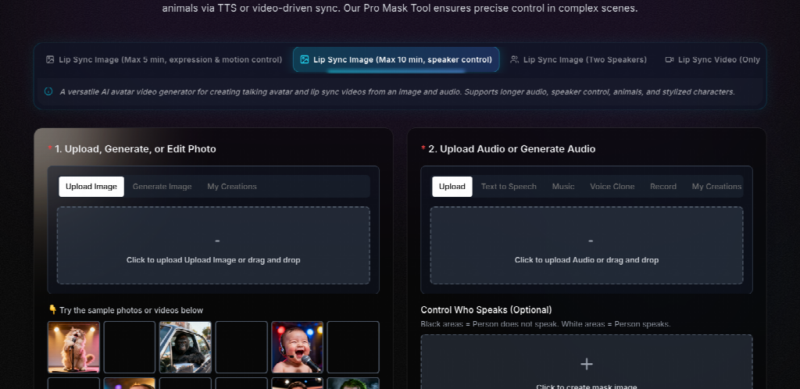
The useful path on Lip Sync Studio starts from the song, not from a selfie. Upload the finished track. Add up to five stills that already belong to the band: vocal close, instrument, room, merch or prop, one wide. Write a direction that names the verse, the chorus, and the bridge as picture changes, not as adjectives. The page then builds an editable storyboard you can fight with.
Fighting with the board is the point. Timing, prompts, and versions sit on each shot. You can split a verse that ran too long. You can throw away a shot that wandered into a sunny street the band has never played. You compose only after the chorus is a different picture from the verse. That is the test a festival intern can pass without reading the bio.
Verse Chorus And Bridge On Paper
Write the sections on the same scrap you already use for the setlist. Verse: close on the mouth or the right hand. Chorus: wider, or a cut to the room, or a step off the wedge. Bridge: one object that is not a face — the vinyl spine, the laminate, the taped paper if it stays still. If you cannot fill those three lines, you do not have a video brief. You have a hope.
Hybrid treatments are allowed. Performance can sit next to a short story as long as the stills can carry both. A conceptual fog world that none of the five pictures support will look like a different band. Keep the world inside the references. Metal readers can smell a borrowed alley.
Performance Cuts Versus Story Cuts For Singles
Performance-led clips stay on the artist, the instrument, the stage action, and the lip-synced vocal moment. Narrative clips try to tell a small story across intro, verses, chorus, bridge, and outro. Conceptual clips go further into a look — analog dirt, animation, a fashion-like still. Hybrid is the honest DIY default: chorus as performance, verse as room, bridge as object.
Documentary-style only works if you actually have documentary stills. A single bathroom mirror photo is not a tour diary. Do not ask the board to invent a van.

An AI music video generator is doing real work when it maps those section types onto the track’s energy instead of pasting the same mid-shot on every bar. It is wasting a night when the brief says “epic” and the stills say “rehearsal under a bare bulb.” The bulb is fine. Epic is the lie.
Keep The Wedge Setlist From Singing
If a still includes the handwritten setlist, treat that paper as type, not as a face. Crop tighter on the vocalist when the chorus needs a mouth. Use the wide frame in a section where nobody has to enunciate at the paper. If a preview makes the ink crawl, kill that shot. A booker who can read Saturday’s order will forgive a cheap grade. A booker who sees a magic setlist will not take the submit seriously.
The same rule holds for merch type, spine text, and any laminate lettering. If the still is there to prove the band exists in a room, the letters have to stay letters. That is a metal problem, not a generic “text preservation” slide. Shirts and spines are how the table makes rent.
When A Camera Crew Still Earns The Fee
Hire people when the single is also a live document you will play for years: a real stage, a real pit, a take you cannot fake from five stills. Hire them when the song depends on bodies in a room that your photos do not contain. Hire them when a festival already asked for live footage and you have a date on a real stage next month.
Do not hire them to solve a storyboard you never wrote. A Saturday crew given “make it heavy” will invent their own chorus, and you will still lack a cut you can defend. Write the three-line list first. If the list needs a room you do not have, that is when the camera day has a job.
Aspect Ratios After The Mix Is Frozen
Freeze the mix before you care about export shape. A chorus cut that only exists in a 16:9 file is still more useful than a 4K loop of the same wedge. Once the board is honest, the page can deliver six aspect ratios at 720p, 1080p, or 4K. That is the moment to cut a square for the places that squash a wide file, and a vertical for the places that never play widescreen.
Basic sits at $29.99 a month on the public plans, with Standard at $49.99 and a cheaper yearly Standard at $39.99. Those numbers are a month of tries, not a camera Saturday. Paid tiers also mark the videos private, which matters if a failed chorus cut should not become a public poster while you are still arguing about the bridge. Free daily credits are enough to see whether the board understands the song. They are not a plan for a release week.
Do not spend the month hunting a finer preset while the mix is still moving. A 4K export of an unlocked bounce is how you pay twice: once in the session, again in the render, and a third time when the take changes on Thursday.
- Performance: mouth, hands, wedge — chorus gets the widest honest frame you have.
- Narrative: only if the five stills already contain the objects in the story.
- Hybrid: verse in the room, chorus on the face, bridge on a still object.
- Reject: any shot that makes the setlist, spine, or laminate start to move like a mouth.
That list is the whole review. If a shot fails one line, remove it. The compose step will not rescue a board that still contains a singing piece of paper.
Ship The Single With A Cut On The Chorus
Lip Sync Studio is for the band that already has a frozen mix, five stills that belong to them, and a chorus that needs a picture change before the inbox closes. It is a poor fit for the band that wants a talking selfie because the poster is late.
Send the file that lets a stranger find the chorus with the sound down. Keep the camera Saturday for the song that needs a room you do not have in the stills. The wedge setlist can stay in the wide shot if it stays paper. The mouth stays on the person who wrote the scream.