The Hidden Gap Between Being Found Online and Being Trusted

Getting found online has never been easier to measure. Dashboards show impressions, rankings, clicks, and now even how often a brand appears inside AI-generated answers. By most of those numbers, plenty of businesses look healthy.
Yet many of them share a frustration. People find a website, read a page or two, and leave without calling, buying, or signing up. The traffic is real. The trust isn’t.
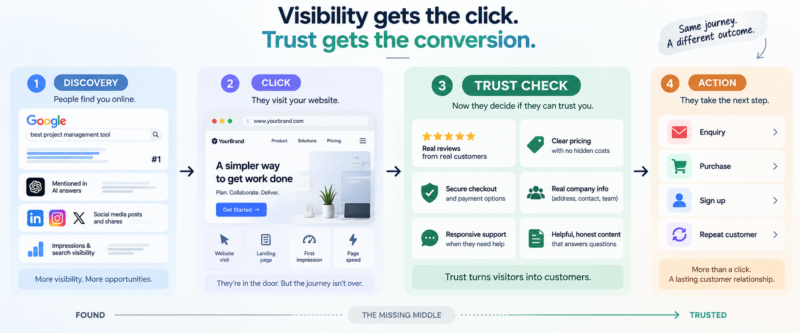
That space between discovery and confidence is one of the most overlooked problems in digital marketing. Visibility gets a brand into the room. Trust decides whether anyone listens once it’s there.
Visibility Is a Door, Not a Decision
Search engines, social feeds, and AI assistants are all good at one thing. They put options in front of people. What they can’t do is make someone comfortable choosing one of those options.
A first-page ranking tells a visitor that a brand exists and is relevant to their query. But it says very little about whether that business is reliable, whether the product works as described, or whether anyone will respond when something goes wrong.
Those judgments happen after the click, often within seconds.
Why Traffic Numbers Can Mislead
Rising sessions look like progress, and sometimes they are. But if bounce rates stay high and enquiries stay flat, the traffic may be telling a different story.
Rankings only matter when they connect to outcomes, a point covered well in this breakdown of how SEO agencies turn search visibility into real business revenue.
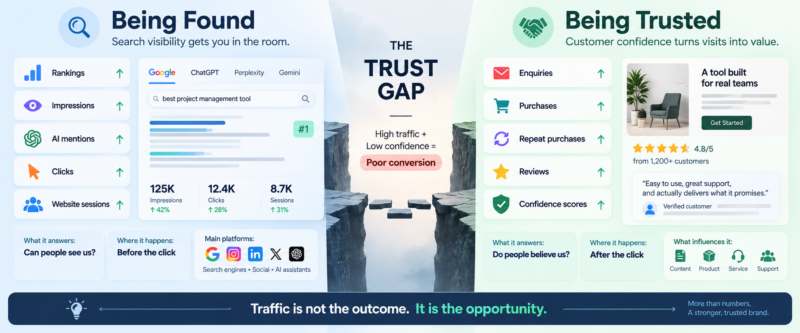
The difference becomes clearer when you compare what each side measures:
| Aspect | Being Found | Being Trusted |
| What it answers | Can people see us? | Do people believe us? |
| Typical metrics | Rankings, impressions, AI mentions | Enquiries, repeat purchases, confidence scores |
| Where it happens | Before a click | After a click |
| Who controls it | Search engines and AI platforms | Your content, product, and service |
| Common blind spot | Treating traffic as success | Never measuring it at all |
A visitor who arrives, hesitates, and leaves is a trust problem wearing a traffic badge.
What Builds Trust Online
Trust online is rarely built by one big claim. It grows through small moments of consistency. Most visitors, often without realising it, check for a handful of signals:
- Speed and stability. Pages that load quickly and don’t jump around feel professionally run.
- Clear pricing. Hiding costs behind a form makes people wonder what else is being hidden.
- Real social proof. Named reviews and recognizable clients carry far more weight than anonymous praise.
- Visible accountability. A physical address, contact details, and a sensible returns policy show someone stands behind the product.
- Helpful tone. Content written to rank rather than to help gets filtered out quickly.
That last signal is doing more work than it used to. A lot of published copy now starts life as a model output, and readers have become good at spotting it. Repetitive phrasing, hedged advice, and paragraphs that circle the same point all signal that nobody really stood behind the page, and that quietly chips away at trust before the visitor reaches the facts. If AI is part of the writing process, the draft is only the starting point. Running it through an AI humanizer can clear out the robotic patterns, but the real trust comes from what an editor adds afterwards: first-hand examples, specific numbers, and opinions only someone who has done the work could give.
Consistency Across Every Touchpoint
The brands that earn trust tend to say the same thing everywhere. The promise in a search snippet matches the landing page, the landing page matches the checkout, and the support team matches the tone of the marketing. You start getting there when you understand your audience and create better content.
The harder part is knowing whether that consistency is landing.
Star ratings help, but people mostly leave reviews when they’re delighted or frustrated, and short surveys often capture politeness rather than honest opinion.
Worse, when people suspect their answers aren’t anonymous or won’t change anything, they stop being candid. That’s how traditional feedback tools erode trust. A better approach would be to ask about specific attributes, such as product quality, support, and value, and keep responses anonymous so people answer honestly.
That shows where trust is strong and where it’s leaking, before those customers disappear.
AI Search Has Made the Gap Wider
People now ask ChatGPT, Gemini, or Perplexity for recommendations before they ever visit a website. In many cases, the AI answer becomes the first impression.
That changes the question. It’s no longer just whether a brand appears, but how it’s described when it does.
An AI response might mention a company alongside a note about slow support, or present a competitor as the safer choice. The brand is technically visible. It’s also losing trust before anyone reaches its site.
Measuring How AI Describes Your Brand
This is where dedicated tracking becomes valuable. Similarweb, a digital intelligence company known for its website traffic and market data, now offers tools built specifically for AI search. Its AI brand visibility tracker shows how often a brand is mentioned in answers across ChatGPT, Google AI Mode, Gemini, and Perplexity, along with the topics and prompts that trigger those mentions.

For the trust question, a few features are notable:
- Sentiment analysis sorts AI mentions into positive, neutral, and negative, so teams see how they’re framed, not just whether they appear
- Citation analysis reveals the domains and URLs AI platforms rely on when forming those answers
- Competitor comparison lists the top 30 brands for each tracked topic
Together, these turn a vague worry into something actionable. If a negative framing traces back to an outdated review or a competitor’s comparison page, you know where the perception is coming from and which content or outreach might rectify it.
Trust Is Also Protected By What You Avoid
Building trust matters, but so does not losing it. One poorly placed ad, a misleading headline, or an association with low-quality content can undo months of careful work.
Advertisers were reminded of this when brand safety came back into the spotlight, and the lesson applies well beyond media buying. Every placement and partnership says something about the business behind it.
The Cost of Small Inconsistencies
Small cracks add up. They will not sink a business, but together they create a feeling that something isn’t quite right:
- A broken link on a pricing page
- A testimonial with no name attached
- An old “last updated” date on a guide that claims to be current
- A contact form that never gets a reply
For many visitors, that feeling is enough to go back to the search results.
Listening Is the Missing Half of the Equation
Most businesses measure visibility carefully and trust barely at all. They know their rankings down to the position, but have only a rough sense of how confident customers feel after buying.
That imbalance explains why so many teams are surprised by churn. The warning signs were there, sitting in conversations and hesitations nobody was measuring.
Turning Feedback Into Real Insight
A more useful approach is to track confidence over time across specific parts of the experience.
How sure do customers feel about product quality? About support? About value for money?
The same thinking sits behind good customer success metrics: fewer vanity numbers, and more measures that lead to decisions.
Close the Gap Between Being Found and Being Trusted
Being found online is the start of the journey, not the end of it. Visibility earns attention. Trust earns action.
That means watching how search engines and AI platforms present your brand, fixing the inconsistencies that silently erode confidence, and listening closely to the people who have already chosen you.
If you have never actually looked at that first part, it takes a few minutes. Tools like RankinAI show which prompts surface your brand across the main assistants and how it gets described when they do, which is usually the fastest way to tell whether you are dealing with a visibility problem or a trust one.
Each of those steps narrows the gap a little further and, without a second thought, customers return to the brands that keep doing them consistently.
And since a slow website is one of the fastest ways to lose a visitor’s confidence, performance is a great place to start. Visit WP Fastest Cache to speed up your WordPress site and give every visitor a first impression worth trusting.