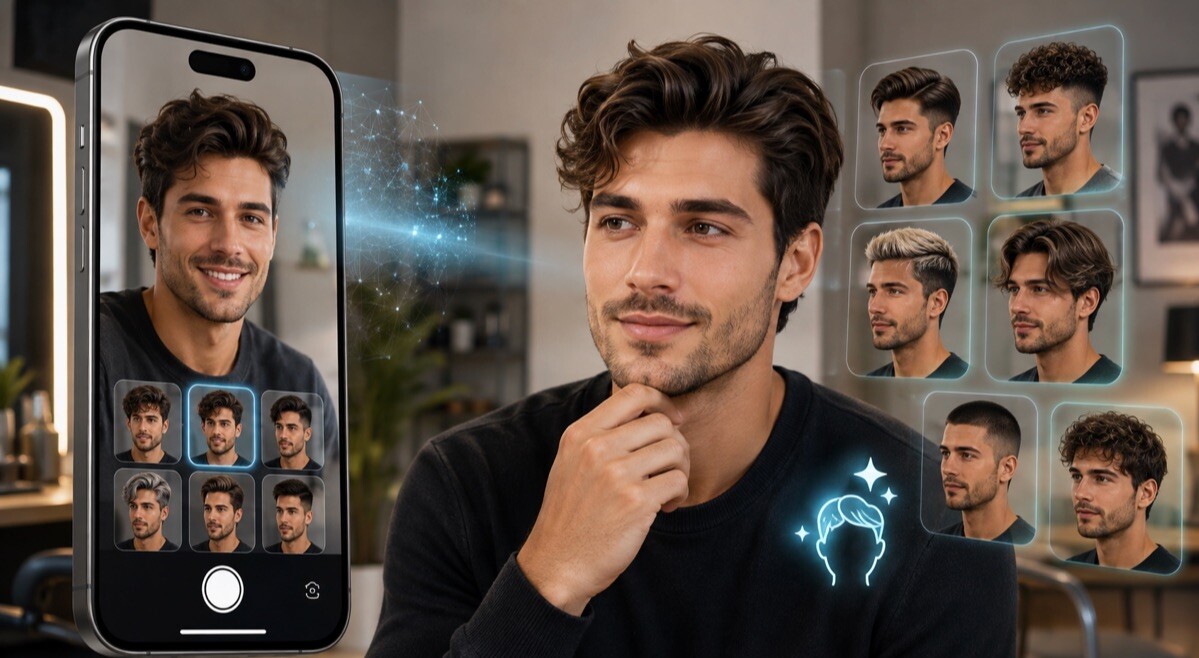
How AI Hair Filters Are Changing the Way We Try New Looks Before Committing

The decision to cut a fringe has ended more than a few good hair relationships. You sit in the chair, describe what you want, the scissors come out, and somewhere between the vision and the reality a gap opens up that takes months to grow back. It is not that hairdressers get it wrong. It is that most people have genuinely no idea how a new style will interact with their face shape, their hair texture, and the way their features are proportioned until they are already wearing it. AI hair filters are changing that dynamic in a way that feels small but is actually fairly significant.
The Problem With Committing to a Look You Cannot Preview
Hair decisions are uniquely high-stakes in the category of appearance choices. Clothing can be returned. Makeup washes off. A haircut grows out eventually, but the timeline is long enough that a mistake has real consequences for daily life over several months. The traditional workaround has been collecting reference images, showing them to a stylist, and hoping the translation from image to actual hair goes smoothly. It rarely does perfectly, because a reference image shows someone else’s hair on someone else’s face, not yours.
Virtual try-on technology existed in a rudimentary form for years before it became genuinely useful. Early versions mapped hair onto a static photo in ways that looked obviously artificial and told you very little about how a style would actually move, frame your face, or photograph in real conditions. The gap between those early tools and what is available now is significant enough that they are essentially different categories of product.
How AI Hair Filters Actually Work
The current generation of AI hair filters uses facial recognition and landmark mapping to understand the specific geometry of the face in the image or video before applying any style change. Rather than overlaying a static hair graphic, the filter identifies hairline position, face width at different points, forehead height, and the relationship between facial features, then renders a style that interacts with those specific proportions.
The result is a preview that accounts for your actual face rather than a generic template. When you use a fringe hair filter, the tool places the fringe at the position that corresponds to your actual hairline and adjusts the density and shape to sit correctly relative to your brow line and eye position. The difference between this and earlier overlay approaches is visible immediately in how natural the result looks and how much more useful it is as a decision-making tool.
Video-based filters add another layer of information by showing the style in motion. How a fringe behaves when you turn your head, whether it falls across your eyes with certain movements, and how it looks from slightly different angles are all things a static photo cannot convey. For anyone seriously considering a style change, this is the version of the tool that actually approximates the information you need.
Fringe Styles and Why They Are Particularly Suited to Virtual Try-On
Fringes are among the most face-altering of all hair changes, which makes them both the most tempting and the most anxiety-inducing category of haircut to consider. A blunt fringe on a round face reads entirely differently than the same cut on an oval or heart-shaped face. A curtain fringe that works perfectly with certain brow shapes can look awkward with others. These interactions are genuinely difficult to predict from a reference image alone.
The practical value of trying different fringe variations virtually before booking an appointment is that it narrows the decision significantly. A person who has looked at themselves with a blunt fringe, a wispy fringe, a side-swept fringe, and a curtain fringe across multiple images arrives at the salon with a much clearer sense of what they actually want and what they are trying to achieve, rather than a vague reference and an instruction to the stylist to use their judgment.
This is useful for stylists as much as for clients. A client who can show the stylist a virtual preview of what they liked and what they did not creates a shared reference point that reduces the guesswork on both sides of the chair.
Beyond Fringes: What AI Hair Tools Are Becoming
The fringe filter is one entry point into a broader category of AI-assisted appearance tools that are developing quickly. Hair colour simulation, length and texture changes, and full style transformations are all available through various platforms at different levels of sophistication. The underlying technology is the same: facial geometry analysis combined with generative rendering that places realistic-looking hair onto your specific face.
For professional stylists, these tools are becoming a consultation aid rather than just a consumer novelty. Showing a client what a proposed cut will look like before touching their hair reduces miscommunication and creates a record of what was agreed, which is useful when client memory of the conversation and stylist memory of the conversation diverge.
For content creators and social media users, the filter format has a separate appeal that is less about decision-making and more about experimentation and entertainment. Trying dramatic looks that would never translate to real life, exploring how different aesthetics interact with your features, and creating content around those experiments is a use case that the platforms building these tools understand and design for explicitly.
What to Look for in an AI Hair Filter Tool
Not all tools in this category perform equally. The quality of the facial landmark detection determines how accurately the style interacts with your specific features. Tools that use generalist overlay approaches rather than proper geometric mapping still exist and produce the uncanny, obviously artificial results that make the whole category look less useful than it is.
Lighting handling is another differentiator. A filter that only works well in flat, even lighting is less useful than one that accounts for shadows, directional light, and the way hair interacts with both. The best tools adjust the rendered hair to match the lighting conditions in the source image, which is what makes the result look like a real photograph rather than a digital composite.
Resolution and edge handling around the hairline is where the technical quality of different tools becomes most visible. Rough edges, obvious masking artifacts, and hair that does not blend naturally into the skin at the hairline are signs of a tool that has not solved the hard parts of the rendering problem.
The broader shift that AI hair filters represent is a move toward lower-stakes experimentation with appearance. The cost of trying a look virtually is zero, the time investment is seconds, and the information gained, even if it only tells you what you definitely do not want, has real value before a decision that will affect how you look every day for the next several months. That is a genuinely useful thing for a piece of software to do, and the tools doing it well are worth knowing about.