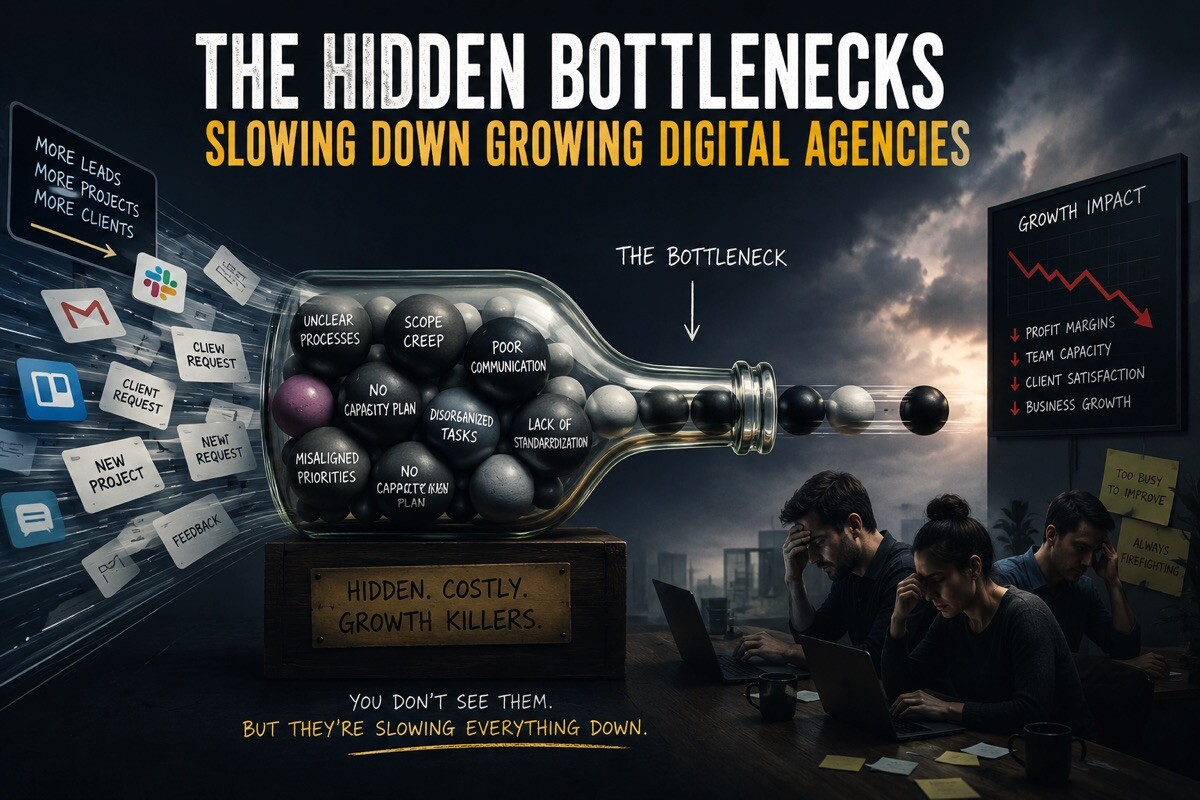
The Hidden Bottlenecks Slowing Down Growing Digital Agencies

Growth is exciting.
When you first launch a digital agency, every new client feels like a major victory. The team is small, communication is easy, and everyone knows exactly what needs to be done. Projects move quickly, clients are happy, and the future looks bright.
Then something interesting happens.
The agency starts growing.
You bring in more clients, hire additional team members, expand your services, and take on larger projects. Revenue increases, but surprisingly, things don’t always become easier. In many cases, they become more complicated.
Deadlines start slipping. Team members feel overwhelmed. Managers spend more time chasing updates than focusing on strategy. Clients begin asking for status reports that take hours to compile.
Many agency leaders assume these problems are simply part of growth. However, the real issue often lies elsewhere.
Hidden bottlenecks quietly emerge as agencies scale, slowing progress and limiting performance. The challenge is that these bottlenecks are rarely obvious. They often disguise themselves as everyday operational issues until they become significant obstacles.
Let’s explore some of the most common hidden bottlenecks that hold growing digital agencies back—and what can be done to overcome them.
Communication Overload
Communication is essential in agency life. Teams need to collaborate, clients expect updates, and projects require constant coordination.
But there is a point where communication becomes counterproductive.
Imagine a team that relies on multiple channels simultaneously: email, Slack, project management tools, video calls, and direct messages. Information gets scattered across platforms, making it difficult to find critical details when needed.
A project manager may spend twenty minutes searching for a client approval buried in an email thread. A designer may miss an important revision because it was mentioned in a chat message instead of the project system.
As agencies grow, these small inefficiencies multiply rapidly.
The solution isn’t necessarily more communication. It’s better communication.
Successful agencies establish clear rules about where information belongs. Client feedback might live exclusively in project management software. Internal discussions might stay within dedicated communication channels. Clear systems reduce confusion and eliminate unnecessary searching.
The Invisible Cost of Manual Processes
Many agencies begin with simple workflows.
A spreadsheet tracks project hours. Another spreadsheet tracks invoices. Team members manually update statuses. Managers manually generate reports.
At first, this works perfectly fine.
However, as client volume increases, manual processes become a serious drain on productivity. Employees spend valuable hours handling repetitive administrative tasks instead of delivering client value.
Consider a growing marketing agency managing twenty active campaigns. If each project manager spends just thirty extra minutes per day updating reports, that’s dozens of lost hours every month.
These aren’t dramatic failures. They’re tiny inefficiencies that quietly consume resources.
Automation can significantly reduce this burden. Modern tools help agencies centralize information, automate reporting, and improve visibility across projects without increasing administrative workload.
Lack of Visibility Across Teams
One of the biggest challenges agencies face during growth is losing visibility.
When there are five employees, everyone generally knows what’s happening. When there are fifty, that becomes much harder.
Leadership teams often discover problems only after they have already affected deadlines or client satisfaction.
For example, a development team may be overloaded while the content team has available capacity. Without accurate visibility into workloads, resource allocation becomes guesswork.
This creates a domino effect:
- Deadlines become harder to predict.
- Team burnout increases.
Leaders need real-time insight into project progress, resource utilization, and capacity planning. Without visibility, decision-making becomes reactive rather than proactive.
The agencies that scale successfully are often the ones that create systems allowing leaders to spot issues before they become crises.
Scope Creep: The Silent Profit Killer
Most agency owners are familiar with scope creep.
A client requests a small adjustment. Then another. Then one more.
Each request seems reasonable in isolation. However, over time, these additional tasks consume substantial resources without generating additional revenue.
The problem becomes especially difficult when teams don’t accurately track how time is being spent.
Many agencies underestimate how much work goes into maintaining client relationships, managing revisions, and handling unexpected requests.
This is where tools like online timesheets can provide valuable insight. When agencies have accurate records of where effort is being invested, they can make better decisions about project pricing, staffing requirements, and client profitability.
Without reliable data, it’s easy to assume a project is successful when it’s actually eroding margins behind the scenes.
Onboarding Bottlenecks
Hiring new talent is often a sign of healthy growth.
Unfortunately, onboarding processes don’t always evolve at the same pace.
New employees may spend days trying to understand systems, locate documentation, or identify who to contact for specific questions.
Experienced team members frequently become unofficial support staff, interrupting their own work to help newcomers navigate the organization.
This creates a hidden productivity bottleneck that many agencies overlook.
A structured onboarding process can dramatically reduce ramp-up time. Centralized documentation, clear workflows, and accessible training resources help new hires contribute faster while minimizing disruptions to existing teams.
The faster new employees become productive, the easier it becomes to sustain growth.
Technology Fragmentation
It’s common for agencies to accumulate software over time.
One tool manages projects. Another handles communication. A third tracks invoices. A fourth stores files. A fifth manages client approvals.
Individually, each tool may perform its function well.
Collectively, they can create friction.
Employees constantly switch between platforms. Information becomes duplicated. Data inconsistencies emerge. Reporting requires pulling information from multiple sources.
Technology should simplify work, not complicate it.
Before adding another platform, agencies should evaluate whether existing tools can meet the need or whether better integration is possible.
A streamlined technology ecosystem often improves productivity more than introducing additional software.
Leadership Becoming a Bottleneck
Many agencies are built around highly involved founders.
In the early stages, this is often a strength. Founders oversee projects, approve decisions, and maintain quality standards.
As the agency grows, however, this model becomes difficult to sustain.
If every major decision requires approval from one person, progress slows dramatically.
Projects wait. Employees hesitate. Opportunities are missed.
Ironically, the very leadership that helped build the agency can become a growth constraint.
The solution is delegation supported by trust and clear processes.
Effective leaders empower managers, establish decision-making frameworks, and focus their attention on strategic priorities rather than operational details.
Growth requires distributing responsibility throughout the organization.
Burnout Hidden Behind Productivity
One of the most dangerous bottlenecks isn’t operational at all.
It’s human.
High-performing agency teams often push themselves hard to meet client expectations. In the short term, this can produce impressive results.
Over time, however, sustained pressure leads to exhaustion, reduced creativity, and declining performance.
The warning signs are often subtle.
Employees become less engaged. Turnover increases. Mistakes become more frequent. Innovation slows down.
Technology can support healthier workloads by providing visibility into capacity and resource allocation. However, tools alone aren’t enough.
Agency leaders must actively create environments where sustainable performance is valued more than constant urgency.
Long-term growth depends on maintaining both operational efficiency and employee well-being.
Growth Doesn’t Have to Feel Chaotic
Many agency leaders assume growing pains are unavoidable.
To some extent, they are.
Every expanding business encounters new challenges, new complexities, and new demands. The difference lies in how those challenges are managed.
The most successful agencies don’t simply work harder as they grow. They build systems that allow them to work smarter.
They identify bottlenecks early. They improve visibility. They reduce manual processes. They invest in technology that supports their teams rather than creating additional complexity.
Most importantly, they recognize that growth isn’t just about acquiring more clients. It’s about creating an organization capable of serving those clients efficiently and sustainably.
The hidden bottlenecks slowing your agency today may not be obvious. They rarely announce themselves.
But once you start looking closely at communication, processes, visibility, technology, and team capacity, you’ll often discover opportunities that can unlock your next stage of growth.
Sometimes the biggest obstacle to growth isn’t a lack of demand.
It’s the invisible friction happening behind the scenes.