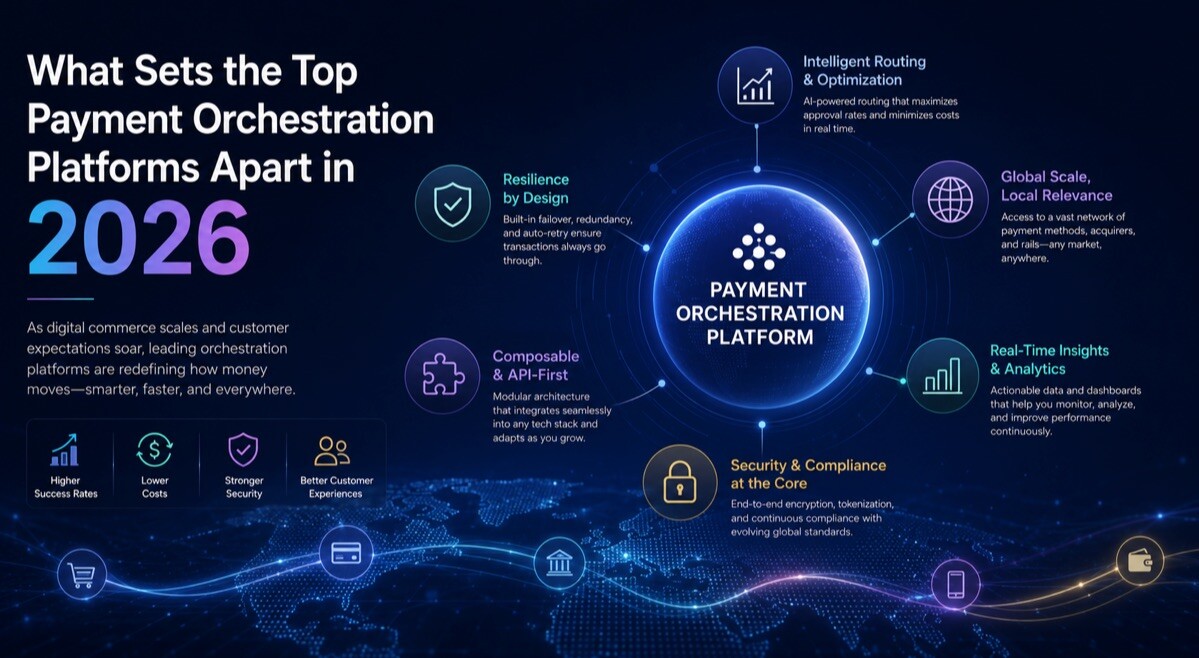
What Sets the Top Payment Orchestration Platforms Apart in 2026

The Boston Consulting Group Global Payments Report outlines a fundamental shift in how revenue moves, highlighting that real-time, account-to-account (A2A) payment volumes are expanding at a massive 40% annual rate. As alternative payment networks and hyper-localized options rapidly grow to account for more than half of all transactions in major economic regions like Brazil and India, companies face a complex reality: rigid, single-channel processing systems simply cannot adapt to these fragmentation patterns fast enough.
That operational friction explains why payment orchestration platforms have become essential. A missing localized option, a slow failover, a processor having a bad day – any of these variables can quietly cost a business real revenue. The question worth asking is: what actually separates a platform that fixes this from one that just adds another layer on top of the same problem?
What Is Payment Orchestration, Exactly?
Payment orchestration is the practice of routing transactions across multiple processors through a single integration instead of relying on one provider. A payments orchestration platform sits between the merchant and the various acquirers, deciding in real time which one should handle each transaction.
Think of it less like a payment gateway and more like a switchboard operator who knows which line is busy, which one charges less, and which one is most likely to get a “yes” from a particular bank. That’s a meaningful shift from the old model, where one processor handled everything and a single outage meant lost sales across the board.
Why Single-Processor Setups Keep Failing Merchants
A business plugged into just one acquirer is exposed every time that acquirer has a problem. Outages happen. Fees creep up. Some processors simply can’t support certain local payment methods, which becomes a real issue the moment a company sells outside its home market.
This is exactly the gap orchestration platforms were built to close. Instead of betting everything on one provider, merchants gain access to several acquirers behind a single API, with the system deciding case-by-case which one to use.
How Do Top Payment Orchestration Platforms Differ From Basic Gateways?
The short answer: depth of routing logic, vendor neutrality, and how much control sits in the hands of non-technical teams. Plenty of providers now market themselves as orchestration platforms, but the gap between a genuine control layer and a glorified router shows up fast once you look closely.
A few traits consistently separate the strongest providers from the rest:
- Vendor neutrality – the platform doesn’t sell its own acquiring services, so routing decisions aren’t influenced by internal profit incentives
- Live, data-driven routing – decisions are based on real-time approval trends, not fixed rules written months ago
- Token portability – customer card data isn’t locked to a single processor, making it possible to switch providers without disrupting checkout
Is Vendor Neutrality Really That Important?
Yes, and it’s easy to overlook. If a platform also sells its own processing services, there’s a built-in incentive to route traffic toward its own stack, even when a competitor would perform better for that specific transaction.
Pro tip: before signing a contract, ask directly whether the provider has its own acquiring arm. A platform with nothing to gain from favoring one processor over another can build routing purely around performance, not internal margins.
Smart Routing vs. Static Rules
Old-style routing worked off fixed rules: send European traffic to Provider A, send US traffic to Provider B, no exceptions. That approach hasn’t kept up with how fast bank behavior and fraud patterns shift.
Modern systems route based on live signals instead – card type, issuing bank, geography, time of day, recent approval trends for a specific BIN range. If a transaction gets declined or a provider goes down, the system reroutes it to another acquirer within milliseconds, often before the customer even notices a delay.
Why Does Local Payment Method Coverage Matter So Much?
Because card payments dominate in some markets and barely register in others. A platform offering only Visa and Mastercard rails will hit a wall the moment a merchant expands beyond a handful of Western markets.
Stronger platforms connect merchants to hundreds of alternative payment methods through one integration – PIX in Brazil, UPI in India, BLIK in Poland, regional wallets that locals actually trust. Instead of building a separate integration for every new country, a merchant simply switches on whatever’s relevant there.
There’s a related piece that’s easy to miss: local treasury support. Settling and holding funds in native currencies helps avoid the foreign exchange fees that quietly chip away at margins when every transaction gets converted back to a home currency.
Token Portability: The Feature That Prevents Vendor Lock-In
What happens to saved card data if a merchant switches processors? In the past, switching meant either losing that saved data or forcing customers to re-enter their card details – both of which hurt conversion.
The better platforms solved this with provider-agnostic tokenization. Customer credentials get vaulted independently of any single acquirer, so a business can add, drop, or swap processors without disrupting the checkout experience. Many systems now also use network tokens instead of raw card numbers when sending data across acquirers, which tends to improve authorization rates while reducing fraud exposure.
No-Code Control: Who Actually Runs the Routing Logic?
For years, adjusting payment rules meant filing a ticket and waiting on engineering. That bottleneck slowed down finance and payments teams who needed to react quickly when approval rates dipped or a new market opened up.
No-code tools changed that. Payment operations staff can now build routing rules, test checkout variations, and adjust retry logic through a visual interface, no code required. It’s a small shift on paper, but it puts day-to-day decisions in the hands of the people watching the data most closely.
Alongside this sits unified reporting. Running several processors used to mean piecing together fragmented data from separate dashboards. Strong orchestration platforms consolidate that automatically, giving finance teams one place to track fees, reconcile transactions, and catch problems early.
A Few Names Worth Knowing
Enterprise buyers evaluating this space tend to keep coming back to a short list, each with its own strength:
| Platform | Known For |
| Yuno | AI-driven routing, broad global payment method catalog |
| IXOPAY | Enterprise-grade orchestration, payment intelligence |
| Primer | Flexible infrastructure, fallback logic |
| Solidgate | European market focus, multi-acquirer flexibility |
| Spreedly | Deep partner network, wide marketplace of integrations |
For a closer side-by-side of how these compare, this rundown of leading payment orchestration platforms 2026 is a useful reference point when narrowing down a shortlist.
How Should a Business Choose Between Them?
Match the platform’s strengths to actual business needs, not brand recognition. A merchant selling in one region with one currency has very different priorities than one expanding across a dozen markets with varied local payment habits.
That said, a few signals reliably separate strong platforms from weak ones:
- Genuine vendor neutrality, with no hidden incentive to favor a particular acquirer
- Routing built on live performance data rather than rules set months ago
- Token portability that removes the risk of being stuck with one processor
A platform missing one of these isn’t necessarily bad – it’s likely just operating at a more basic level than the orchestration label suggests.
Frequently Asked Questions
What’s the difference between a payment gateway and a payment orchestration platform?
A gateway connects a merchant to one processor. A payment orchestration platform connects to many processors and decides, transaction by transaction, which one to use.
Do payment orchestration platforms replace the need for a payment processor?
No. They sit on top of existing processors and acquirers, managing routing between them rather than replacing them.
Are top payment orchestration platforms only useful for large enterprises?
Not exclusively, but the benefits scale with transaction volume and market complexity. Businesses selling in just one country with one payment method see less upside than those operating across several regions.
How quickly does intelligent failover actually happen?
Failover typically happens within milliseconds. If one processor declines a transaction or goes down, the system reroutes it to another before the customer notices any delay.
Does switching to an orchestration platform mean losing saved customer card data?
Not with platforms that support token portability. Card credentials are stored independently of any single processor, so switching providers doesn’t require customers to re-enter their details.