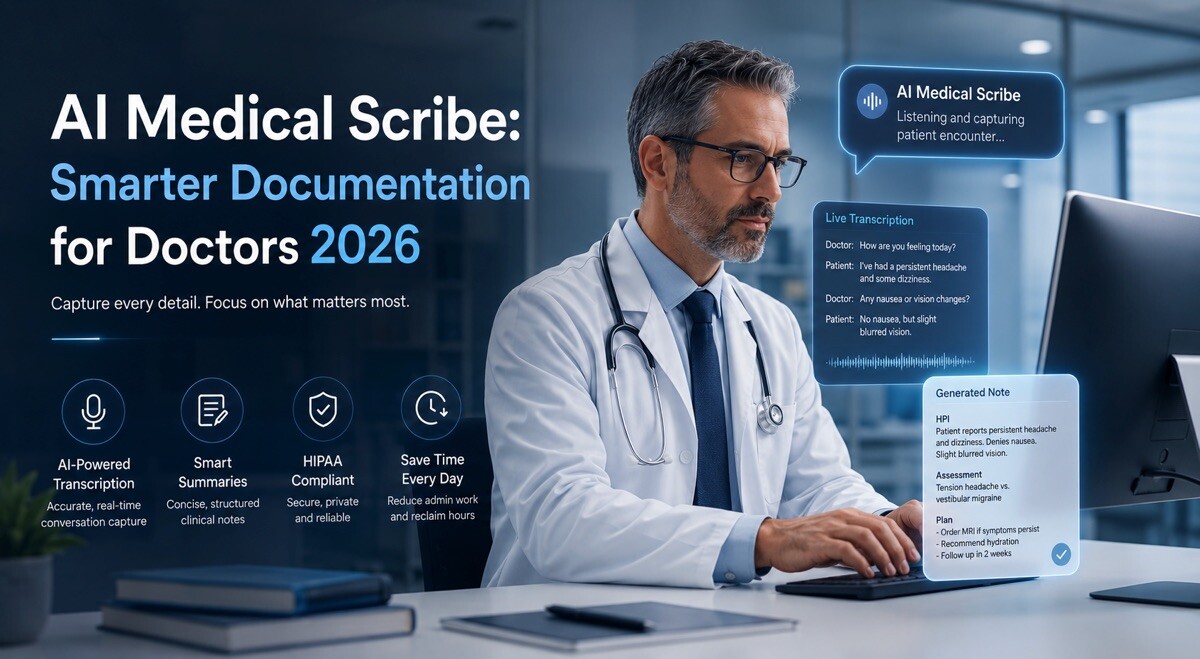
AI Medical Scribe: Smarter Documentation for Doctors 2026

Every extra minute a doctor spends typing notes is a minute not spent looking a patient in the eye. Clinical documentation has quietly become one of the biggest sources of physician burnout, with many doctors reporting two or more hours of charting for every hour of patient care. That imbalance is unsustainable, and it’s pushing hospitals and private practices alike to look for better tools.
This is where an AI Medical Scribe comes in. Instead of manually typing notes during or after a visit, doctors can now rely on AI-powered software to listen, transcribe, and organize clinical documentation in real time. It’s a shift that’s reshaping how physicians spend their day, and in 2026, adoption is accelerating fast.
What is an AI Medical Scribe?
An AI Medical Scribe is software that listens to a patient encounter and converts the conversation into a structured clinical note. It combines speech recognition, natural language processing, and medical terminology models to understand context, not just words.
Here’s generally how it works in practice:
- The physician conducts the visit normally, with the microphone (via a phone, tablet, or dedicated device) capturing the conversation.
- The AI transcribes speech and identifies clinically relevant information: symptoms, history, assessment, and plan.
- That raw transcription is then structured into a standard note format, such as SOAP (Subjective, Objective, Assessment, Plan).
- The finished note is synced directly into the practice’s electronic health record (EHR) system, ready for physician review and approval.
The key difference between this and basic dictation software is context. An AI Medical Scribe doesn’t just convert speech to text, it understands medical terminology, filters out small talk, and organizes information the way a human scribe would. Most platforms also learn a physician’s documentation style over time, which means the notes get more accurate and more personalized with continued use.
Why Doctors Are Adopting AI Medical Scribes in 2026
The reasons behind this shift aren’t complicated. Documentation was eating into time that should be spent with patients, and doctors are choosing tools that give that time back.
Time savings. Physicians using an AI Medical Scribe often report cutting documentation time by half or more. Notes that used to take fifteen minutes after each visit can now be reviewed and finalized in a few minutes.
Reduced burnout. Less after-hours charting, sometimes called “pajama time,” means physicians go home earlier and stay in the profession longer. Burnout tied to administrative overload has been one of the leading causes of physician attrition, and reducing that load has a direct effect on retention.
Improved patient interaction. When a doctor isn’t typing or looking at a screen mid-conversation, patients notice. Eye contact and active listening improve, and many physicians say visits simply feel more human again.
Better accuracy and consistency. Manual notes, especially ones written quickly at the end of a long day, are prone to gaps or shorthand that’s hard to interpret later. An AI-generated note tends to be more complete and more consistent from patient to patient, which also helps with billing accuracy and continuity of care.
Platforms like AI medical scribe are helping physicians reclaim hours previously lost to charting, and that kind of practical time recovery is exactly why adoption has picked up so quickly this year. It’s not a novelty tool anymore, it’s becoming a standard part of the clinical workflow, the same way EHRs themselves did a decade ago.
Why Documentation Matters Beyond Healthcare
Healthcare isn’t the only field where documentation separates good outcomes from guesswork. The underlying principle, that consistent tracking leads to better decisions, applies almost anywhere someone is trying to improve a process over time.
Take fitness tracking as an example. Someone who logs workouts, weight, and recovery notices patterns a person relying on memory alone would miss. They can see exactly which routine produced results and which one stalled progress, and adjust with actual data instead of assumptions.
The same logic shows up in personal care routines, too. Someone following a hair care routine and actually tracking which products they use, when, and what results follow will typically get better outcomes than someone changing products at random and hoping for the best.
In both cases, the value isn’t the tracking itself, it’s what the tracking makes possible. Patterns become visible. Cause and effect become traceable. Decisions stop being guesses and start being informed choices. That’s precisely what an AI Medical Scribe is doing for clinical work: turning a previously inconsistent, memory-dependent process into something structured and reliable.
Whether it’s a physician’s notes, a training log, or a skincare journal, the discipline of documentation is what turns scattered effort into measurable progress. The tools differ by field, but the underlying habit is the same.
Conclusion
Clinical documentation has long been treated as a necessary burden, something doctors tolerate rather than a process that actually helps them. That’s changing. AI Medical Scribe tools are proving that documentation can be fast, accurate, and largely invisible to the patient experience, rather than something that pulls a physician’s attention away from the person in front of them.
The broader lesson extends well past medicine. Whether it’s a hospital, a home fitness routine, or a personal care habit, consistent documentation turns guesswork into insight. As AI-assisted tools continue to mature through 2026 and beyond, the practices that build tracking and structure into their daily routines, clinical or otherwise, are the ones most likely to see real, measurable improvement.
Frequently Asked Questions
Is an AI Medical Scribe accurate enough to replace manual note-taking?
For most routine visits, yes. Modern AI Medical Scribe tools are trained on medical terminology and clinical context, so they can produce notes that are as complete as manually written ones. That said, physicians still review and approve every note before it’s finalized, so accuracy is a shared responsibility between the AI and the clinician.
Does an AI Medical Scribe integrate with existing EHR systems?
Most platforms are built to sync directly with popular EHR systems, so notes flow into the patient record without manual copy-pasting. Integration details vary by vendor, so it’s worth confirming compatibility with your specific EHR before adopting a tool.
Is patient data safe when using an AI Medical Scribe?
Reputable platforms are built with HIPAA compliance in mind, including encrypted audio, secure data storage, and strict access controls. It’s still important to review a vendor’s specific security and compliance documentation, since standards can vary between providers.
How long does it take for doctors to get comfortable using an AI Medical Scribe?
Most physicians report a short adjustment period, often just a few visits, before the workflow starts feeling natural. Many tools also improve over time by learning a doctor’s documentation style and preferences.
Can an AI Medical Scribe be used across different medical specialties?
Yes, many platforms are designed to handle terminology across specialties like primary care, cardiology, dermatology, and psychiatry. Some tools also allow customization so the note structure matches the conventions of a specific specialty.