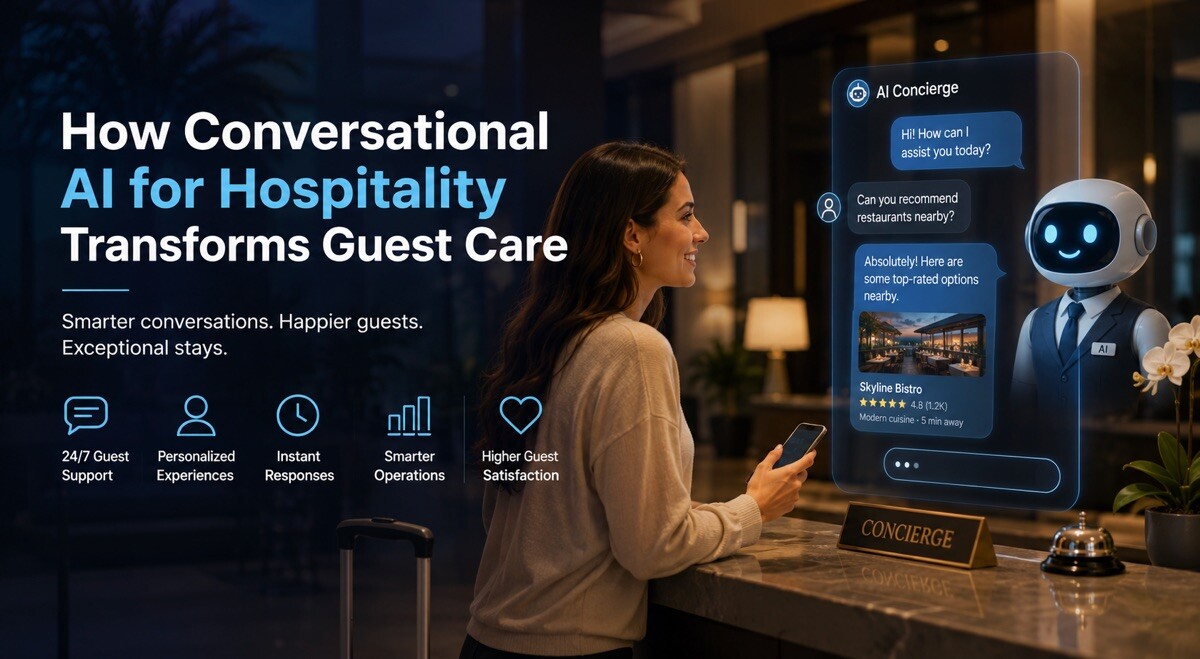
How Conversational AI for Hospitality Transforms Guest Care

Walk into almost any hotel lobby today and you might notice something different. Guests are checking in through a chat window on their phone before they even reach the front desk. Questions about pool hours or late checkout get answered instantly, day or night, without anyone picking up a phone.
This shift is happening because of conversational AI for hospitality, a technology that is quietly reshaping how hotels, resorts, and vacation rentals interact with the people who stay with them. It is not about replacing human warmth with cold automation. It is about giving guests faster answers and giving staff more time to focus on the moments that truly need a human touch.
To understand why this matters, it helps to look at what guest care actually looked like before these tools existed, and how much has changed in just a few years.
What Conversational AI Actually Means in a Hotel Setting
Conversational AI refers to software that can understand natural language, whether typed or spoken, and respond in a way that feels like talking to a real person. In hospitality, this usually shows up as chatbots on a hotel website, messaging assistants on WhatsApp or SMS, or voice assistants built into smart room devices.
When people talk about conversational AI for hospitality, they are describing this entire category of tools built specifically to handle guest questions, requests, and interactions throughout a stay. The technology behind it has come a long way from the clunky chatbots of a decade ago that could only follow rigid scripts.
Modern systems can understand context, remember previous questions within a conversation, and even pick up on tone. If a guest types something urgent, like a broken air conditioner in the middle of summer, the system can recognize the priority and route it accordingly instead of treating it like a routine request.
Why Hotels Started Adopting It
Guest expectations changed faster than most hospitality businesses could keep up with. People got used to instant replies from delivery apps, banks, and online retailers, and they started expecting the same speed from hotels. A guest who has to wait twenty minutes on hold just to ask about breakfast hours is going to feel frustrated, even if the hotel itself is lovely.
At the same time, front desk and guest service teams were often stretched thin, especially during peak seasons or short-staffed shifts. Conversational AI for hospitality gave properties a way to bridge that gap. It does not get tired, does not need a lunch break, and can handle dozens of simple questions at once without breaking a sweat. That frees up human staff to spend their energy on guests who need real problem solving or a friendly face.
How It Actually Improves Guest Care
The benefits go beyond simple convenience. When guest care improves through better communication, it touches almost every part of the stay.
Faster Response Times Build Trust
One of the clearest changes is speed. A guest asking about parking availability at midnight does not want to wait until morning for an answer. With conversational tools in place, that question gets answered right away, which builds a sense of reliability. Guests start to trust that the property is paying attention, even outside normal business hours.
This matters more than it might seem at first glance. Trust is built through small, consistent actions, not grand gestures. When a system responds quickly and accurately, it signals to the guest that their comfort is being taken seriously.
Personalization Without Extra Effort
Good conversational systems can pull from booking data, past stays, or stated preferences to tailor responses. A returning guest who always requests extra pillows might get a message confirming that request has already been noted, without having to ask again. Someone traveling for a work conference might get information about the business center without needing to hunt for it.
This kind of personalization used to require a very attentive staff member who remembered every detail about every guest. Now, the technology handles the memory work, while staff can focus on delivering the experience itself.
Reducing Repetitive Work for Staff
Front desk teams answer the same handful of questions dozens of times a day. What time is checkout? Is there a shuttle to the airport? Where is the nearest pharmacy? These questions are important to guests but repetitive for staff. Handing them off to a conversational assistant does not diminish the guest experience. If anything, it improves it, because staff members are not rushing through a routine question just to get to the next one.
This shift allows hospitality workers to spend more time on genuine hospitality, like helping a guest plan a special anniversary dinner or resolving a complaint with real empathy and attention.
Where Conversational AI Fits Into the Guest Journey
To really appreciate the impact, it helps to walk through a typical stay and see where these tools show up.
Before Arrival
Long before a guest steps through the door, conversational AI for hospitality is often already at work. It can confirm reservations, answer pre-arrival questions, and even help with upselling room upgrades or add-ons like early check-in. This early interaction sets the tone for the whole stay, since guests who feel informed before arrival tend to feel more relaxed once they get there.
During the Stay
Once guests check in, the same tools continue working in the background. Room service orders, requests for extra towels, questions about local attractions, all of these can be handled through a simple chat interface. Some hotels have even integrated voice assistants into rooms, letting guests control lighting or temperature just by speaking.
What makes this valuable is not just the convenience, but the reduction in friction. A guest who wants an extra blanket at eleven at night does not want to call the front desk and wait on hold. A quick message that gets acknowledged within seconds feels far more respectful of their time.
After Checkout
The guest journey does not end at checkout, and neither does the role of conversational tools. Automated follow-up messages can ask about the stay, gather feedback, or offer a simple thank you. This kind of gentle touchpoint helps hotels understand what worked and what did not, all without requiring a staff member to manually reach out to every guest.
The Human Side of the Equation
It would be easy to assume that more automation means less human connection, but the opposite tends to be true when these tools are used thoughtfully. Conversational AI for hospitality is best understood as a support system for staff, not a replacement for them. The technology handles the predictable, repetitive parts of guest communication, while people remain in charge of the moments that require judgment, empathy, or creativity.
Think about a guest whose flight got cancelled and who needs to extend their stay under stressful circumstances. That is not a situation for a chatbot to fully resolve. It requires a person who can listen, offer reassurance, and make quick decisions. The presence of automated tools for routine tasks actually makes it more likely that a staff member will have the time and mental space to handle that kind of situation well.
Building Trust Between Guests and Technology
There is also a learning curve on the guest side. Not everyone is comfortable typing questions to a chatbot, especially older travelers or those less familiar with messaging apps. Hospitality businesses that succeed with this technology tend to make it optional rather than mandatory, always leaving a clear path to a human if that is what the guest prefers. This balance respects different comfort levels while still offering the speed and convenience that many travelers now expect.
Conclusion
As natural language processing continues to improve, these tools are likely to become even more capable of understanding nuance, emotion, and context. Hotels that adopt this technology thoughtfully, rather than rushing to automate everything, tend to see the best results. The goal has never been to remove people from hospitality. It has been to give both guests and staff a smoother, less frustrating way to communicate, so that the parts of hospitality that actually require a human touch get the attention they deserve.
The hotels that get this right understand something simple: technology works best when it makes people feel more cared for, not less. That is the real measure of success, and it is what should guide how any property chooses to bring these tools into their guest experience.