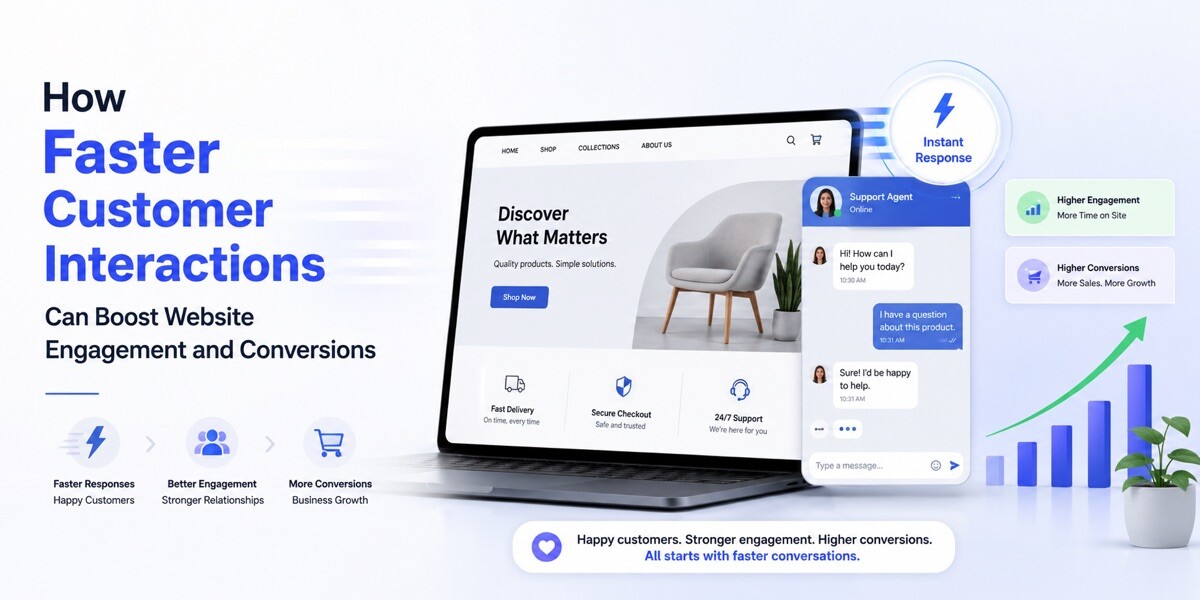
How Faster Customer Interactions Can Boost Website Engagement and Conversions

In today’s digital world, people expect answers almost instantly. Whether they’re shopping online, comparing services, or simply looking for information, visitors rarely have the patience to wait. A slow response can be the difference between gaining a loyal customer and losing one to a competitor.
Think about your own online experiences. Have you ever visited a website, had a question, and left because you couldn’t find the answer quickly enough? Most people have. Modern consumers value convenience, speed, and efficiency. When businesses understand this expectation and create faster customer interactions, they often see improvements not only in customer satisfaction but also in website engagement and conversion rates.
The connection between speed and business success is stronger than many organizations realize. Faster interactions help visitors stay engaged, build trust, and move through the customer journey with fewer obstacles. Let’s explore why this matters and how businesses can use it to their advantage.
Why Speed Matters More Than Ever
The internet has conditioned users to expect immediate results. Search engines deliver answers within seconds. Social media updates appear instantly. Online shopping platforms provide real-time recommendations and support.
As a result, website visitors bring these expectations with them wherever they go.
When someone lands on your website, they’re often looking for something specific. They may want to compare products, check pricing, understand a service, or solve a problem. If they encounter delays, confusion, or communication barriers, their interest can fade quickly.
Fast customer interactions reduce this friction. Instead of leaving with unanswered questions, visitors receive the information they need right away, helping them continue their journey toward a purchase or inquiry.
The Link Between Engagement and Response Time
Website engagement isn’t just about page views. It’s about how users interact with your content, how long they stay, and whether they take meaningful actions.
When visitors receive prompt assistance, they are more likely to:
- Spend more time exploring your website.
- View additional pages and resources.
For example, imagine a visitor browsing a software company’s pricing page. They have a question about a specific feature. If a live chat representative responds within seconds, the visitor can continue evaluating the product with confidence. If they must wait hours for an email response, they may leave and never return.
Every interaction creates an opportunity to deepen engagement. Fast responses ensure those opportunities aren’t wasted.
Building Trust Through Immediate Communication
Trust plays a critical role in online decision-making. Customers want reassurance before they share personal information, make purchases, or commit to a service.
Quick responses signal professionalism and reliability. They show that a company values its customers’ time and is prepared to help when needed.
Imagine contacting two businesses with the same question. One responds within minutes, while the other takes two days. Which company would you trust more?
Most people naturally gravitate toward the business that demonstrates responsiveness. Even if the products are similar, the customer experience creates a powerful differentiator.
This is especially important for businesses operating in competitive industries where customers have multiple alternatives available with just a few clicks.
Reducing Customer Frustration
One of the biggest obstacles to conversions is uncertainty.
Visitors often hesitate because they have unanswered questions. They may wonder about pricing, shipping, product compatibility, service availability, or implementation details. Without clear answers, they postpone decisions or abandon the process entirely.
Fast customer interactions help eliminate these concerns before they become barriers.
Consider an online retailer. A customer wants to know whether a product will arrive before an upcoming event. A quick response provides reassurance and encourages the purchase. Without that information, the customer may choose another retailer that offers clearer communication.
Reducing uncertainty helps create smoother customer journeys and higher conversion rates.
The Role of Automation in Faster Interactions
Technology has transformed how businesses communicate with customers. While human support remains valuable, automation now plays an important role in delivering immediate assistance.
Chatbots, automated workflows, intelligent FAQs, and self-service resources can answer common questions around the clock. These tools help customers receive information instantly, even outside business hours.
The key is finding the right balance between automation and human support.
Simple questions can often be handled automatically, while more complex inquiries can be escalated to team members. This approach improves efficiency while maintaining a positive customer experience.
Businesses that successfully combine automation with human expertise often create support systems that feel both responsive and personal.
Personalization Creates Stronger Connections
Speed alone isn’t enough. Customers also want interactions that feel relevant to their needs.
Personalized responses can significantly enhance engagement because they demonstrate understanding. Instead of generic answers, visitors receive guidance tailored to their situation.
For instance, a returning customer might receive product recommendations based on previous purchases. A prospective client could be directed toward content that matches their interests or industry.
Even small personalization efforts can make interactions feel more meaningful.
Businesses increasingly use technologies that help deliver customized experiences quickly. For example, tools such as Trueqrcode can streamline access to information by allowing users to instantly connect with digital resources, reducing unnecessary steps and improving overall convenience.
When customers feel understood, they’re more likely to stay engaged and continue interacting with a brand.
Real-World Examples of Faster Interactions Driving Results
Many successful companies have built their growth strategies around responsiveness.
E-commerce brands frequently use live chat to answer questions during the purchasing process. This immediate assistance helps reduce cart abandonment and increases sales.
Software companies often provide instant onboarding support to help new users understand key features. Faster guidance leads to higher product adoption and improved customer retention.
Educational platforms use automated support systems to help learners access resources, solve technical issues, and continue their courses without interruption.
In each case, faster interactions remove obstacles that might otherwise prevent users from reaching their goals.
The underlying principle remains the same: the easier it is for customers to get help, the more likely they are to stay engaged and take action.
Measuring the Impact
Businesses that invest in faster customer interactions should track their results to understand what’s working.
Some useful metrics include:
- Average response time.
- Conversion rate.
- Customer satisfaction scores.
- Bounce rate.
- Time on site.
- Lead generation performance.
Improvements in these areas often indicate that customers are benefiting from a more responsive experience.
For example, if response times decrease and conversion rates increase, it’s a strong sign that faster interactions are helping visitors move through the sales funnel more effectively.
Regular monitoring allows businesses to identify opportunities for further optimization and continuous improvement.
Creating a Culture of Responsiveness
Technology can certainly help, but creating faster customer interactions ultimately requires a customer-focused mindset.
Organizations that prioritize responsiveness often empower their teams with the tools, training, and processes needed to support customers efficiently.
This means simplifying communication channels, reducing internal bottlenecks, and ensuring that customer inquiries receive timely attention.
When responsiveness becomes part of a company’s culture, customers notice. Positive experiences lead to stronger relationships, repeat business, and valuable word-of-mouth recommendations.
Over time, these benefits contribute to sustainable growth and a stronger online presence.
Looking Ahead
Customer expectations will continue to evolve as technology advances. What feels fast today may feel slow tomorrow. Businesses that adapt to these changing expectations will be better positioned to attract, engage, and convert online audiences.
The good news is that improving customer interactions doesn’t always require major investments. Small changes—such as reducing response times, improving self-service resources, and streamlining communication—can deliver meaningful results.
Ultimately, every customer interaction represents an opportunity. When businesses respond quickly and effectively, they create smoother experiences, build trust, and encourage action.
The next time you evaluate your website’s performance, look beyond design and content alone. Consider how quickly visitors can get the answers they need. In many cases, the speed of your customer interactions may be one of the most powerful drivers of engagement and conversions.
By focusing on responsiveness, businesses can transform casual visitors into engaged users, engaged users into customers, and customers into long-term advocates. In a competitive digital landscape, that advantage can make all the difference.