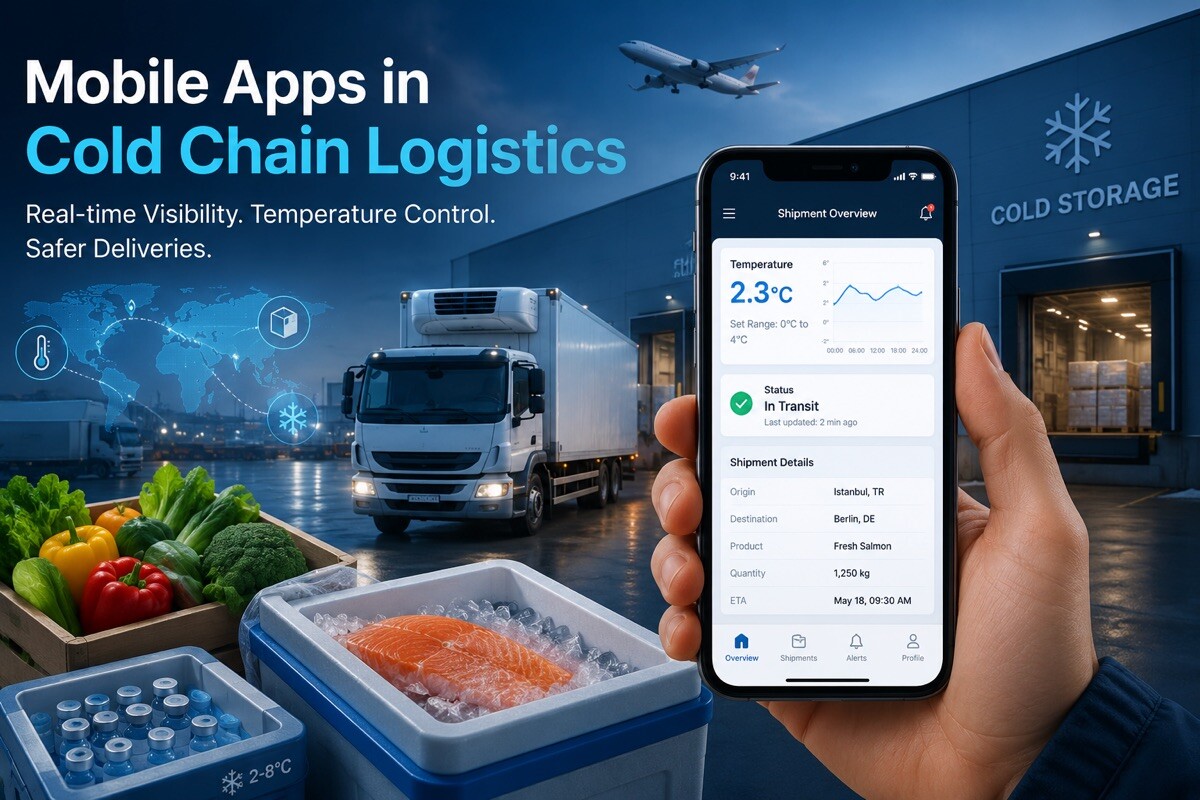
Mobile Apps in Cold Chain Logistics: Keeping Temperature-Sensitive Goods Safe End-to-End

Cold chain logistics sounds simple on paper: keep products cold from point A to point B. In reality, it’s a chain of small failures waiting to happen—traffic delays, broken refrigeration units, unstable power, or just weak mobile signal in the wrong place.
That’s why many companies end up working with a bespoke mobile app development company instead of relying on standard logistics software. Off-the-shelf tools usually assume stable connectivity and predictable workflows, which is rarely the case in real cold chain operations. Bespoke mobile app development here is less about adding features and more about making sure the system doesn’t break when conditions get messy.
Why Cold Chain Operations Are Hard to Digitize
Cold chain isn’t just “delivery with tracking.” It’s a constant monitoring process where conditions matter as much as location.
In practice, teams deal with things like:
- Temperature changes that happen in minutes, not hours
- Multiple handovers between warehouses, drivers, and inspectors
- Mixed hardware from different vendors
- Spotty connectivity during transport
- Strict compliance rules that vary by region
Most standard logistics apps only track where a shipment is. Cold chain needs to track what is happening to it physically, second by second.
That gap is where bespoke mobile app development usually becomes necessary.
Offline-First Design Isn’t Optional Here
In cold chain transport, “always online” is more of a wish than reality. Trucks go through tunnels, rural zones, border crossings, and storage areas with poor reception.
So mobile apps can’t rely on constant syncing. They need to work offline by default.
A practical setup usually looks like this:
- Data from sensors is stored directly on the device
- Everything keeps running even without internet
- Sync happens later, when the connection stabilizes
- The system fills gaps instead of losing data
What matters is continuity. If the app stops working every time the signal drops, the whole monitoring chain becomes useless.
When Temperature Alerts Actually Matter
In cold chain logistics, alerts are only useful if they arrive at the right moment—and if someone can act on them.
Good systems don’t just send notifications. They filter noise.
Typically, they include:
- Temperature thresholds tailored per product type
- Instant alerts when limits are exceeded
- Escalation rules if no one responds
- Logs that explain what happened and when
- Integration with compliance reports
The tricky part is avoiding alert fatigue. If the system cries wolf too often, operators start ignoring it—which defeats the whole purpose.
Syncing Data Across a Fragmented System
Cold chain logistics usually involves a chain of different actors: producers, warehouses, transport companies, customs, and retailers. Each of them sees only part of the journey.
That creates a synchronization problem. Data arrives late, overlaps, or sometimes conflicts.
A more stable approach usually follows this flow:
- Devices record events locally as they happen
- Data is queued until a connection is available
- Only changes are sent, not full datasets
- The backend merges everything into a single timeline
This helps avoid gaps in temperature history, which are often the biggest issue during audits or disputes.
Sensors, Devices, and Real-World Messiness
Cold chain apps don’t live alone on a phone. They’re usually connected to external hardware—sometimes simple, sometimes very complex.
Common setups include:
- Bluetooth temperature sensors inside containers
- GPS trackers on vehicles
- IoT-enabled cooling units
- Humidity and vibration sensors
The problem is that every supplier has its own format and behavior. There’s no universal standard across the industry.
This is where a bespoke mobile app development company becomes useful again—building flexible integration layers that can handle different devices without forcing everyone into one ecosystem.
Compliance Isn’t Just Paperwork Here
In industries like pharmaceuticals or food distribution, compliance is tightly linked to temperature history. If you can’t prove conditions were stable, the shipment may be rejected—even if nothing “looks” wrong.
Mobile systems help by automatically capturing:
- Time-stamped environmental data
- Chain-of-custody events
- Temperature logs across the full route
- Exception records (when something went wrong)
Instead of assembling reports manually, teams can generate audit-ready documentation from collected data. That alone reduces a lot of operational stress.
UX Design for People Who Don’t Sit at a Desk
Cold chain apps are used in loading bays, trucks, storage rooms, and sometimes outdoors in bad weather. That changes how interfaces should behave.
What works in practice:
- Big buttons, minimal typing
- Clear status indicators (online / offline / syncing)
- Fast access to shipment status
- Simple confirmation actions instead of complex forms
- Interfaces that still work with gloves or in low light
The goal is not elegance—it’s speed and clarity under pressure.
Where These Systems Usually Fail
A lot of cold chain software looks fine in demos but struggles in real operations. The usual weak points are predictable:
- Assuming constant internet access
- Not testing offline scenarios properly
- Weak handling of sensor inconsistencies
- Overcomplicated alert systems
- Poor performance with large data streams
The gap between “lab conditions” and real transport environments is often bigger than expected.
Why Custom Development Becomes the Default Option
At some point, many companies realize that generic logistics platforms don’t fully match how their operations actually work. Cold chain processes tend to be too specific and too sensitive for one-size-fits-all tools.
Working with a bespoke mobile app development company usually means building around real workflows instead of forcing teams to adapt to software limitations.
Teams like DevCom, for example, often focus on building systems that stay stable even when connectivity drops, data streams get messy, or hardware varies across partners.
Where Cold Chain Tech Is Going Next
Cold chain systems are slowly moving beyond simple monitoring. Instead of just reacting to temperature issues, they’re starting to predict them.
Some newer directions include:
- Predicting refrigeration failures based on sensor patterns
- Suggesting better transport routes for temperature stability
- Automatically rerouting shipments when risks appear
- Adjusting thresholds dynamically based on product sensitivity
It’s still early, but the shift is clear: from tracking problems to preventing them.
Conclusion
Cold chain logistics is one of those areas where software can’t afford to be fragile. It has to work in imperfect conditions—unstable networks, mixed hardware, and constant movement.
That’s why bespoke systems are becoming more common. When companies rely on a bespoke mobile app development company, they’re not just building an app—they’re building a system that survives real-world complexity.
And in cold chain logistics, survival is basically the whole job.