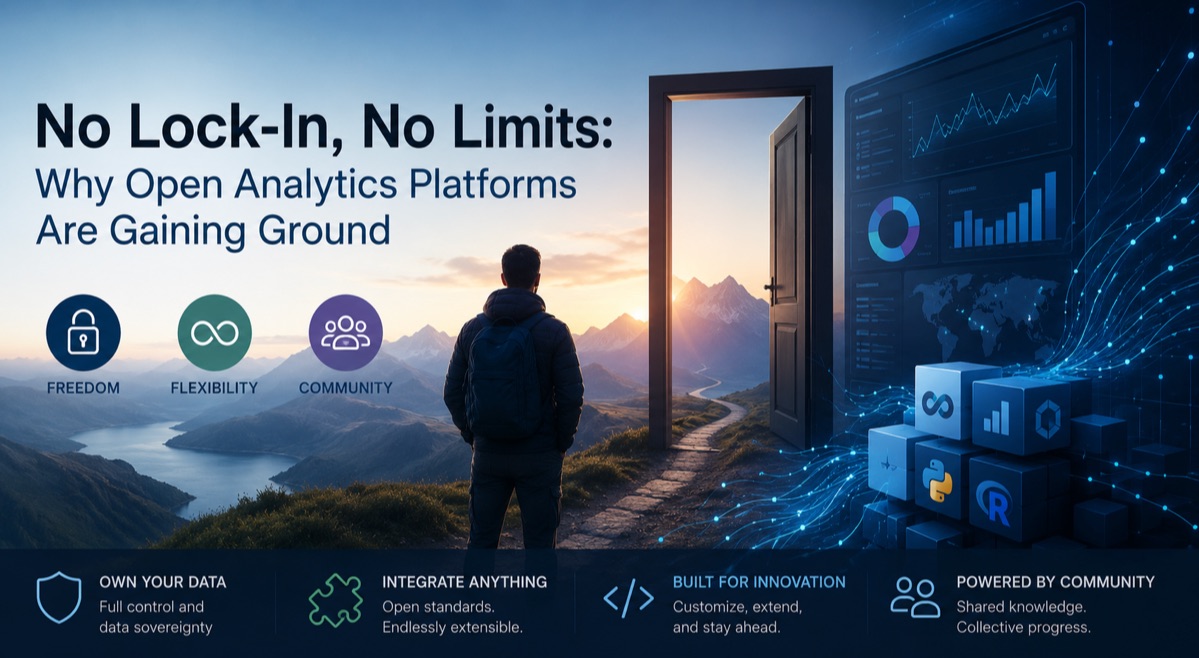
No Lock-In, No Limits: Why Open Analytics Platforms Are Gaining Ground

Data teams are quietly rethinking how they build their analytics stacks. For years, the default choice was a closed, vendor-managed platform: convenient at first, but increasingly restrictive as data volumes grew and business needs changed. Today, more organizations are shifting toward open analytics platforms, systems built on open standards, open file formats, and interoperable components that don’t trap data or workflows inside a single vendor’s ecosystem.
This shift isn’t happening because open tools are trendy. It’s happening because the costs of closed systems have become harder to ignore, and the technical maturity of open alternatives has caught up to, and in some cases surpassed, proprietary options.
The Hidden Cost of Proprietary Data Systems
Vendor lock-in rarely feels like a problem on day one. It becomes obvious later, when a company wants to switch providers, negotiate better pricing, or integrate a new tool, and discovers that its data is stored in a proprietary format that only works smoothly within one ecosystem.
Migrating out of a closed system often requires exporting data, transforming it, and rebuilding pipelines from scratch, a process that can take months and introduce errors along the way. According to research from Gartner, organizations frequently underestimate the total cost of switching platforms, with migration projects commonly running over both budget and timeline. That risk alone has pushed many IT and data leaders to prioritize flexibility earlier in their planning, rather than treating it as an afterthought.
What Makes a Platform “Open”
The term “open” gets used loosely in the software industry, so it helps to be precise. In the context of data and analytics, openness generally refers to a few concrete characteristics:
- Open file formats, such as Parquet or ORC, that any compatible tool can read and write rather than proprietary formats tied to one vendor.
- Open-source or standards-based query engines that aren’t controlled exclusively by a single company.
- Interoperability with multiple compute engines, allowing teams to use different tools for different tasks on the same underlying data.
- Transparent governance, where the roadmap and development process are visible and often community-influenced rather than dictated entirely behind closed doors.
An open analytics platform doesn’t necessarily need to be free or entirely open-source in every component. Many organizations run open-source engines alongside managed commercial tooling, but the defining trait is that their data, analytics assets, and workflows remain portable rather than permanently bound to one provider.
Why Data Teams Are Making the Switch
Several converging factors are driving adoption of open analytics platforms beyond simple cost savings.
First, data volumes have grown substantially. IDC has projected that global data creation will reach roughly 180 zettabytes by the mid-2020s, and much of that growth is happening inside organizations that need to store, query, and analyze information across multiple tools and teams. Closed systems often struggle to scale cost-effectively at that volume, since pricing models are frequently tied to proprietary storage and compute bundled together.
Second, the tooling ecosystem around open formats has matured considerably. Query engines, orchestration frameworks, and visualization tools built to work with open table formats are now robust enough for production use at scale, not just experimental projects. This maturity reduces the technical risk that once made open-source analytics a harder sell to risk-averse IT departments.
Third, regulatory and data governance pressures have increased the value of transparency. When data lives in an open format with clear lineage, it’s generally easier to audit, document, and demonstrate compliance, a growing concern as data protection regulations expand across different regions.
What We’ve Learned
The growing interest in open analytics platforms reflects a broader shift in how organizations think about data infrastructure: not just as a technical decision, but as a long-term strategic one. Lock-in costs, scaling limitations, and governance demands have made portability and transparency more valuable than they were a decade ago.
That said, openness comes with real trade-offs in complexity and support that shouldn’t be glossed over. The organizations getting the most value from open analytics platforms tend to be those that go in with realistic expectations — treating openness as a means to greater flexibility and control, not as a shortcut to lower effort. As data ecosystems continue to grow more complex, the ability to move data and tools freely between systems is likely to remain a meaningful advantage, even as the specific technologies involved continue to evolve.