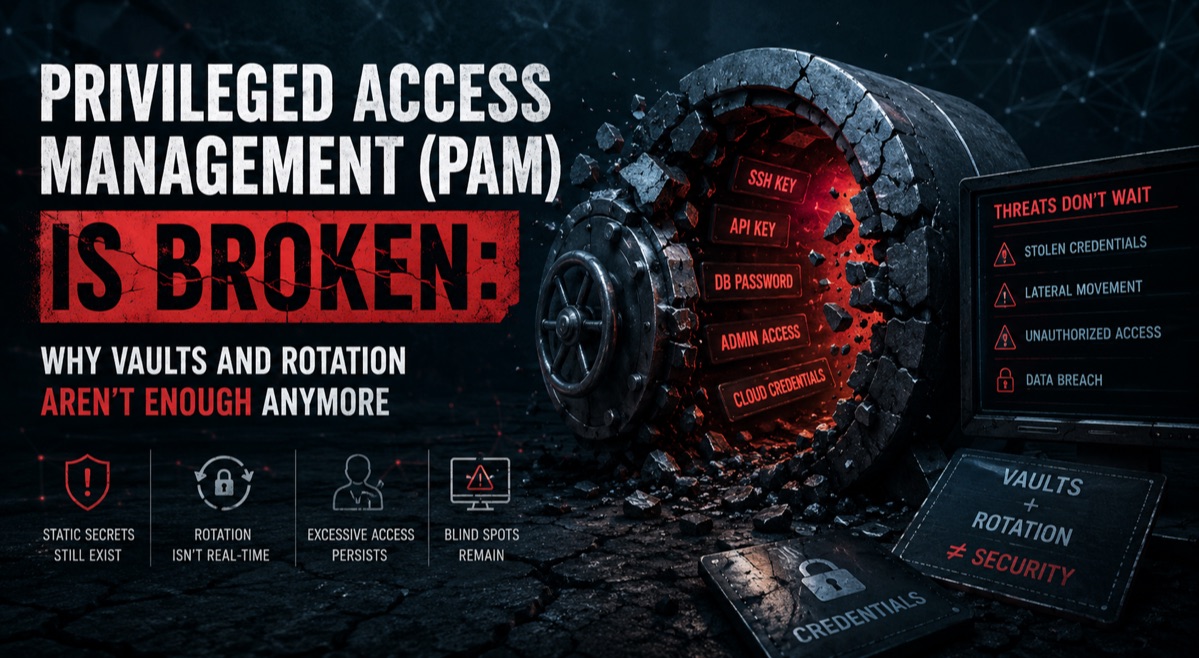
Privileged Access Management (PAM) Is Broken: Why Vaults and Rotation Aren’t Enough Anymore

For nearly two decades, privileged access management has rested on a simple formula: lock down credentials in a vault, rotate them on a schedule, and log every session. That formula made sense when infrastructure was mostly static, admins logged into a handful of known servers, and “privileged access” meant a small list of human accounts with elevated rights. That world no longer exists, and the tools built for it are struggling to keep up.
Today’s environments are dynamic, cloud-native, and increasingly run by machines rather than people. Containers spin up and disappear in seconds. Service accounts and API keys often outnumber human users by a wide margin. Yet many organizations still rely on PAM architectures designed around long-lived credentials sitting in a central vault, checked out and rotated on a timer. The result is a widening gap between what these systems were built to protect and what actually needs protecting.
The Vault Model Was Built for a Different Era
Traditional PAM vaults work by storing privileged credentials centrally, encrypting them, and controlling who can retrieve them. Rotation policies then change passwords or keys on a fixed interval, the idea being that even a stolen credential becomes useless once it’s rotated out.
This approach assumes a few things that are no longer reliably true:
- That privileged accounts are relatively few and well-inventoried
- That access happens through predictable, human-driven sessions
- That rotating a secret on a schedule is fast enough to outpace an attacker
- That most sensitive access originates from users, not machines or automated pipelines
Research from identity security firms has repeatedly found that machine identities now outnumber human identities in enterprise environments by a significant margin — some estimates put the ratio at 45:1 or higher when counting service accounts, tokens, and workload identities. A vault architecture designed around checking out a password for a human session simply wasn’t built to manage that volume or that pace of change.
Where Rotation Falls Short
Credential rotation is often treated as the safety net that makes vaulting sufficient on its own. In practice, rotation has real limits.
First, rotation is reactive by design. A credential is valid until it’s rotated, which means there’s always a window, sometimes hours, sometimes days, during which a compromised secret remains usable. Attackers have shown they can operate within these windows. The 2023 Verizon Data Breach Investigations Report found that stolen credentials were involved in nearly half of breaches analyzed, and many of those credentials remained valid well after initial compromise because rotation cycles hadn’t caught up.
Second, rotation doesn’t address how a credential is used once it’s checked out. A rotated password can still be copied, shared, or embedded in a script by mistake. Rotation changes the value of the secret, not the behavior around it.
Third, rotation at scale is operationally expensive. Every service account tied to a hardcoded credential, every integration built assuming a static key, becomes a dependency that has to be tracked and updated. Many organizations quietly extend rotation intervals or exempt certain accounts simply because the coordination cost of frequent rotation is too high — which defeats the purpose.
The Shift Toward Just-in-Time and Identity-Centric Models
The industry response to these gaps has been a move away from standing privileged access altogether. Instead of a credential sitting in a vault waiting to be checked out, access is granted just-in-time, scoped narrowly to a specific task, and expires automatically when the task ends. This reduces the window of exposure to minutes rather than days, and it removes the need to manage a long-lived secret in the first place.
This is part of why interest in a legacy PAM alternative has grown so quickly among security teams re-architecting their identity programs. A legacy PAM alternative typically shifts the model from “store and rotate a secret” to “verify identity and grant ephemeral, task-scoped access,” which better matches how modern infrastructure actually operates. Rather than a single vault acting as the central point of trust, and a single point of failure, access decisions are tied to continuously verified identity, device posture, and context at the moment access is requested.
It’s worth noting that this shift isn’t only about human users. Machine identities, workloads, and automated pipelines increasingly need the same treatment: short-lived, scoped credentials issued dynamically rather than static secrets baked into configuration files or CI/CD pipelines. Analysts covering identity security have pointed out that secrets sprawl, credentials embedded in code repositories, config files, and automation scripts, is now one of the most common root causes of cloud breaches, precisely because those secrets sit outside the reach of traditional vault-and-rotate controls.
What This Means for Security Teams
None of this means vaults are useless or that rotation should be abandoned. Both still serve a purpose, particularly for legacy systems that can’t easily support just-in-time access. But treating vaulting and rotation as a complete PAM strategy, rather than one layer within a broader identity security approach, leaves real gaps.
A more resilient approach tends to combine several elements:
- Ephemeral, task-scoped access instead of standing privileged accounts wherever technically feasible
- Continuous verification of identity and context, not just a one-time check at login
- Visibility into machine and workload identities, not just human accounts
- Reduced reliance on static secrets embedded in code, scripts, or configuration
- Session-level monitoring that captures behavior, not just credential checkout events
Security teams evaluating a legacy PAM alternative are generally not looking to eliminate the concept of privileged access management — they’re looking to modernize how it’s enforced, given how much the underlying infrastructure has changed since the original vault-and-rotate model was designed.
What We’ve Learned
PAM isn’t broken because vaulting and rotation are bad ideas — it’s broken because those mechanisms were designed for a smaller, slower, more human-centric world than the one most organizations now operate in. Machine identities, ephemeral infrastructure, and automated pipelines have outpaced a model built around checking out a password for a session. The organizations adapting most successfully aren’t discarding PAM as a discipline; they’re rethinking the mechanisms underneath it, moving toward identity-centric, just-in-time access that treats standing credentials as a liability rather than a convenience. Understanding this shift matters regardless of which specific tools an organization ultimately chooses, because the underlying problem — long-lived secrets in a world that no longer stays still — isn’t going away on its own.