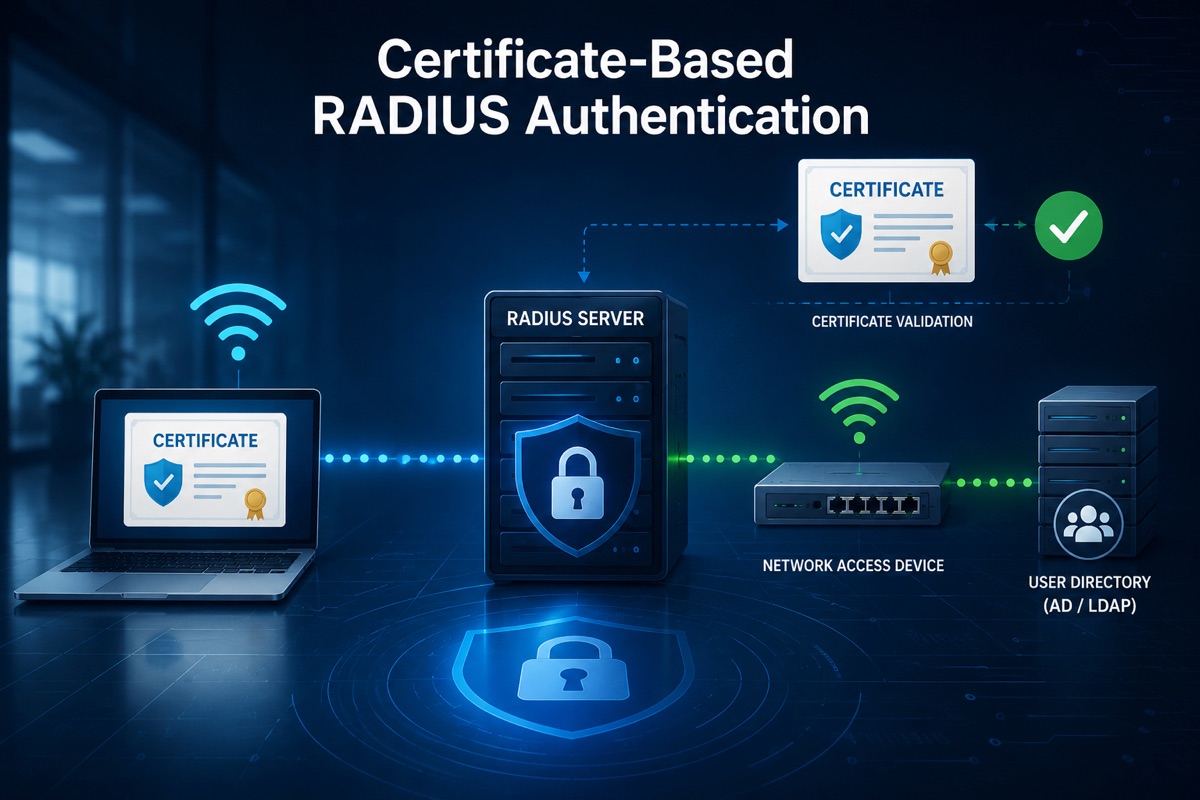
Certificate-Based RADIUS Authentication: Killing the Password for Good

For decades, network access has hinged on a single, fragile idea: that a string of characters typed into a login box proves who someone is. It doesn’t, not reliably. Passwords get reused, phished, guessed, and leaked in bulk, and every year the security industry re-learns the same lesson when another credential dump surfaces online. RADIUS authentication sits at the center of this problem for enterprise networks, because it’s the protocol most organizations rely on to decide who gets onto Wi-Fi, VPNs, and wired ports in the first place. The good news is that RADIUS doesn’t have to mean passwords. Paired with digital certificates, it can remove the credential entirely from the authentication equation, and that shift is quietly becoming standard practice in security-conscious organizations.
Why Passwords Keep Failing at the Network Edge
RADIUS (Remote Authentication Dial-In User Service) was built in the early 1990s to centralize authentication, authorization, and accounting for dial-up network access. It has since become the backbone of enterprise network access control, verifying identity for everything from corporate Wi-Fi to switch ports. In most deployments, that verification still comes down to a username and password checked against a directory service.
The trouble is that passwords are a poor security boundary. Verizon’s long-running Data Breach Investigations Report has repeatedly found that a large share of confirmed breaches involve stolen or misused credentials, and phishing remains one of the most common ways those credentials get taken. Passwords also create operational drag: helpdesk teams spend a meaningful chunk of their time on resets, and users, faced with password fatigue, tend to reuse the same credentials across multiple systems. Every reused password is a single point of failure that can compromise several accounts at once.
Network authentication makes this worse because RADIUS, when password-based, is often paired with protocols like PEAP-MSCHAPv2. That combination has known weaknesses — it’s vulnerable to offline dictionary attacks if an attacker captures the exchange, and it can be undermined by rogue access points impersonating a legitimate network. The protocol wasn’t designed with today’s threat landscape in mind, and layering password hygiene rules on top of it only goes so far.
How Certificate-Based Authentication Changes the Model
Certificate-based radius authentication replaces reusable passwords with a cryptographic key pair. Instead of entering a password, a user or device presents a digital certificate issued by a trusted certificate authority. The RADIUS server validates the certificate, verifies its issuing authority, and confirms that the requesting client possesses the corresponding private key.
This approach is commonly implemented through EAP-TLS, which supports certificate-based authentication for 802.1X network access. Under EAP-TLS, the client and RADIUS server authenticate one another before access is granted, establishing mutual trust between both parties.
This mutual verification provides stronger protection than password-based methods, in which credentials may be stolen, reused, or exposed through phishing and other attacks.
A few practical advantages follow from this design:
- Phishing resistance — there is no password for a user to type into a fake login portal, because there is no password.
- No credential to steal in transit — the private key never leaves the device, so intercepting network traffic yields nothing usable.
- Reduced helpdesk burden — certificates, once issued and auto-renewed, don’t get forgotten the way passwords do.
- Stronger device assurance — because certificates are typically tied to specific devices, network access authenticates the device as well as the person using it.
- Elimination of credential reuse risk — a certificate can’t be recycled across unrelated services the way a password often is.
Where the Complexity Actually Lives
None of this means certificate-based deployment is effortless. The real work shifts from managing passwords to managing a public key infrastructure (PKI). Someone has to issue certificates, track expiration dates, handle revocation when a device is lost or an employee leaves, and make sure every endpoint — laptops, phones, IoT devices, printers — can actually support certificate-based supplicant configuration. In the middle of a RADIUS authentication rollout, this is usually where organizations either succeed or stall.
Certificate lifecycle management is the crux of it. A certificate that should have been revoked after an employee’s departure but wasn’t is arguably a bigger risk than a weak password, because it can go unnoticed for a long time. Automated enrollment protocols, such as SCEP (Simple Certificate Enrollment Protocol) or newer EST-based workflows, help reduce this burden by tying certificate issuance and renewal to existing device management systems rather than manual IT tickets. Organizations that skip this automation often find their PKI becomes as unmanageable as the password problem it was meant to solve.
There’s also a bootstrapping challenge: every device needs to receive its initial certificate through some trusted, ideally automated, channel before it can use certificate-based RADIUS authentication at all. This typically means integrating the PKI with mobile device management (MDM) or endpoint configuration tools, which is a nontrivial project for organizations with large or diverse device fleets.
The Broader Shift Toward Passwordless Network Access
This move away from passwords in network authentication mirrors a wider industry trend. The FIDO Alliance and similar initiatives have pushed passwordless authentication for user logins for years, citing the same core weaknesses: passwords are guessable, phishable, and expensive to manage at scale. Certificate-based RADIUS extends that same logic to network access control, closing off one of the more overlooked entry points into a corporate environment — the Wi-Fi or wired network itself.
Standards bodies have taken notice too. NIST’s Digital Identity Guidelines have increasingly emphasized phishing-resistant authentication methods, and certificate-based approaches meet that bar in a way password-based methods generally cannot. As zero-trust architectures become more common, the ability to cryptographically verify both user and device identity at the network layer — rather than trusting a password and a MAC address — fits naturally into that broader security model.
Final Analysis
Certificate-based RADIUS authentication doesn’t eliminate security work; it relocates it. Instead of policing password complexity, expiration, and reuse, IT teams manage a certificate lifecycle: issuance, renewal, and revocation. That trade tends to favor the defender, because certificates are far harder to phish, intercept, or reuse than a typed credential, and the underlying cryptography is well understood and battle-tested. For organizations still relying on password-based RADIUS authentication, the operational cost of setting up a proper PKI is real — but so is the cost of the breaches that password-based network access continues to enable. As phishing-resistant authentication becomes less of a best practice and more of an expectation, certificate-based RADIUS is likely to move from an advanced configuration to a baseline one.